Category: Economics

  • Curious Cat Investing and Economics Carnival #10

    Welcome to the Curious Cat Investing and Economics Carnival: find useful recent personal finance, investing and economics blog posts.

    • Global Aging – “Over time, low birth rates lead not only to fewer children, but also to fewer working-age people just as the percentage of dependent elders explodes. This means that as population aging runs its course, it might well go from stimulating the economy to depressing it. Fewer young adults means fewer people needing to purchase new homes, new furniture, and the like, as well as fewer people likely to take entrepreneurial risks. ” (The economic consequences of demographic changes are enormous. Investors often fail to appreciate how important they are – John)
    • Google: A Free Cash Flow Analysis by Peter Mycroft Psaras – “I learned this trick by analyzing Warren Buffett’s purchase of International Dairy Queen and noticed that many of the investments he was making then were low capital expenditure/ high free cash flow machines.”
    • Oil Consumption by Country 1990-2009 by John Hunter – “The USA consumed 18.7 million barrels a day in 2009. Only China was also over 5 million barrels, they reached 8.2 million in 2009. Japan is next at 4.4 million.”
    • 9 lazy portfolios for UK investors – “You don’t need to pay for black box analytics that spit out your fully personalized, mean variance optimised, risk calibrated portfolio. You can just keep things simple and do it yourself.”
    • Where corn prices go (and that’s UP), meat prices will follow by Jim Jubak – “But it is good news for farm incomes as higher prices for corn and other commodities push up revenues. That’s good news for the stocks of Mosaic (MOS) and Agrium (AGU) in the fertilizer group, seed companies Monsanto (MON) and Syngenta (SYT), and farm equipment makers Deere (DE) and AGCO (AGCO).”
    • Three Small Financial Tweaks You Should Make Before Winter by Mark Riddix – “At a minimum, try to increase your [retirement] contribution 1% every year. Although you shouldn’t miss 1% every time you add it, over time those small increases become 5% and 10%, which means a big long-term boost to your investments.”
    • How to Avoid Lifestyle Inflation by Ryan Guina – “Live beneath your means. An increase in income does not change the fact that living beneath your means is the single most important step in financial independence.”
    • How to keep yourself from retiring broke – ” According to the Center for Retirement Research, Americans, who are between 32 and 64 years old now, will be short about $90,000 on average to retire comfortably and ‘on time’.”
    • Yield Curve by Robert Wasilewski – “You’ll find today’s spread is historically steep… The spread is the compensation that investors get for taking on price risk for buying longer maturities. Bond investors constantly assess whether the additional yield, i.e. spread, compensates for the incremental risk.”
    • Asset Allocation In A Rising Interest Rate Environment by Gaétan Ruest – “Typically, a shorter term bond will be less impacted in a rising interest rate environment than a long term bond. But this is only true if the increase in the short term interest rates is the same as at the long term.”

    Related: investing booksarticles on investingCurious Cat Investing and Economics Search
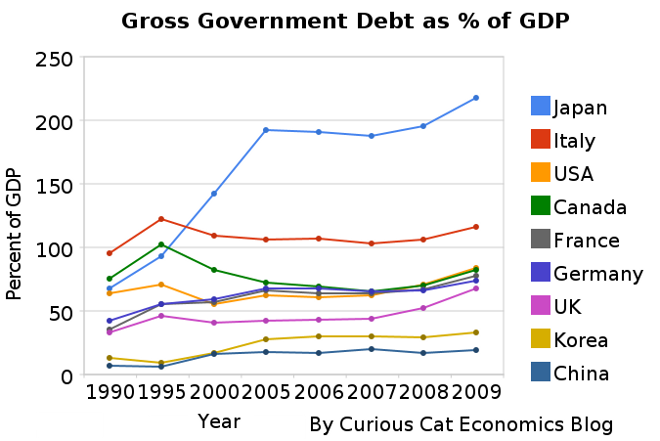
  • Government Debt as Percentage of GDP 1990-2009: USA, Japan, Germany, China…

    The world today has a much different economic landscape than just 20 years ago. China’s amazing economic growth is likely the biggest story. But the overwhelming success of many other countries is also a huge story. Today it is not the developing world that has governments spending taxes they promise their grandchildren will pay, but instead the richest countries on earth that choose to spend today and pay tomorrow. While “developing” countries have well balanced government budgets overall.

    graph showing government debt as percentage of GDPThe chart shows gross government debt as percentage GDP from 1990-2009. By Curious Cat Investing and Economics Blog, Creative Commons Attribution. Data source: IMF

    ___________________________

    There are plenty of reasons to question this data but I think it gives a decent overall picture of where things stand. It may seem like government debt should be an easy figure to know but even just agreeing what would be the most reasonable figure for one country is very difficult, comparing between countries gets even more difficult and the political pressures to reduces how bad the data looks encourages countries to try and make the figures look as good as they can.

    The poster child for irresponsible spending is Japan which has gross government debt of 218% of GDP (Japan’s 2009 figure is an IMF estimate). Greece is at 115%. Gross debt is not the only important figure. Government debt held within the country is much less damaging than debt held by those outside the country. Japan holds a large portion of its own debt. If foreigners own your debt then debt payments you make each year are paid outside your country and it is in essence a tax of a portion of your economic production that must be paid. If the debt is internal it mean taxpayers have to support bond holders each year (but at least when those bondholders spend the money it stays within your economy).
    (more…)

  • More Kiva Entrepreneur Loans: Kenya, Honduras, Armenia…

    I made several more Kiva loans to entrepreneur in Kenya, Lebanon, Nicaragua, Kenya, Honduras and Armenia (brining my total loans to 251). It really is great to see real people using capitalism to improve their lives. And being able to help by lending some money is wonderful. When looking for loans I give preference to loans that improve productivity and increasing capacity of the entrepreneur. If they use the proceeds of the loan to increase their capacity to produce they can pay off the loan and find themselves much better off.

    photo of Douglas Osusu and posho grinding millsDouglas Osusu, Kisii, Kenya, in front of his posho mill (used for grinding maize into flour).

    A nice example of this is the loan to Douglas Osusu (pictured). He has requested this loan of 80,000 KES to purchase a dairy cow and a posho mill. This loan also has a portfolio yield (Kiva’s equivalent of an annual percentage rate) of 19%. 19% is very loan for loans on Kiva (remember there are significant costs to servicing micro-loans) – I like the rate to be under 30% but sometimes accept rates up to 40% (or even higher occasionally). I also give great preference to low rates, as the lower the rate the better for the entrepreneur. The 3rd factor I consider is the history of the field partner bank (default rate, delinquency rate and currency exchange loss rate). In this case the field partner is new and carries risk because of that. Still in this case I really like the loan and I like that this lender is charging low rates so I want to take the risk and see how they can do. The amount I lend is based on the combination of these factors – I lend more when I have several reasons to really like the loan.

    Join other readers by making loans and joining the Curious Cats Lending Team: 8 members, 213 loans totaling $8,775. Comment with the link to your Kiva page and I will add a link on Curious Cat Kivans.

    My current default rate is 1.39% and the delinquency rate is 8.49% (see chart of USA general delinquency rates). The delinquency rate is exaggerated due to technical details (some difficulties in reporting in various countries and such things). Agricultural loans often become delinquent on Kiva but still are paid in full (in my experience). While the defaulted loan rate is 1.39% if you look at the percent of dollars lost I have a rate of 1.2% (this is nearly all due to a bank that failed over a year ago to which I had 2 loans where I lost $87.50 of $100 – there are also 2 other losses for under $5). I add to my total loan amount a couple times a year but also I get to keep relending as money is paid back.

    Some of my favorite ways to help reduce extreme poverty are Trickle Up, Kiva and using Global Giving to find small organizations.

    Related: 100th Entrepreneur LoanMore Kiva Entrepreneur Loans: Kenya, El Salvador (June 2010)Kiva Opens to USA Entrepreneur LoansMicroFinance Currency Risk – Kiva Fellows Blog: Nepalese Entrepreneur Success

  • 40 Billionaires Pledge to Donate Half Their Wealth

    40 billionaires pledge to give away half of wealth

    In addition to Buffett and Gates – America’s two wealthiest individuals, with a combined net worth of $90 billion, according to Forbes – 38 other billionaires are taking the give-it-away pledge. They include New York Mayor Michael Bloomberg, entertainment executive Barry Diller, Oracle co-founder Larry Ellison, energy tycoon T. Boone Pickens, media mogul Ted Turner, David Rockefeller, film director George Lucas and investor Ronald Perelman.

    This is great news. We need more charity. And we don’t need more trust fund babies. The Giving Pledge was established by Bill Gates and Warren Buffet to encourage this spirit.Charity should be a part of your personal finance plan if you are reading this (if you have access to a computer you are wealthier than most people alive today).

    To many of the rich today act like they made their money by creating it by themselves. You can’t be a billionaire without getting it given to you by your parents or making your wealth from society. It is wonderful when people provide great solutions to society and become wealthy. It is ridicules to think those people’s wealth is not the result of the society others created. Using that wealth to make society better is right. Spoiling kids and grandkids with it is acceptable, to a certain level. After a couple million that is insulting, however.

    Related: House Votes to Restore Partial Estate Tax Very Richest: Those with Over $7 MillionRich Americans Sue to Keep Evidence of Their Tax Evasion From the Justice DepartmentGates Foundation and Rotary Pledge $200 Million to Fight Polio

  • 10 million More Renters In the Next 5 Years

    Renter Nation by Gene Epstein

    From now through 2015, the long slog that will unfortunately characterize the economic expansion will bring slow growth in jobs and wages. That pace of improvement should be just strong enough to permit new households to form, but not robust enough for the members of those households to afford to own homes

    Demographics also will deal home sellers and builders a clear blow. Not surprisingly, the home-ownership rate tends to rise with age. For example, while the overall U.S. rate is 67.2%, the rate for households headed by someone under 35 is just 38.9%.

    Thus, whenever the age distribution of households tilts in favor of younger adults, the overall home-ownership rate declines.

    Largely because the echo boomers are more numerous than the baby busters, there are now more U.S. residents aged 15 to 29 than 30 to 44. So five years from now, the nation will have more 20-to-34-year-olds than 35-to-49-year-olds.

    Dallas-based Axiometrics tracks monthly price and occupancy data on apartments in 305 markets around the country. Its research chief, Jay Denton, reports that, on new leases written through this year’s first six months, effective rents—those after all concessions are taken into account—rose a robust 3.2%, after declining through 2009 and much of 2008. And occupancy growth, adds Denton, is close to the best he’s seen in the past 13 years.

    Related: articles on real estate investingReal Estate and Consumer Loan Delinquency Rates 1998-2009Apartment-vacancy Rate is 7.8%, a 23-year High (Nov 2009)

  • Greenspan Says Congress Should Let Tax Cuts Expire

    Alan Greenspan made several huge errors while chairman of the Federal Reserve. Failing to deal with the massive risk taking and fraud by the member banks of the Federal Reserve was one. And supporting tax cuts for a country that was hugely in debt (while current deficits were still huge was another. Yes anyone can claim (and he did) future surpluses, but there had yet to be a single year of surplus, and obviously we would have been in deficit even before the tax cuts put us much much further in debt, history has shown .

    But Greenspan said government estimates project more than enough surplus funds to pay off the debt and reduce taxes too.

    That is either amazingly bad economic forecasting or a lie. My guess is he knew this wasn’t true. Which would make it a lie. If he really was that out of touch with economic reality, we have to question why we ever thought he had insight into the economy.

    Greenspan Says Congress Should Let Tax Cuts Expire

    WOODRUFF: On those tax cuts, they are due to expire at the end of this year. Should they be extended? What should Congress do?

    GREENSPAN: I should say they should follow the law and let them lapse.

    WOODRUFF: Meaning what happens?

    GREENSPAN: Taxes go up. The problem is, unless we start to come to grips with this long-term outlook, we are going to have major problems. I think we misunderstand the momentum of this deficit going forward.

    Related: Estate Tax Repeal (2006)Charge My Government to My Kids (2007)USA Federal Debt Now $516,348 Per Household

    Accepting that, I don’t agree with those that vilify his performance. He was Fed chairman from 1987-2006. He made some very bad decisions that cost people dearly. But it isn’t very surprising someone in such power for so long would make some very bad and costly decisions. My guess is he caved to pressure from political allies that reminded him how the current President Bush’s father blamed Greenspan’s decisions for his losing the Presidency. And so Greenspan was trying to do what he could to do what the then President Bush wanted. Not a very honorable explanation but people often do not make the most honorable choices.

    In 2003 he publicly disagreed with the wisdom of additional cuts:

    Alan Greenspan, the Federal Reserve chairman, today rebutted many of President Bush’s arguments in favor of big new tax cuts, saying that the economy probably does not need any short-term stimulus and warning that budget deficits could spiral out of control.

    Politicians, eager to give favors, at the expense of the future, went ahead and passed more tax cuts – weakening the country for their (and their political allies) short term benefit.

    Related: Estate Tax Repeal (2006)Charge My Government to My Kids (2007)USA Federal Debt Now $516,348 Per Household

    Greenspan’s thoughts on the economy, from his July 16th 2010 interview:
    (more…)

  • Have We Lost Our Capitalist Heritage?

    I read various things stating that the USA is behaving in socialist (or similar ways). And there are often attempts to state that what the writer desires is capitalism and what they don’t like is an attack on motherhood, apple pie and capitalism.

    I’m not sure when or where those writers would say capitalism did exist. It is true we have corporations using their power (political power and market power [oligopolies, monopolies]) to serve their interests. This would not surprise Adam Smith at all, from the Wealth of Nations:

    People of the same trade seldom meet together, even for merriment and diversion, but the conversation ends in a conspiracy against the public, or in some contrivance to raise the prices/

    He knew that is what they would attempt to do and said they had to be regulated to allow capitalism to function (but many that say they want capitalism don’t want any regulation of the sort they don’t want). Some seem to agree that some regulation is needed but any regulation they don’t want is seen as “socialist” or “anti-capitalist” or… At least the Libertarians are very consistent about practically no regulation – I question that being capitalism, but at least I understand their position.

    Maybe the amount of direct cash payments and sheer amount of not very indirect subsidies (free money from the Fed, huge government contracts to political friends, tax breaks for big contributors [hedge fund managers, corporations using offshore tax havens…], quotas to aid political contributors) have been very high recently. But those changes are more a matter of degree than a qualitative change from the few years before that and few year before that and so on.

    I am not sure if people are thinking back to the days when we had large trusts as “capitalism”? Some people equate “capitalism” with essentially no government (no FDA, no SEC, no DoD, no FDIC, no EPA…) – so then maybe the wild west or Afghanistan today is capitalism. I don’t. I would say that we have been become less interested in maintaining a free market (allowing oligopolies and monopolies to exist and distort markets) and an excessive amount of letting those with gold pay politicians to get special deals lately (the last 20-30 years). But it is really just a matter of being worse in those areas not some huge qualitative change.

    We broke up trusts for awhile but lately have been supporting those with lots of clout using the clout to prevent competition.

    Of course perfect competition is not really reasonable to expect in many markets in the real world. But the aim of shooting toward open and competitive markets is just not something we seem to have paid much attention to for decades. I’m not sure when we did. And paying attention to sensible things like externalities is still very weak. Even in the trust busting era the actions (to move toward a more capitalist economy where markets could function more freely) were fought by many. And while the efforts made a huge difference, it isn’t as though they went to anything close to perfect competition.

    Countries like Hong Kong (questionably a “country”) and Singapore do lots of things that are nice capitalistic practices. But they have plenty of practices that are not very capitalistic. I’m not really sure what paragons of Capitalism those that appose regulating markets suggest as better models than the USA. Perhaps they believe the USA is the most capitalistic but it is still not capitalistic enough. A perfectly reasonable positions, I would think, but I am not sure if that is their belief or not.

    Related: Ignorance of CapitalismUSA Spent $2.2 Trillion, 16.2% of GDP, on Health Care in 2007

  • 5 painful health-care lessons from Massachusetts

    5 painful health-care lessons from Massachusetts:

    Costs are rising relentlessly for both families and for the state government. The median annual premium for family plans jumped 10% from 2007 to 2009 to $14,300 — again, that’s a substantial rise on top of an already enormous number. For small businesses, the increase was 12%. In 2006, the state spent around $1 billion on Medicaid, subsidies for medium-to-lower earners, and other health-care programs. Today, the figure is $1.75 billion. The federal government absorbed half of the increase.

    Hence reform’s proponents boast that expenses have risen only $354 million or around 6% a year. But the real increase is double that, including the federal share. And it’s highly possible that given the current budget pressures, the U.S. will reduce the contribution that has encouraged the state to spend so lavishly…

    Interesting article. I don’t agree with all their claims. It isn’t as though expecting to go from the extremely broken system we have suffered with for decades to one without flaw is a likely outcome. What would be nice is if we can learn from experiments and adjust. Those who profit enormously at the expense of society from the current system are going to provide critiques of any changes. And those that want to fix the broken system should listen to sensible criticism and make improvements (not just defend any changes because the existing system is so bad).

    Related: USA Heath Care System Needs ReformInternational Health Care System PerformanceUSA Spends Record $2.3 trillion ($7,681 Per Person) on Health Care in 2008

  • Can Bankers Avoid Taking Responsibility Again?

    Banks continue to pay our politicians well to make sure they continue doling out special favors to the large banks. It is up to you, and your neighbors whether you hold politicians accountable for the actions they took to create the climate for the credit crisis and the huge favors granted (with your money) by politicians to those investment bankers. The bankers count on their money buying the politicians. I would have to say they are smart to believe that, though there is a small chance the invulnerability they feel is possible to pierce with enough foolish moves by the bankers and their friends (but in order for that to happen people would have to actually vote to elect ethical, intelligent and patriotic politicians instead of those who play the public for fools). I would put my money on the public again using their votes to elect those that will enrich special interests that pay the politicians at the expense of the country.

    Banks Say No. Too Bad Taxpayers Can’t

    Fannie and Freddie helped grease the nation’s housing machinery before and during the boom years, scooping up loans from all corners of the country. The more of these that Fannie and Freddie bought, the easier it was for banks to write new mortgages.

    To protect themselves from getting piles of garbage loans shoveled their way when they buy mortgages, Fannie and Freddie require lenders or loan servicers to sign contracts requiring those firms to repurchase loans that don’t meet certain standards relating to borrower incomes, job status or assets. Loans that were extended fraudulently, or deemed to have been predatory, are also candidates for buybacks.

    Surprise, surprise: banks don’t want to repurchase these loans. So when Fannie or Freddie identify problem mortgages and request repayment, a battle royal begins. Banks may argue, for example, that the repayment requests have flaws of their own.

    But for us as taxpayers, watching this battle from the sidelines, one growing concern is how aggressively Fannie and Freddie will pursue their requests. If banks refuse to buy back flawed loans, taxpayers will have to cover more of the losses.

    According to March 31 figures from Freddie, for instance, the amount of problem loans that it has asked other firms to buy back stood at $4.8 billion — up 26 percent from $3.8 billion just three months earlier.

    Banks have been unwilling to mark all of the bad loans they have and mortgage securities they hold to their true values because that would require a loss,” said Kurt Eggert, a professor at the Chapman University School of Law. “But this is about banks trying to avoid losses and having the taxpayers absorb them.”

    Michael Cosgrove, a Freddie spokesman, said that the company is aggressive about enforcing its right to recover on questionable loans because it has a duty to be a good steward of taxpayer dollars. “These reviews are more important than ever; there is no reason why taxpayers should pay for decisions that led to the sale of bad loans to Freddie Mac,” he said.

    $4.8 billion? That seems amazingly low for all the fraudulent activity these banks are suppose to have engaged in. But so long as they can foist the problem loans into the taxpayers hands they can claim to deserve billions in bonuses for themselves. The staggering magnitude of the special favors bought by the bankers is amazing. The politicians have shown they are supporting their banking friends while saying a few tough words. And most likely the politicians and bankers will be celebrating another successful election this fall. If we want to change the outcome we can. But we don’t seem interested in doing so.

    Related: Paying Back Direct Cash from Taxpayers Does not Excuse Bank MisdeedsThe Best Way to Rob a Bank is as An Executive at OneSabotaging Regulated Financial Markets Leads to Predictable ConsequencesCongress Eases Bank Laws – 1999

  • Fiscal Irresponsibility Results from Financial Illiteracy

    Failing to pay for the deferred costs of current expenditures gets all those practicing credit card budget thinking in trouble. That includes lots of individuals. But it also includes many governments. They pay huge rewards to special interests and act like they think the cost doesn’t exist. Only an extremely financially illiterate society could elect so many of these people. We have not learned that in the modern financial economies financial illiteracy is a huge societal problem (along with scientific illiteracy).

    Padded Pensions Add to New York Fiscal Woes

    In Yonkers, more than 100 retired police officers and firefighters are collecting pensions greater than their pay when they were working. One of the youngest, Hugo Tassone, retired at 44 with a base pay of about $74,000 a year. His pension is now $101,333 a year.

    Such poor financial management by public sector organization (California is horrible also) are causing huge damage to those living in such poorly managed states.

    the cost of public pensions has been systemically underestimated nationwide for more than two decades, say some analysts. By these estimates, state and local officials have promised $5 trillion worth of benefits while thinking they were committing taxpayers to roughly half that amount.

    The use of public money for outsize retirement pay really stings when budgets don’t balance, teachers are being laid off, furloughs are being planned

    Roughly one of every 250 retired public workers in New York is collecting a six-figure pension, and that group is expected to grow rapidly in coming years, based on the number of highly paid people in the pipeline.

    Thirteen New York City police officers recently retired at age 40 with pensions above $100,000 a year; nine did so in their 30s.

    Before Yonkers adopted a richer pension formula for police in 2000, for instance, it was told the maximum cost would be $1.3 million a year. But instead, the yearly cost is now $3.75 million and rising. David Simpson, a spokesman for the mayor of Yonkers, said pension cost projections were “often lowballs,” so the city could get stuck. “Once you give something, you can’t take it away,” he said.

    It isn’t complicated. So long as you elect people that are financial illiterate and only care about granting favors to special interests, not the consequences of doing so, you are setting yourself up for a great deal of pain once your credit card bill comes due.

    Related: NY State Raises Pension Age to Save $48 BillionCharge It to My KidsBogle on the Retirement CrisisPoliticians Again Raising Taxes On Your Children