Category: Economics

  • Kiva Loans Give Entrepreneurs a Chance to Succeed

    photo of Manuel De Jesus in front of his milling equipment
    Manuel De Jesus, miller and farmer in El Salvador, will use his loan to buy parts for this milling euipment.

    There is a great deal focus recently on the “99%” (via occupy wall street and the like). The truth is these are mainly about the 5% or 10% (those rich, but not quite as rich as the richest 1% – and much further from the richest than they were a few decades ago). As I have written before, most of those in the USA (also Europe, Japan…) are rich (though this is changing, a greater percentage of the USA is not rich, looking globally, than maybe any point since the 1930s).

    We get confused because many near us are even richer and think that means the rest of us are very poor. But those in the USA are often in the 5% or 10% – not the 30% or 60% or 90% they seem to think they are. $50,000 in annual income puts you in the top 1% globally. $25,000 puts you in the top 10%.

    I agree with the desire to reduce the political and market corruption, as I have written for years.

    For the 99% (or the 90% anyway), I really think the best things are government policies that reduce corruption and increase market forces. Letting actually capitalism work instead of political and corporate cronyism failing to let markets work as they should. Also giving education and the chance to build a better life for yourself are important. Thankfully many countries have been doing very well on this front: Singapore, Korea, Brazil, Ghana, China… That doesn’t mean there are not huge issues to still address for most of the 90%, there are.

    Microfinance in general, and Kiva in particular, are one great way to help. Again it isn’t perfect. And those getting the loans are not given an easy life. They are given a chance to try and build there business to improve there economic condition. This isn’t a certain success. And I do worry that taking on too high an interest rate, or loan amount, can leave people worse off than before. But when looking at the system of microfinance I really like the opportunity it gives people, who haven’t been given many.

    Those getting loans have to make smart personal finance and business decisions. If they do well they can greatly improve their financial situation. I made several more loans today, using money repaid by previous borrowers. I try to find loans where I am able to help fund a investment that will improve capacity (but that isn’t always possible) – a new machine that makes them more efficient for example. I also try to avoid loans where the interest rate is over 30% (which might seem very high, but rates below 20% are very rare given the economics of these loans – they are very costly to service). What Kiva does is provide the funds people like me lend as interest free loans to the partner banks. The idea is that this allows partner banks to provide more capital for loans (obviously) and at a lower rate because the bank isn’t having to pay interest on the funds.

    My loans today went to: Mali, Honduras, Senegal, Ecuador, Togo, Philippines and in the photo above El Salvador. The Curious Cat Kivans group has now lent $12,925 in 320 loans. We now have 11 members, join up and help give people an opportunity to improve their economic condition.

    Related: More Kiva Entrepreneur Loans: Kenya, Honduras, Armenia…Using Capitalism in Mali to Create Better LivesFunding Entrepreneurs in Nicaragua, Ghana, Viet Nam, Togo and Tanzania
  • Anti-Market Policies from Our Talking Head and Political Class

    It is very simple. Adam Smith understood it and commented on it. If you allow businesses to have control of the market they will take benefits they don’t deserve at the expense of society. And many business will seek every opportunity to collude with other businesses to stop the free market from reducing their profits and instead instituting anti-competitive practices. Unless you stop this you don’t get the benefits of free market capitalism. Free markets (where perfect competition exists, meaning no player can control the market) distribute the gains to society by allowing those that provide services in an open market efficiently and effectively to profit.

    Those that conflate freedom in every form and free markets don’t understand that free markets are a tool to and end (economic well being for a society) not a good in and of themselves. Politically many of these people just believe in everyone having freedom to do whatever they want. Promoting that political viewpoint is fine.

    When we allow them to discredit free market capitalism by equating anti-market policies as being free market capitalism we risk losing a great benefit to society. People, see the policies that encourage allowing a few to collude and take “monopoly rents” and to disrupt markets, and to have politicians create strong special interest policies at the expense of society are bad (pretty much anyone, conservative liberal, anything other than those not interested in economics see this).

    When people get the message that collusion, anti-competitive markets, political special interest driven policies… are what free market capitalism is we risk losing even more of the benefits free markets provide (than we are losing now). That so few seem to care about the benefit capitalism can provide that they willingly (I suppose some are so foolish they don’t understand, but that can’t be the majority) sacrifice capitalism to pay off political backers by supporting anti-market policies.

    Allowing businesses to buy off politicians (and large swaths of the “news media” talking heads that spout illogical nonsense) to give them the right to tap monopoly profits based on un-free markets (where they use market power to extract monopoly rents) is extremely foolish. Yet the USA has allowed this to go on for decades (well really a lot longer – it is basically just a modification of the trust busting that Teddy Roosevelt tried). It is becoming more of an issue because we are allowing more of the gains to be driven by anti-competitive forces (than at least since the boom trust times) and we just don’t have nearly as much loot to allow so much pilfering and still have plenty left over to please most people.

    I am amazed and disgusted that we have, for at least a decade or two, allowed talking head to claim capitalist and market support for their special interest anti-market policies. It is an indictment of our educational system that such foolish commentary is popular.

    Free Texts Pose Threat to Carriers

    At 20 cents and 160 characters per message, wireless customers are paying roughly $1,500 to send a megabyte of text traffic over the cell network. By comparison, the cost to send that same amount of data using a $25-a-month, two-gigabyte data plan works out to 1.25 cents.

    This is exactly the type of behavior supported by the actions of the politicians you elect (if you live in the USA).

    It is ludicrous that we provide extremely anti-market policies to help huge companies extract monopoly profits on public resources such as the spectrum of the airwaves. It is an obvious natural monopoly. It obviously should be managed as one. Several bandwidth providers provide bandwidth and charge a regulated rate. And let those using it do as they wish. Don’t allowing ludicrous fees extracted by anti-free-market forces such as those supporting such companies behavior at Verizon, AT&T…

    Related: Financial Transactions Tax to Pay Off Wall Street Welfare DebtExtremely Poor Broadband for the USA (brought to us by the same bought and paid for political and commentary class)Ignorance of CapitalismMonopolies and Oligopolies do not a Free Market Make

    (more…)

  • Protect Yourself from Credit Card Fraud

    I have written about the importance of protecting yourself against the companies that provide you financial services. There are few (if any) industries that as systemically try to trick and deceive customers out of large amounts of money as the financial services sector does. In addition to watching them, you it also makes sense to watch your credit card charges. For some reason attorneys general let large scale financial fraud go with much less policing than petty theft by juveniles (if some kids come in and take your TV they will be in trouble, if some large bank does the same thing to all of the household goods of many people that never even were their customers criminal charges are ignored for everyone involved – one of many such examples of bad decisions by attorneys general).

    Because financial fraudsters are allowed to continue without much fear of prosecution: thousands, or tens or thousands, or hundreds of thousands and then maybe something will be done, of course that is a lot of people to suffer before action is taken. For that reason we are subject to long standing schemes to take money fraudulently go on for a long time. I wouldn’t even be surprised if most companies found to have taken money that isn’t theirs are left off when they refund money to those people that caught them and that is seen as ok.

    Given this state of affairs, many have discovered just sending bills to people and companies and billing your credit card for things you didn’t order is a good way to steal money. Since law enforcement is extremely lax about stopping this. It is in your interest to protect yourself.

    Bill Guard is one new service to watch your credit card charges and alert you to potentially fraudulent charges. It seems like a pretty good idea. Like Google flagging spam email for you. I really would think credit card companies should do this (they do but I guess not nearly well enough – no surprise there). I don’t so much love the idea of sharing credit card info with these people. And I don’t charge much so I can review my bill easily, myself. I can imagine lots of others though have difficulty remember every charge. If so, this may well be wise.
    (more…)

  • Economic Consequences Flow from Failing to Follow Real Capitalist Model and Living Beyond Our Means

    The current frustration with economic conditions in the USA and Europe has at its core two main elements. First the anti-capitalist concentration of power in a few monopolistic and oligopolistic corporations (along with the support and encouragement of governments and the governments failure to regulate markets to encourage capitalist practices). And second the consequences of living beyond our means finally becoming much more challenging.

    What we have had has been very questionably capitalist. The largest reason for this “questionable” nature is not related to labor but instead to the inordinate power given to a limited number of large corporations. The corporations are suppose to not have “market power” in real capitalism. They have huge and growing market power. To me the main problem is that power disruption to the functioning of capitalist free markets.

    There is also the problem that we have been living far beyond our means. This has nothing to do with capitalism or not capitalism. It is as simple as you produce 100 units of goods and use 110 that can’t continue forever. The USA started building a surplus in the 1940’s, I imagine Europe did in the 1950’s. Since about the 1980’s both areas have been living far beyond their means. While they were consuming what they saved over the previous decades it wasn’t so bad. While they mortgaged their future to live lavishly today that was worse. We continue to live beyond our means and are beginning to see some consequences but we haven’t come close to accepting the lavish lifestyles we enjoyed (while Europe and the USA lived off past gains and off very advantageous trade with the rest of the world) is not possible any longer. We can’t just have everyone in Europe and the USA live exceeding well and the rest of the world support us. Eventually we have to realize this (or in any event we will experience it, even if we don’t realize it).

    Those 2 factors need to be addressed for our economic future to be as bright as it should be.

    Related: Too big too fail, too big to existUsing Capitalism in Mali to Create Better LivesCreating a World Without Poverty

  • Curious Cat Investing and Economic Carnival #14

    Welcome to the Curious Cat Investing and Economics Carnival: find useful recent personal finance, investing and economics blog posts and articles. If you want to have an post considered for the next carnival please submit it to quixperito: money.

    • A Retailer’s Perspective on Amazon’s Amazingly Awesome Quarter by Scot Wingo – “This quarter provided more mounting evidence that Amazon is essentially running away with market share in e-commerce. Consequently, we believe retailers urgently need to think of an Amazon Strategy – partner, compete, co-opetition? Amazon is becoming so big and growing so fast, you almost can’t afford not get on this train.”
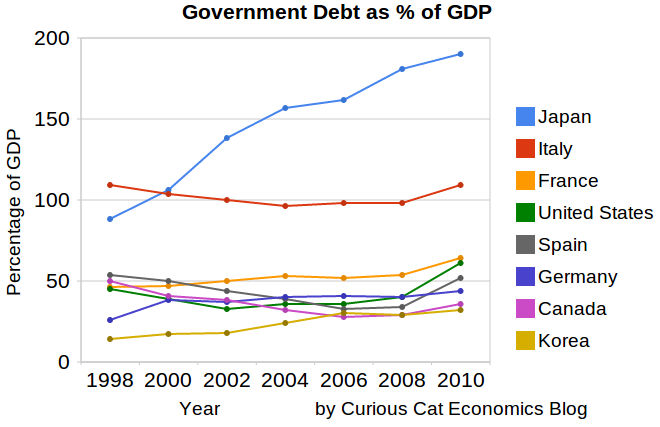
    • Government Debt as Percent of GDP 1998-2010 for OECD countries by John Hunter – There has been a dramatic increase from 2008-2010. The USA is up from 41% of GDP to 61%. Spain is up from 34% to 52% (but given all the concern with Spain this doesn’t seem to indicate the real debt problems they have. Economic data contains quite of bit of noise, unfortunately.

      graph of government debt for OECD countries from 1998-2010

    • Cause of Decline in U.S. Financial Position by Barry Ritholtz – “The Pew Center reported in April 2011 the cause of a $12.7 trillion shift in the debt situation, from a 2001 CBO forecast of $2.3 trillion cumulative surplus by 2011 versus the estimated $10.4 trillion public debt in 2011. The major drivers were:
      Revenue declines due to two recessions, separate from the Bush tax cuts of 2001 and 2003: 28%
      Defense spending increases: 15%
      Bush tax cuts of 2001 and 2003: 13%
      Increases in net interest: 11%
      Other non-defense spending: 10%
    • How This Blog Earns Full-Time Income from Part-Time Work by David Weliver – “for the most part, I’ve tried to focus on simply writing on topics that are unique, helpful, that answer specific questions. (It’s easy enough to be helpful, I think, but with billions of web pages out there, being unique is a never-ending challenge).”
    • How to live off investment income – 1. Set up a cash buffer account between your regular monthly spending, and your income-spewing engines. 2. Work out how much of your annual investment income you will/can spend. The rest of the money you will reinvest…
    • A Risky Investment Isn’t a Bad Investment by Kevin McKee – “If you want all the potential for Apple-esque gains, you need to be prepared to accept Enron-esque results. That’s the magic of risk; it goes both ways. Would I hold 100% of my portfolio in company stock? No.”
    • (more…)

  • Extremely Poor Broadband for the USA

    The USA has extremely poor broadband service (compared to other rich countries). It is slow and expensive. Those that support economic policies more in line with the USA than other nations have a great deal of explaining to do about why the options are so bad. It is similar to the broken health care system.

    Those that support politicians leading to this state for broadband say they support “free markets.” In actuality, they support anti-competitive practices by extremely large companies (oligopolistic behavior). Free market theory (the original form) requires that no individual company can dictate to the market. You have free competition – no barrier to entry, no restraint on entry, customers can buy where they want… But the politicians we elect instead support policies and practices that restrain free trade and prohibit good solutions in order to benefit those that pay the politicians well. And then we vote for those politicians.

    Those wanting the anti-competitive markets have won in our political system. The main thing I wish was clearer was that we stop pretending these people have some capitalist leaning. They are anti-capitalist. If they want to support the policies they do I wish they would be required by the voters to at least be honest. Unfortunately the voters elect them with their dis-honest representations. If the politicians were honest they would have a more difficult time being elected (because voters want to pretend they like capitalism even while voting for politicians that just seek to give special benefits to those that pay the politicians. And then the politicians claim to support markets, and business and consumers when really they just favor making anti-market legislation and regulation to favor their contributors. As long as we vote for people that claim to support capitalism but undermine it at every step to help their friends we do deserve to suffer. I just wish we could convince enough of our fellow citizens that flashy propaganda and repeating lies over and over isn’t the same as facts and truth.

    1Gbps fiber for $70—in America? Yup.

    Where I live in Chicago, Comcast’s 105Mbps service goes for a whopping $199.95 (“premium installation” and cable modem not included). Which is why it was so refreshing to see the scrappy California ISP Sonic.net this week roll out its new 1Gbps, fiber-to-the-home service… for $69.99 a month.

    Given the anti-competitive policies in the USA, if they have much success they will probably just be bought (or maybe as others suggest fought in other anti-competitive ways, but buyouts are normally easiest for actually strong competitor) to allow anti-competitive pricing and service to continue. The only real hope is someone with actual power sees it in their interest to fight against the entrenched interests. Google is the best hope I think. It isn’t that Google has nearly as much political power as those interests but they are smart and have the advantage of just having to expose the anti-competitive behavior and apply pressure.

    The narrative the politicians and voters say they support is capitalism. But the reality is just those with the gold make the rules. But when this is made obvious and continually pressed by someone with power, clout, intelligence and political savvy it makes politicians and regulators hesitant to continue business as usual. Normally they just delay for a few months and then continue the corrupt practices. Google, plus others, plus lots of individual interest can fight that off – but it takes perseverance.

    Related: USA Broadband is Slow. Really Slow.Plugging America’s Broadband GapEliminate Your Phone BillNet Neutrality: This is serious

  • Buffett Cautions Against Buying Long Term USD Bonds

    This is another article supporting my belief that long term bonds are not investments I want to take on now. The risks of inflation and low yields seem like a very bad combination.

    Buffett Says Avoid Long-Term Bonds Tied to Eroding Dollar, quoting Warren Buffett:

    “I would recommend against buying long-term fixed-dollar investments”

    “I would much rather own businesses,” he said. “It’s very easy to take away the value of fixed-dollar investments.”

    By “take away” he mean the government can undertake policies to “inflate” their way out of a budget mess. By undertaking policies that create inflation (drastically increasing the money supply, borrowing huge amounts of money, running huge trade deficits…) the country can devalue the currency, the US dollar in this case, and thus reduce the effective cost of the payments they have to make on long term bonds (because they pay back the loans with devalued, inflated, dollars). I believe he is right and long term USD bonds are a very risky (inflation risk) investing option today. Of course I have felt the same way for the last 5 years. I own very little in the way of bonds – I do own a bit of TIPS (Treasury Inflation-Protected Securities), in my 401(k) – but stopped allocating money to that class in the last year.

    Related: Bill Gross Warns Bond Investors (March 2010)Bond Yields Stay Very Low, Treasury Yields Drop Even MoreWho Will Buy All the USA’s Debt?

  • Dishonest and Dangerous State Budgets

    Bill Gates is really doing some great stuff the last few years. He takes a look at the enormous problem with state government’s failure do deal with the very long term health care failure in the USA (this has been going on for the last few decades) and the financial games them play. His Twitter quote is: Enron would blush at the financial untruth State governments engage in.

    I have written about these problems before, including in: USA State Governments Have $1,000,000,000,000 in Unfunded Retirement Obligations. One small (compared to the problem for the whole country) He notes is that California has a $62.5 billion health care liability and $3 billion set aside for it.

    We have been doing a very bad job of electing people to honest manage budgets. We, or our children and grandchildren are going to pay for those failures. The longer we fail to elect people that will deal with the real decisions that need to be made for government spending and taxing the greater those bills for our mistakes will be.

    Related: Are Municipal Bonds Safe?USA Heath Care System Needs ReformUSA Spends Record $2.5 Trillion, $8,086 per person 17.6% of GDP on Health Care in 2009The USA Pays Double for Worse Health ResultsThe Long-Term USA Federal Budget Outlook

  • Manufacturers Coming Back to the USA

    An increasing number of news articles are reporting on the increasing strength of manufacturing in the USA (and globally, actually).

    Made (once again) in America

    NovaSom chose Zentech Manufacturing Inc. for two key reasons: Executives here could oversee quality control, and the kits could be shipped to domestic customers in just days, not weeks or months.

    After years of American companies shipping jobs and contracts overseas, some are choosing local manufacturers or even “re-shoring” – bringing those jobs and work back to the United States.

    One-fourth of more than 850 companies surveyed by MFG.com, a global online marketplace for manufacturers looking to source custom parts, returned work to North America from overseas in the last quarter of 2010.

    The “decrease” in manufacturing in the USA has been exaggerated as I written for year (manufacturing has grown steadily over the last few decades in the USA). It is true though manufacturing in some plants has moved overseas. Over the last few years more and more stories report on American companies moving manufacturing back to the USA that they had moved offshore previously.

    The Institute for Supply Management most recent survey reports a surge in US manufacturing to its highest reading in nearly seven years.

    Related: Manufacturing Cars in the USALeading Manufacturing Countries Globally (1980-2009) Global Manufacturing Employment Data – 1979 to 2007

    (more…)

  • Top 15 Manufacturing Countries in 2009

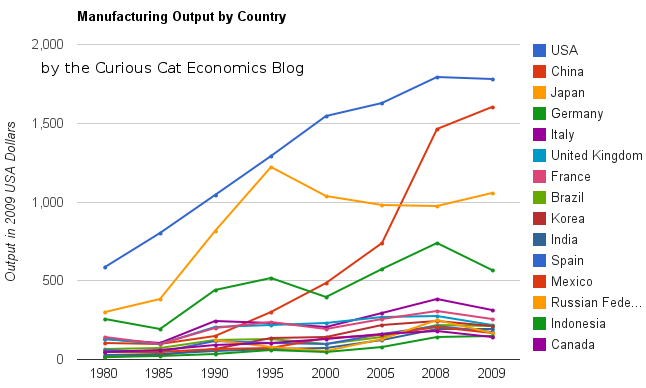
    China continues to grow manufacturing is output. In 2009, the USA, and most countries saw declines in manufacturing production. China, however, continued to grow. China is now finally approaching the level of manufacturing done in USA. The latest data again shows the USA is the largest manufacturer but China looks poised to take over the number one spot soon.

    chart of manufacturing production by leading manufacturing countries
    The chart showing manufacturing output by country was created by the Curious Cat Economics Blog based on UN data (in 2009 USA dollars). You may use the chart with attribution.

    The large decline in Germany was 23%. This was a 18% decline in Euro terms, and when you added the decline of the Euro the total USA dollar decline was 23%. Quite extraordinary. Most European countries were down over 15%. In fact, so extraordinary it makes me question the data. World economic data is useful and interesting but it isn’t perfect. USA manufacturing declined just .5%. China increased manufacturing production by 9%.

    The last 2 years, China has stopped separating out mining and utilities from manufacturing. The percentage of manufacturing (to manufacturing, mining and utilities) was 78% for 2005-2007 (I used 78% of the manufacturing, mining and utilities figure provided in the 2008 and 2009 data – but that could be wrong). The unadjusted 2009 China total was $2.05 trillion and for the USA the total manufacturing, mining and utilities was $2.33 trillion. In 2009, the manufacturing total was 76% of USA manufacturing, mining and utilities. The percentage varies significantly between countries (the Russian federation is about 55% and Japan about 91%) and various over time as a countries economy changes.

    The big, long term story remains the same. China has continued to grow manufacturing output tremendously. I see very little data to support the stories about manufacturing having to leave China to go elsewhere (especially when you look at the “lower wages” counties mentioned in news stories – they are not growing at any significant rate). The USA is still manufacturing a huge amount and that production has steadily grown over time.

    When you look back over the period from 1980 to today you can see

    1. The biggest story is the growth in Chinese manufacturing
    2. The USA started out the largest and has grown significantly
    3. Japan did very well from 1980 to 1995, and since they have struggled
    4. The USA, China, Japan are really far ahead of other countries in total manufacturing output, and Germany is solidly in 4th place.
    5. After that the countries are fairly closely grouped together. Though there are significant trends hidden by the scale of this graph, which I will explore in future posts. South Korea has growth significantly over this period, for example.
    6. The biggest macro trend that the data shows, but is not so visible in this chart (other than China’s growth), is the very strong performance of emerging markets (and in fact some counties have fully become manufacturing powerhouses during this period, most notably China but also, South Korea and Brazil). And I see that continuing going forward (though that is speculation).

    Two more interesting pieces of data. Italy is the 5th largest manufacturing country, I don’t think many people would guess that. Since 1980 Italy surpassed the UK and France but China rocketed passed them. And Indonesia has moved into 14th place, edging out Canada in 2009.

    I plan to take more time in 2011 to look at global manufacturing and other global economic data more closely and to write about it here.

    Related: Data on the Largest Manufacturing Countries in 2008Top 12 Manufacturing Countries in 2007Top 10 Manufacturing Countries 2006Leading global manufacturers in 2004