Category: economy

  • USA Added 290,000 Jobs In April

    The stock market showed again yesterday how non-efficient it can be at times. Several stocks fell to pennies a share for awhile before returning to tens of a dollars a share. While the markets continue to react violently, the economy appears to be gaining more strength.

    Nonfarm payroll employment rose by 290,000 in April, the unemployment rate increase to 9.9%, and the labor force increased sharply, the U.S. Bureau of Labor Statistics reported today. Job gains occurred in manufacturing, professional and business services, health care, and leisure and hospitality. Federal government employment also rose, reflecting continued hiring of temporary workers for Census 2010. Since December, nonfarm payroll employment has expanded by 573,000, with 483,000 jobs added in the private sector. The vast majority of job growth occurred during the last 2 months.

    Household Survey Data

    In April, the number of unemployed persons was 15.3 million, and the unemployment rate edged up to 9.9%. The rate had been 9.7% for the first 3 months of this year.

    The number of long-term unemployed (those jobless for 27 weeks and over) continued to trend up over the month, reaching 6.7 million. In April, 45.9% of unemployed persons had been jobless for 27 weeks or more.

    In April, the civilian labor force participation rate increased by 0.3 percentage point to 65.2 percent, as the size of the labor force rose by 805,000. Since December, the participation rate has increased by 0.6 percentage point. The employment-population ratio rose to 58.8 percent over the month and has increased by 0.6 percentage point since December.

    Manufacturing added 44,000 jobs in April. Since December, factory employment has risen by 101,000. Over the month, gains occurred in several durable goods industries, including fabricated metals (9,000) and machinery (7,000). Employment also grew in nondurable goods manufacturing (14,000).

    Related: USA Added 162,000 Jobs in MarchUnemployment Rate Reached 10.2% (Oct 2009)USA Unemployment Rate Rises to 8.1%, Highest Level Since 1983 (March 2009)Over 500,000 Jobs Disappeared in November, 2008
    (more…)
  • Middle Class Families from 1970-2005

    As I have said before, Elizabeth Warren is one of the people I find most informative on the economy we have created. This lecture (from January 31, 2008) is very interesting: The Coming Collapse of the Middle Class: higher risks, lower rewards and a shrinking safety net. It is important for us to realize that the decisions we make have consequences. If we allow corruption to grow and grow in the USA we will suffer more and more. If we continue to elect people that give away society wealth to those the pay them to the detriment of society (investment banks, drug companies, “intellectual property” lawyers, retail banks, farmers, trial lawyers, hedge fund managers, trust fund babies, physicians…) that naturally means their is less wealth for the rest of society.

    Interesting data. Looking at standard family (Mom, Dad and 2 kids from 1970 to 2005), in inflation adjusted dollars: earnings increased a great deal (due to women working much more) but disposable income decreased. This is because basic expenses increased: health care, housing, transportation… (and this is with assuming employer provided health care – which has really been decreasing in likelihood over time). Those families are also more deeply in debt and reliant on 2 incomes. And if either income producer losses their jobs the economics of the family fail. Which means the family is much more at risk.

    It really is great that lectures like this are available to us now.

    Related: Elizabeth Warren Webcast On Failure to Fix the SystemIn the USA 43% Have Less Than $10,000 in Retirement SavingsFailure to Regulate Financial Markets Leads to Predictable ConsequencesLobbyists Keep Tax Off Billion Dollar Private Equities Deals and On For Our Grandchildren

  • China Economy Grows 11.9% in 1st Quarter

    China’s GDP increased 11.9% in 1st quarter of 2010, from last year. China is now the 2nd largest economy (overtaking Japan in the last year). More cars will be bought this year in China than any other country (they overtook the USA in 2009). The 4th quarter of 2009 saw an increase of 10.7% above 2008. Real estate appreciation continues and the government reported housing prices in 70 major cities rose 11.7% in March compared to 2009. I believe it would be wise for China to take stronger action to deflate a bubble. Raise rates. Cut back on infrastructure spending. Raise the value of the Yuan.

    March’s China consumer price index was 2.4% higher than a year earlier, while the producer price index was up 5.9%.

    China’s economy feels the heat by Robert M Cutler

    Property prices rose at a record pace in March, up almost 12% from a year earlier, according to the National Bureau of Statistics on Wednesday. This represents a considerable short-term acceleration after housing prices in 70 major cities rose only 1.5% in 2009, according to official data.

    The government has held its overnight interest rate steady at 5.31% since January 2009.

    The government has already moved to slow the real estate market through higher mortgage rates and required down payments and the re-introduction of sales taxes.

    The ministry of housing and urban-rural development has said it intends to crack down on price speculation in the property market and curb attempts to hoard land. Measures being considered include requiring a down payment of 40% on second residences

    Related: China GDP up 8.7% in 2009China Forecasts 9.6% GDP Growth, Close to Becoming 2nd Largest EconomyCapitalism in China

  • Consumer Debt Needs to Decline Much More

    Economic data don’t point to boom times just yet

    American households are trying to reduce debt to stabilize finances. But they are doing so slowly, with total household debt at 94 percent of gross domestic product in the fourth quarter down just slightly from 96 percent when the recession began in late 2007.

    By contrast, that ratio of household debt to economic output was 70 percent in 2000. To get back to that level, Americans would need to pay down $3.4 trillion in debt

    And it isn’t like the 2000 level was one of great consumer discipline. The economy needs to improve in several ways to be approaching a state that could be called a healthy economy. The 2 biggest, in my mind are 1) decreasing debt (consumer and government) and 2) increasing jobs. My next most important would probably be increasing the number of “good” jobs. Many other data points are important, such as: decreasing income inequality; increasing the age at retirement (because of all the systemic problems caused by extremely long retirements financed not by savings but taxes on existing workers); low inflation (luckily that is continuing to look good); value added economic activity (real GDP); decrease in the cost of the health care system as a % of GDP; decrease in financial leverage; economic strength worldwide (economic weakness of Japan, Europe… can severely hamper economic success in the USA). I do not see a bubble hyped economy as a healthy economy – even if lots of measures look good.

    Related: Americans are Drowning in DebtDollar Decline Due to Government Debt or Total Debt?Financial Illiteracy Credit TrapConsumer Debt Down Over $100 Billion So Far in 2009 (Nov 2009)

  • Will The Savings Rate Fall Back Again

    Welcome to the False Recovery by Eric Janszen

    Because of the way the government measures household savings, the increase doesn’t signify more money in people’s wallets; instead, it suggests that consumers are paying off their mounting debt during a period of reduced borrowing. That’s no harbinger of growth.

    Companies planning for sudden and relatively near-term growth should reshape their strategies to make the best of economic flatness.

    He makes a decent point for companies, but the he flips back and forth between the need to save more (because we are buried in debt) and the need to spend more (because we need to grow the economy right now). And while I wouldn’t stake my life on it I wouldn’t be surprised that we have a strong economic rebound (it is also perfectly conceivable we have a next to no growth or even fall into a recession). But it seems to me the return to bubble thinking and spending beyond our means is making a strong comeback.

    The money is not going under mattresses or into bank accounts, from where it will emerge one day to jump-start the economy. It’s actually subsidizing the previous boom, which was built on debt and the presumption that assets would always cover that debt.

    Another ok, point but we have hardly paying off anything of the previous living beyond our means. It would take decades at this rate.

    Banks can loosen lending policies to allow people to borrow and spend again—but for that to solve anything, consumers must be extremely judicious in how they take on and use their debt. It’s more likely that consumer debt levels will rise again as individuals stretch themselves to afford what they want. Alas, this will drive the reported savings rate back down. By the end of 2010, I expect it to dip below 3%. Then, any drop in asset values will set off the debt trap. We’ll again see a rising savings rate and tightened lending, followed by loosened lending and a declining savings rate. The recovery will become a series of starts and stops: promising progress, periods of retreat.

    So the problem is the saving are not actually resulting in increased ability to spend (first point above) – which is bad he says, because it means their won’t be more spending (because people won’t have the ability to spend). Then he says when banks lend the consumers money they will spend and the saving rate will go down (which is bad – though he doesn’t seem to really want more savings (because that means business won’t get increased sales).

    The conventional wisdom likes to point out the long term problem of low savings rate but then quickly point out we need more spending or the economy will slow. Yes, when you have an economy that is living beyond its means if you want to address the long term consequences of that it means you have to live within your means. It isn’t tricky. We need to save more. If that means the economy is slower compared to when we lived beyond our means that is what it takes. The alternative is just to live beyond your means for longer and dig yourself deeper into debt.
    (more…)

  • Apartment Rents Rise, Slightly, for First Time in 5 Quarters

    Apartment Rents Rise as Sector Stabilizes

    Nationally, effective rents, which include concessions such as one month of free rent, rose 0.3% during the quarter compared with a 0.7% decline in the fourth quarter of last year and a 1.1% drop in the first quarter of 2009.

    enters are also staying put longer: the average renter now stays for 19 months, up from an average of 14 months, said Mr. Friedman, and despite low mortgage rates and greater home affordability, fewer renters are leaving to buy homes. “This is the first time in many, many years that it feels like even people who could afford to buy are making the investment decision not to,” Mr. Friedman said.

    Portland, Ore., posted the largest rent decline, at 0.7%, followed by Las Vegas, San Diego, and Southern California’s Inland Empire. Those three markets have all seen an uptick in home-buying activity, particularly among the low end from first-time buyers and investors.

    Colorado Springs had the largest rent increases, 2.5%, followed by Washington DC, 2% and San Antonio 1.5%. There is a very nice new online tool, Padmapper, for renters or landlords. It is a mashup on Google Maps of rental listings by location from Craigslist and other sources. Very good search options. Easy to use. Find more real estate links on the Curious Cat Cool Connections Directory.

    Related: It’s Now a Renter’s Market (April 2009)Housing Rents Falling in the USA (February 2009)Apartment-vacancy Rate is 7.8%, a 23-year High

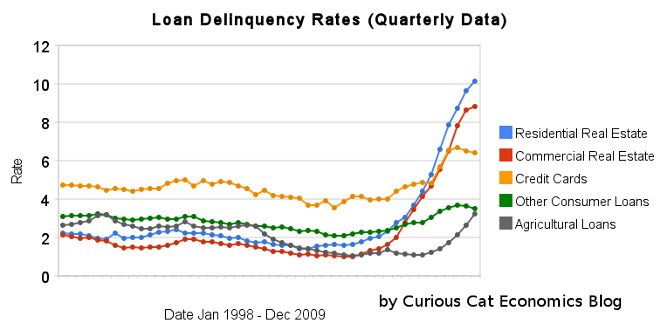
  • Real Estate and Consumer Loan Delinquency Rates 1998-2009

    The chart shows the total percent of delinquent loans by commercial banks in the USA.

    charts showing loan delinquency rates in the USA, 1998-2009

    That last half of 2009 saw real estate delinquencies continue to increase. Residential real estate delinquencies increased 143 basis points to 10.14% and commercial real estate delinquencies in 98 basis points to 8.81%. Agricultural loan delinquencies also increased (112 basis points) though to just 3.24%. Consumer loan delinquencies decreased with credit card delinquencies down 18 basis points to 6.4% and other consumer loan delinquencies down 19 basis points to 3.49%.

    Related: Loan Delinquency Rates Increased Dramatically in the 2nd QuarterBond Rates Remain Low, Little Change in Late 2009Government Debt as Percentage of GDP 1990-2008 – USA, Japan, Germany… posts with charts showing economic data
    (more…)

  • USA Added 162,000 Jobs in March

    Nonfarm payroll employment increased by 162,000 in March, and the unemployment rate held at 9.7%, based on U.S. Bureau of Labor Statistics surveys. Hiring for the census added 48,000 jobs in March, a large temporary increase, but less than expected amount, for the month. The change in total nonfarm payroll employment for January was revised from -26,000 to +14,000, and the change for February was revised from -36,000 to -14,000 together this results in an addition of 90,000 jobs.

    The 162,000 added jobs is the largest increase since March of 2007. It is a good start but the economy will have to continue to increase the number of job added each month to reduce unemployment. Population growth requires an addition of approximately 125,000 jobs a month. The current labor pool has been temporarily reduced by those who have dropped out of the labor market. As jobs return they will come back into the market.

    The economy has lost 8.2 million jobs since the recession started in December 2007. Now that was the bubble induced peak still, by the time the economy adds 8 million jobs many more jobs will be needed (since 125,000 additional jobs are needed each month). Still if we added 200,000 a month it would take 40 months to get back to the previous peak total. And by that time the economy would have accumulated another 9 million jobs needed (it would be about Dec 2013 = 6 * 12 months *125,000/month). While the bubble induced peak may well be a unrealistic target, the job market needs to add over 200,000 jobs a month to regain ground lost over the last several years.

    In March, the number of unemployed persons was little changed at 15.0 million, and the unemployment rate remained at 9.7%. The number of long-term unemployed (those jobless for 27 weeks and over) increased by 414,000 over the month to 6.5 million. In March, 44.1% of unemployed persons were jobless for 27 weeks or more. Both are all time highs.

    The civilian labor force participation rate (64.9%) and the employment-population ratio (58.6%) continued to edge up in March. The average length of unemployment rose to 31 weeks – the highest average ever (since 1948).
    Related: USA Unemployment Rate Remains at 9.7%663,000 Jobs Lost in March, 2009 in the USAAnother 450,000 Jobs Lost in June, 2009Manufacturing Employment Data – 1979 to 2007
    (more…)

  • 50% of Commercial Real Estate Mortgages Will be Underwater

    Half of Commercial Mortgages to Be Underwater

    By the end of 2010, about half of all commercial real estate mortgages will be underwater, said Elizabeth Warren

    We now have 2,988 banks – mostly midsized, that have these dangerous concentrations in commercial real estate lending.” As a result, the economy will face another “very serious problem” that will have to be resolved over the next three years, she said, adding that things are unlikely to return to normalcy in 2010.

    Warren said it’s time for the government to “pull the plug” on mortgage lenders Fannie Mae and Freddie Mac. “I’m one of those people who never liked public-private partnership to begin with. I think what they did was use public when public was useful and private when private was useful,” she said. “And I think we’ve got to rethink that whole thing.”

    “There is no implicit guarantee anymore,” she added. “I don’t care how big you are, if you make serious enough mistakes, then your business can be entirely wiped out.”

    Financially literate people should know that the current commercial real estate market is in serious trouble. I still figure it will rebound well. I just want to wait and see how far prices fall and then try to buy when people are so frustrated they will sell at very low prices.

    Related: Commercial Real Estate Market Prospects Remain DimMortgage Delinquencies and Foreclosures Data Indicates 2010 Could Show ImprovementJumbo Loan Defaults Rise at Fast Pace (Feb 2009)

  • How the New Health Care Law May Affect You

    10 Ways the New Healthcare Bill May Affect You by Katie Adams

    Starting this year, if you have an adult child who cannot get health insurance from his or her employer and is to some degree dependent on you financially, your child can stay on your insurance policy until he or she is 26 years old.

    Starting this fall, your health insurance company will no longer be allowed to “drop” you (cancel your policy) if you get sick.

    Starting this year your child (or children) cannot be denied coverage simply because they have a pre-existing health condition. Health insurance companies will also be barred from denying adults applying for coverage if they have a pre-existing condition, but not until 2014.

    If you currently have pre-existing conditions that have prevented you from being able to qualify for health insurance for at least six months you will have coverage options before 2014. Starting this fall, you will be able to purchase insurance through a state-run “high-risk pool”, which will cap your personal out-of-pocket expenses for healthcare. You will not be required to pay more than $5,950 of your own money for medical expenses; families will not have to pay any more than $11,900.

    Under the new law starting in 2014, you will have to purchase health insurance or risk being fined.

    Starting in 2018, if your combined family income exceeds $250,000 you are going to be taking less money home each pay period. That’s because you will have more money deducted from your paycheck to go toward increased Medicare payroll taxes. In addition to higher payroll taxes you will also have to pay 3.8% tax on any unearned income, which is currently tax-exempt.

    Related: How the health care bill could affect youAnswers About Health Care BillWhy the Health Care Bill May Eventually Curb Medical Costspost on health careUSA Consumers Paying Down DebtPersonal Finance Basics: Long-term Care Insurance