Category: economy

  • USA Unemployment Rate at 9.6%

    Nonfarm payroll employment decreased by 54,000 job in August, and the unemployment rate increased to 9.6%, the U.S. Bureau of Labor Statistics reported today. Government employment fell, as 114,000 temporary workers hired for the census completed their work. Private-sector payroll employment continued to trend up modestly (+67,000).

    The estimates were for worse news so that loss of 54,000 jobs was seen as good news. That is still pretty bad news. There was some slightly good news though in that 123,000 fewer jobs were lost in the June and July than previously thought. So the total jobs report shows a gain of 69,000 from the previously reported data. The change in total nonfarm payroll employment for June was revised from -221,000 to -175,000, and the change for July was revised from -131,000 to -54,000.

    The number of unemployed persons now stands at 14.9 million. Among the major worker groups, the unemployment rate for adult men (9.8%), adult women (8.0%), teenagers (26.3%). The number of long-term unemployed (those jobless for 27 weeks and over) declined by 323,000 over the month to 6.2 million. In August, 42% of unemployed persons had been jobless for 27 weeks or more.

    In August, the civilian labor force participation rate stood at 64.7% and the employment-population ratio was 58.5%. Since its most recent low in December 2009, private-sector employment has risen by 763,000.

    Employment in health care increased by 28,000 in August. Thus far in 2010, the health care industry has added an average of 20,000 jobs per month, about in line with the average monthly job growth in 2009. Manufacturing employment declined by 27,000 over the month. A decline in motor vehicles and parts (-22,000) offset a gain of similar magnitude in July as the industry departed somewhat from its usual layoff and recall pattern for annual retooling.

    The average workweek for all employees on private nonfarm payrolls was unchanged over the month at 34.2 hours. The manufacturing workweek for all employees increased by 0.1 hour to 40.2 hours, and factory overtime was up by 0.1 hour. The average workweek for production and nonsupervisory employees on private nonfarm payrolls increased by 0.1 hour to 33.5 hours.

    Average hourly earnings of all employees on private nonfarm payrolls increased by 6 cents, or 0.3 percent, to $22.66 in August. Over the past 12 months, average hourly earnings have increased by 1.7 percent. In August, average hourly earnings of private-sector production and nonsupervisory employees increased by 3 cents, or 0.2 percent, to $19.08.

    The data points to a stagnant economy. The free fall created by the credit crisis has been stopped thankfully and there is hope for better news going forward but nothing definite. Job growth is a key right now and growth of over 200,000 jobs a month is needed to really provide hope for a stronger economy, which would start to reduce the risks of sliding back into another recession (and to allow improvement on reducing the amount of the government deficit).

    Related: USA Economy Lost 125,000 Jobs and Unemployment Rate Decreased to 9.5% (July 2010)Unemployment Rate Reached 10.2% (Nov 2009)Another 450,000 Jobs Lost in June 2009
  • Real Estate and Consumer Loan Delinquency Rates 2000-2010

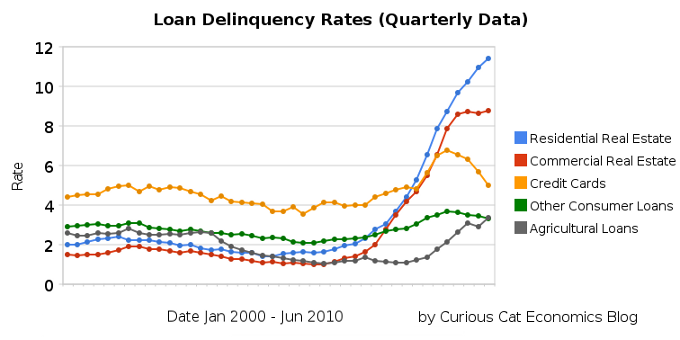
    The chart shows the total percent of delinquent loans by commercial banks in the USA.

    chart showing loan delinquency rates 2000-2010

    The first half of 2010 saw residential real estate delinquencies continue to increase and other consumer loan delinquencies decreasing (both trends continue those of the last half of 2009). Residential real estate delinquencies increased 118 basis points to 11.4%. Commercial real estate delinquencies increased just 7 basis points to 8.79%. Agricultural loan delinquencies also increased (25 basis points) though to just 3.35%. Consumer loan delinquencies decreased, with credit card delinquencies down 131 basis points to 5.01% and other consumer loan delinquencies down 15 basis points to 3.34%.

    Related: Real Estate and Consumer Loan Delinquency Rates 1998-2009Bond Rates Remain Low, Little Change in Late 2009Government Debt as Percentage of GDP 1990-2008 – USA, Japan, Germany…posts with charts showing economic data
    (more…)

  • Fixed Mortgage Rates Reach New Low

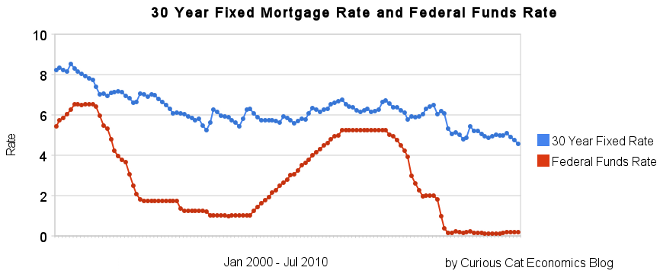
    30 year fixed mortgage rates have declined sharply recently to close to 4.5%.

    chart showing 30 year fixed mortgage rates: 2000 to July 2010

    If you are considering refinancing a mortgage now may well be a very good time. If you are not, you maybe should consider it. If so look to shorten the length. If you originally took out a 30 year mortgage and now have, for example, 24 years let, don’t add 6 years to your repayment term by getting a new 30 year mortgage. Instead, look to shorten your pay back period with a 20 year mortgage. The 20 year mortgage will have an even lower rate than the 30 year mortgage.

    If you plan on staying in the house, a fixed rate mortgage is definitely the better option, in my opinion. If you are going to move (and sell your hose) in a few years, an adjustable rate mortgage may make sense, but I would learn toward a fixed rate mortgage unless you are absolutely sure (because situations can change and you may decide you want to stay).

    The poor economy, unemployment rate still at 9.5%, has the Fed continuing massive intervention into the economy. The Fed is keeping the fed funds rate at close to 0%.

    If you are looking at a new real estate purchase, financing a 30 year mortgage sure is attractive at rates under to 4.5%.

    Related: historical comparison of 30 year fixed mortgage rates and the federal funds rate30 Year Fixed Mortgage Rates Remain Low (Dec 2009)Lowest 30 Year Fixed Mortgage Rates in 37 YearsWhat are mortgage definitions

    For more data, see graphs of the federal funds rate versus mortgage rates for 1980-1999. Source data: federal funds rates30 year mortgage rates

  • Oil Consumption by Country 1990-2009

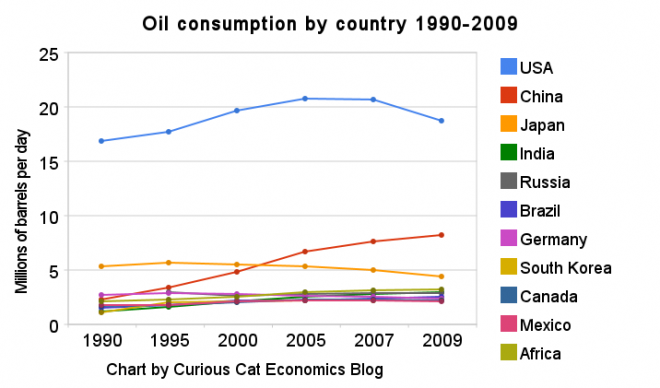
    The United States uses far more oil than any other country. The chart shows this very well. The chart shows all countries using over 2 million barrels of oil a day. The USA consumed 18.7 million barrels a day in 2009. Only China was also over 5 million barrels, they reached 8.2 million in 2009. Japan is next at 4.4 million.

    The data is from the US Department of Energy for total consumption of petroleum products.

    Mexico, Canada, South Korea, Germany, Brazil, Russia and India all use between 2 and 3 million barrels a day. All of Africa is at 3.2 million.

    Related: Oil Consumption by Country in 2007Manufacturing output by Country 1990-2008Increasing USA Foreign Oil Dependence In The Last 40 yearsWind Power Capacity Up 170% Worldwide from 2005-2009

  • Consumers Continue to Slowly Reduce Their Debt Level

    Consumer debt decreased at an annual rate of 3.25% in the second quarter. Revolving credit (credit card debt) decreased at an annual rate of 9.5%, and nonrevolving credit (car loans…) was about unchanged.

    Revolving consumer debt now stands at $827 billion down $39 billion this year. That is on top of a $92 decline in 2009. Hopefully we can continue this success.

    Through June of 2010 total outstanding consumer debt was $2,419 billion, a decline of $30 billion ($21 billion of the decline was in the 2nd quarter). This still leaves over $8,000 in consumer debt for every person in the USA and $20,000 per family.

    Consumer debt grew by about $100 billion each year from 2004 through 2007. In 2009 consumer debt declined over $100 billion so far: from $2,561 billion to $2,449 billion.

    The huge amount of outstanding consumer and government debt remains a burden for the economy. At least some progress is being made to decrease consumer debt.

    Those living in USA have consumed far more than they have produced for decades. That is not sustainable. You don’t fix this problem by encouraging more spending and borrowing: either by the government or by consumers. The long term problem for the USA economy is that people have consuming more than they have been producing.

    Thankfully over the last year at least consumer debt has been declining, but it needs to decline more. I disagree with those that want to see short term improvement in the economy powered by consumer debt. It would be nice to see improvement to the current economy. But we can’t afford to achieve that with more debt. Government debt has been exploding so unfortunately that problem has continued to get worse.

    Data from the federal reserve.

    Related: Consumer Debt Declined a Record $21.5 Billion in JulyThe USA Economy Needs to Reduce Personal and Government Debt

  • Auto Manufacturing in 2009: USA 5.7 million, Japan 7.9 million, China 13.8 million

    This webcast includes lots of interesting data on China’s economy (the SAIC green transportation concepts is also interesting but not as much as the economic data, to me). I knew China had overtaken the USA in purchases of new cars. I knew China continues to grow manufacturing output amazingly. I did not know how incredibly rapidly Chinese growth in manufacturing cars has been in the last couple of years.

    In 2007 the USA produced 10.8 million cars and light trucks, Japan 11.6 million, China 8.9 million. In 2008 USA 8.7 million, Japan 11.6 million, China 9.3 million. In 2009 USA 5.7 million, Japan 7.9 million and China 13.8 million. That is an amazingly quick transformation. The credit crunch is obviously a big part of the issue but the bigger story is the growth on the broad Chinese consumer economy (most of those Chinese cars are being bought in China).

    Another interesting country is India: In 2007 they produced 2.3 million, 2008 2.3 million and in 2009 2.6 million. Global production: 2007 – 73 million, 2008 – 70 million, 2009 – 62 million.

    The webcast includes more interesting statistics. More than 250 million people have been removed from abject poverty (this is am amazingly great outcome that is often ignored). In 1978, .2% Chinese homes had a refrigerator; by 2008, 94% had refrigerators. In 2030 China will have 220 cities with over 1 million people. Today China has 110.

    Related: Manufacturing Output as a Percent of GDP by CountryChina Forecasts 9.6% GDP Growth, Close to Becoming 2nd Largest Economy (Dec 2009)The Relative Economic Position of the USA is Likely to Decline

  • Landlords See Increase in Apartment Rentals

    Apartment Rentals Surge in U.S. on Foreclosures, Jobs

    The number of occupied apartments increased by 215,000 in the 64 largest U.S. markets in the first half, according to MPF Research. That’s almost double the units added in all of 2009 and the most since the firm began tracking the data in 1992. The vacancy rate declined to 6.6 percent last month from 8.2 percent in December.

    The Bloomberg REIT Apartment Index has gained 28 percent this year, double the 14 percent advance in the broader Bloomberg REIT Index.

    Finances for homeowners didn’t improve fast enough to prevent more than 1.65 million foreclosure filings in the first half, an increase of 8 percent from the same period in 2009, RealtyTrac Inc., a data company in Irvine, California, said July 15. A record 269,962 U.S. homes were seized from delinquent owners in the second quarter as lenders set a pace to claim more than 1 million properties by the end of 2010.

    The U.S. homeownership rate fell to 66.9 percent in the second quarter, the lowest since 1999, the U.S. Census Bureau said today. The rate peaked at 69.2 percent in the fourth quarter of 2004.

    Effective rents, or what tenants pay after concessions or breaks from landlords, increased 1.4 percent in the biggest markets in the first half, according to MPF Research. Rents may rise 4 percent to 6 percent in both 2011 and 2012, compared with a gain of about 2 percent this year, Willett said.

    Rentals are picking up partially due to the economy picking up allowing some who moved into their parents house to move back out. Also the continued numbers of people losing their houses increases the ranks of potential renters. The market is still absorbing many people reducing their housing footprint (people joining up with others to save on expenses). This is one of several important areas to watch (job growth is still probably the most important). As large numbers of apartment are rented and houses are rented or bought it is a strong indicator people are gaining some financial stability.

    Related: Apartment Rents Rise, Slightly, for First Time in 5 Quarters (April 2010)Apartment-vacancy Rate is 7.8%, a 23-year High (Nov 2009)Sales of New Homes Plunged in USA in May to Record Low

  • Intel Reports Their Best Quarter Ever

    Intel reports their best quarter ever.

    Revenue $10.8 billion
    Gross Margin 67%
    Net Income $2.9 billion

    Intel is one of the stocks in our 12 stocks for 10 years portfolio (and has been since 2005). Intel currently pays a dividend of about 3%. Intel’s gross margins continue to be amazing. 67% is just fantastic.

    Intel is only one company, but the earnings are good new for the economy (they indicate quite a large demand for the products that include Intel’s chips). We certainly can use good news on the economy. We need more good news and the key I believe, now, is adding jobs. Earnings have been good recently and this is one sign that high tech earnings continue to do well. Google announcing earnings on Thursday.

    The effective tax rate was 31%. Which is a good thing in my opinion. I don’t think it is a good thing when companies make billions of dollars and avoiding paying the taxes that allow society to function. I am all for making changes to reduce government spending, but I am not for individuals and companies avoiding paying their fair share.

    full press release

    Related: Amazon Soars on Good Earnings and Projected Sales (Oct 2009)Looking at Microsoft as an InvestmentGreat Google Earnings (April 2007)

  • USA Economy Lost 125,000 Jobs and Unemployment Rate Decreased to 9.5%

    Total nonfarm payroll employment declined by 125,000 in June, and the unemployment rate edged down to 9.5 percent, the U.S. Bureau of Labor Statistics reported today. The decline in payroll employment reflected a decrease (-225,000) in the number of temporary employees working on Census 2010. Private-sector payroll employment edged up by 83,000. I will be amazed if the unemployment rate is not higher 3 months from now. And I will be surprised if we don’t add over 400,000 jobs in the next 3 months.

    Both the number of unemployed persons, at 14.6 million, and the unemployment rate, at 9.5 percent, edged down in June. Among the major worker groups, the unemployment rate for adult women (7.8%) declined, while the rates for adult men (9.9%) and teenagers (25.7%) showed little or no change.

    In June, the number of long-term unemployed (those jobless for 27 weeks and over) was unchanged at 6.8 million. These individuals made up 45% of unemployed persons. The civilian labor force participation rate fell by 0.3 percentage point in June to 64.7%. The employment-population ratio, at 58.5%, edged down over the month.

    There were 1.2 million discouraged workers in June, up by 414,000 from a year earlier. (The data are not seasonally adjusted.) Discouraged workers are persons not currently looking for work because they believe no jobs are available for them.

    Total nonfarm payroll employment decreased by 125,000 in June, reflecting the departure of 225,000 temporary Census 2010 workers from federal government payrolls. Total private employment edged up over the month (+83,000). So far this year, private-sector employment has increased by 593,000 but in June was 7.9 million below its December 2007 level.

    Health care employment edged up in June (+9,000). Over the past 12 months, the industry has gained 217,000 jobs. Manufacturing employment continued to trend up over the month (+9,000). The industry has added 136,000 jobs since December 2009. Construction employment decreased by 22,000 in June, with the largest decline in nonresidential specialty trade contracting. On net, construction employment has shown little change over the last 4 months.

    Related: Unemployment Rate Drops to 9.7% But Job Gains DisappointUSA Added 290,000 Jobs In April 2010Unemployment Rate Reached 10.2% (Oct 2009)
    (more…)

  • Manufacturing Output as a Percent of GDP by Country

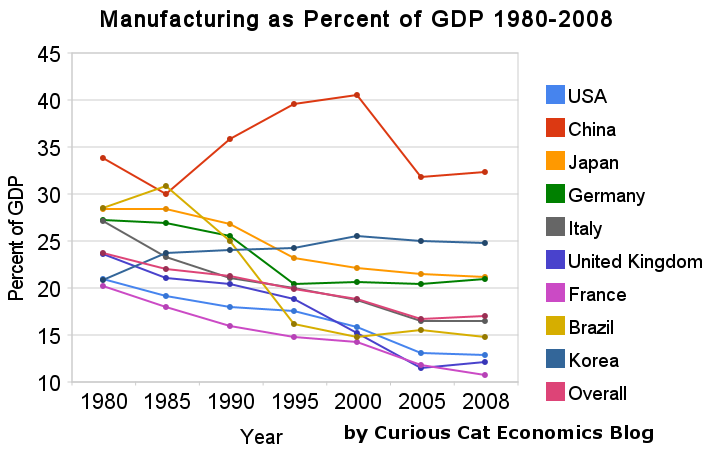
    In previous posts I have shown data for global manufacturing output by country. One of the things those posts have showed is that manufacturing output in China is growing tremendously, but it is also growing in the United States. The chart below shows manufacturing production by country as a percent of GDP. China dominates again, with over 30% of the GDP from manufacturing.

    chart of manufacturing output as percent of gdp by country 1980-2008

    Chart showing manufacturing output, as percent of GDP, by country was created by the Curious Cat Economics Blog based on UN data* (based on current USA dollars). You may use the chart with attribution.

    For the 14 biggest manufacturing countries in 2008, the overall manufacturing GDP percentage was 23.7% of GDP in 1980 and dropped to 17% in 2008. I left India (15% in 1980, 15% in 2008), Mexico (20%, 18%), Canada (17%, 13%), Spain (25%, 14%) and Russia (21% in 1990 [it was part of USSR in 1980], 15%) off the chart.

    Over the last few decades Korea, and to some extent China, are the only countries that have increased the percent of GDP from manufacturing. China has not only grown manufacturing activity tremendously but also other areas of the economy (construction, mining, information technology). The countries with the largest manufacturing portions of their economies in 2008 were: China 32%, South Korea 25%, Japan and Germany at 21%. The next highest is Mexico at 18% which declined slightly over the last 15 years (with NAFTA in place). Globally, while manufacturing has grown, other areas of economic activity have been growing faster than manufacturing.

    The manufacturing share of the USA economy dropped from 21% in 1980 to 18% in 1990, 16% in 2000 and 13% in 2008. Still as previous posts show the USA manufacturing output has grown substantially: over 300% since 1980, and 175% since 1990. The proportion of manufacturing output by the USA (for the top 14 manufacturers) has declined from 31% in 1980, 28% in 1990, 32% in 2000 to 24% in 2008. The proportion of USA manufacturing has declined from 33% in 1980, 29% in 1990, 36% in 2000 to 30% in 2008. While manufacturing output has grown in the USA it has done so more slowly than the economy overall.

    Related: The Relative Economic Position of the USA is Likely to DeclineManufacturing Data, Accuracy QuestionsTop 12 Manufacturing Countries in 2007Manufacturing Employment Data: 1979 to 2007USA Manufacturing Output Continues to Increase (over the long term)

    * I made edits to the 1980 Brazil manufacturing data and 1980, 1985 and 2008 China manufacturing data because the UN data only showed manufacturing data combined with mining and utility data. And I am using older UN data that had manufacturing separated from mining and utility figures for China in the other years.