Category: economy

  • The Economy is Weak and Prospects May be Grim, But Many Companies Have Rosy Prospects

    The fundamental truth right now is that the overall economy in Europe, the USA and Japan is weak and has some serious long term problems. But the connection between that and company weakness is not incredibly strong. Many companies have huge cash hoards, built up through the large profits they continue to make. Yes, the economy entering a serious downturn will hurt many companies. A railroad is going to lose some sales if retail sales decline (and so they don’t have to be shipped). Airlines (historically problematic companies to begin will) will struggle. Banks that pay exorbitant amounts to senior staff have trouble making money without handouts of taking huge risks that then result in more handouts once the risks fail (as usually a bad economy will expose the risks they have taken). Companies that can only do well based on large top line growth will suffer. But that isn’t all companies.

    When you look at companies like Google, Apple, Tesco, Danaher, Amazon even Toyota I really don’t see many problems looking forward. They seem perfectly capable of staying profitable, even growing profits, even in the face of economic decline in Europe, the USA and Japan (if that happens: it is possible, but not certain – very low growth is possible). Companies that have very good prospects at staying profitable, even getting more profitable going forward are hardly the type of investment I want to sell. Especially not to put it in the bank and get 0%, or a money market fund and pay someone for the privilege of having my money.

    The options for investing today don’t look so great. But I really don’t see any reason to be concerned about owning stocks that have good prospects to do well even if the quite a few large economies do poorly in the next decade. In fact I am happy to own them. Frankly the biggest worry I have is that the senior executives will loot the owners profits with exorbitant pay (this is not a worry at Toyota and less of one at Amazon). I would worry more about owning index funds in such an environment. But even as bad as things look now, I am not sure they will really turn out as bad as we fear – especially for many companies, for some yes, but many are well prepared for change).

    And the prospects in emerging markets look incredibly good to me. Yes they will slow their growth a bit if the large economies stall, but I think it is foolish to avoid investments in China, Singapore, Brazil, Korea, India, Ghana, Malaysia, Indonesia. In fact that is where companies like Google, Tesco, Apple, Toyota and Amazon are going to be making lots of money. Emerging markets are volatile and the companies in them are too. This will continue.
    (more…)
  • USA add 117,000 Jobs in July and Adjusts Previous Growth in May and June Up 56,000 More

    The report on employment released today was not good news but it was less bad than feared. Total nonfarm payroll employment rose by 117,000 in July, and the unemployment rate was little changed at 9.1%, the United States Bureau of Labor Statistics reported today. Employment growth in July, follows little growth over the prior 2 months. Total private employment rose by 154,000 over the month. Sectors experiencing growth include: health care, retail trade, manufacturing, and mining. Government employment continued to trend down.

    Some good news is found in the adjustments to the last two months job numbers. The change in total nonfarm payroll employment for May was revised from +25,000 to +53,000, and the change for June was revised from +18,000 to +46,000. That adds 56,000 jobs to the 117,000 jobs added in July and brings to the total for this report to 173,000 additional jobs. Still not great but much better than the last 2 months. The economy needs to add 125,000 a month to keep up with population growth.

    And currently the economy needs to add much more to make up for all the jobs lost due to the too big to fail institution created credit crisis. The damage done to the economy by those institutions and continuing to be done in order to support those companies remains enormous. I believe we need to see 230,000 jobs added a month consistently (in order to be making ground up for the damage done), before we can believe we are doing well.

    Remember it was just over 2 years ago we were losing hundreds of thousands of jobs a month. We are doing much better now, but fixing how broken things were is not easy. Between January of 2008 and February of 2010, the economy lost 8.75 million jobs. Since February 2010, 1.94 million jobs have been added. That means we have still lost 6,810,000 jobs and when you consider we have to add 125,000 a month to keep up we have 43 * 125,000 = 5,375,000 we haven’t added bringing a the total of jobs needed to over 12,000,000 (the number we need to add to get back to where we were). But truthfully we probably were at a bubble induced level at the peak so 12,000,000 is probably an overestimate of how many jobs we need to gain back.
    (more…)

  • Movies About the Financial Crisis

    Although we usually write about investing advice, today we’re going to head in a slightly different direction and look at some entertaining films about the financial credit crisis. Hollywood was a bit slow, to get these movies released but now the movies on the crisis are coming quickly. Attempting to recover from the credit crisis is still dominating the economies of Europe and the USA.

    Gold has been performing quite well as the markets worry about the aftermath of the credit crisis and the large amount government debt in many rich countries. Movies can provide some distraction from the worries about whether we should avoid risks in of the the stock market at the moment, if it’s a good idea to invest in gold via bullionvault.com or whether BRIC countries might really be where the action is. Movies certainly will have their version of action.

    A popular movie about the financial crisis is ‘Inside Job’ (clip above). Directed by Charles Ferguson, who’d previously made the highly acclaimed ‘No End In Sight’ about the Iraq war, and given a voiceover by Matt Damon, the film won the Oscar for documentaries in 2011. It gained positive reviews all over the world for it’s simple explanations of a very complex topic.

    Meanwhile on the other side of the Atlantic ocean, British director David Sington made ‘The Flaw’. This flaw in question refers to the admission by Alan Greenspan (former Federal Reserve Chairman) that his model of how the world works did not match up to the weird and wonderful nature of reality. Greenspan admitted that had mistakenly put too much faith in the self-correcting power of free markets. The film has not been as widely reviewed as Inside Job, but The Economist said that while it is unbalanced, it is worth a watch.

    Wherever there is an obvious political point to be made, there is sure to be Oliver Stone not far behind yelling it out. ‘Wall Street: Money Never Sleeps’ stars young Shia LaBeouf as a Wall Street trader learning from the master: Gordon Gecko. The film even has a few cameos from figures from the financial world and is generally thought of as a good beginners guide to the crisis.

    Finally, two films currently in production that look at the crisis. Firstly, Paul Giamatti will be starring in the fictionalization of Andrew Sorkin’s best selling investigation into the crisis, Too Big To Fail. George Clooney is also reportedly getting in on the act with ‘700 Billion Man’, centred on Neel Kashkari, a one time Goldman Sachs executive who helped build the gigantic Troubled Asset Relief Program, aka the financial bailout.

    We can’t guarantee these films will be balanced, but they should be interesting. Enjoy.

  • Can We Expect the Health Care System in the USA to Become Less Damaging to the Economy?

    We have had over 20 years of health care costs going up more than inflation – every year. That is an amazing (and horrifyingly bad) record. We need very strong evidence to conclude we can even just reduce the increase in damage done year after year by the broken health care system.

    Getting to the point where we actually start reducing the increased damage done each year is a big leap from where we are (reducing the acceleration of damage [reducing from hugely above inflation to largely above inflation is better than not doing that but hardly a good sign – it is still worse than the year before, just the increase in badness is less than the increase in badness from the previous year).

    Health care is so bad I often see people try to look at data and see that the rate of getting worse is declining and seeing that as a positive sign. Things are still getting worse. And they are already extremely bad. I really can’t see arguing for things getting worse more slowly as being something we should be happy with. Even just making tiny improvements (given how bad we have let things get over the decades is not good enough). We need to actually reduce spending on health care. Certainly, the absolutely least we can expect is increasing less than inflation (that is an extremely low expectation – though one the health care system has failed at for decades). We shouldn’t accept such horrible performance.

    Once we actually can start making things better year after year (not just reducing the acceleration of badness) we likely have decades before we can reduce the enormous drain the USA health care system puts on all of us living here to a level that is just average for rich countries.

    There are pockets of good things being done in health care but so so so much more is needed.

    Further, at mid-year in 2011, our costs per employee are tracking about even with 2010 numbers. That raises the possibility of a 2012 with no premium increases for employees. It will be the 6th time in nine years with no premium increase.
    Some other positive results in 2010:

    • Emergency room visits were 71 per 1000 lives, or 38% of average. Serigraph people use the ER room only in a real emergency.
    • Inpatient surgeries were 51 vs. 80 average per 1000.
    • Radiology scans totaled 775 vs. 1300.
    • Claims related to poor lifestyle choices were only 3% of our total claims, versus 7.7% for our peers.

    These strikingly positive numbers are a testimonial to the engagement of the Serigraph workforce in reforming how care is delivered in this country. They are helping to mange this complex issue.

    Reforms such as a consumer-driven plan, on-site primary care, finding the best centers of value and transparency on prices and quality are making a difference, a huge difference.
    We still have a lot of innovation to do. For instance, we decided recently to go after depression, the second most costly chronic disease in the work place. Few companies, if any, have an enlightened managerial effort on that front.

    Great work by Serigraph.

    Related: The USA Can’t Afford to Pay for the Current Health Care SystemResources to improve health care system performancearticles on improving health care

  • I Strongly Support Elizabeth Warren and the Consumer Financial Protection Bureau

    I strongly support Elizabeth Warren and strongly support her for to head the Consumer Financial Protection Bureau. She would do a great deal to improve the economy of the USA. And she would do a great deal to improve the life of tens or hundreds of millions of people. We have allowed a few people to bribe our elected officials to distort markets to damage hundreds of millions and provide huge gains for a few. We need to support capitalism not crooked elites breaking capitalism to favor their allies at the expense of the economy and those who want to benefit from free markets. It is very difficult to impede the greed fueled distortions that politicians put in place to break free markets and provide huge benefits to those who pay them. Elizabeth Warren is one of the few that is knowledgeable and skillful enough to reduce the damage those people cause the economy and everyone else.

    Why I Support Elizabeth Warren and the CFPB

    To simplify, government’s retreat from principled and thoughtful regulation licensed investment banks, credit agencies, insurance companies, and Wall Street gurus to put greed above reason. We permitted them to persuade ordinary citizens (and pension funds and homeowners) that securitized instruments, of similar efficacy to carney-sold patent medicines, were worth buying. We also allowed them to sell the idea that wishing could repeal the law that what goes up must come down.

    Nobody is entirely innocent; money’s promise is for most of us a siren’s call. And, as a nation, we’ve willfully scanted education in civic and financial literacy in schools at all levels. So guilt is not worth focusing on. We need instead a future practice of clear rules and tough oversight. And we need to remind ourselves that Adam Smith’s concept of an invisible hand did not contemplate that hand’s picking the pockets of the people whose individual decisions and actions, if the market works perfectly, let supply match demand.

    There are few political appointments I care much about. They normally are so co-opted even if they have good ideas they can’t get anything done. Don Berwick is a great person to have lead health care reform. The system is so messed up I am skeptical he can actually get much done, but I also strongly support him.

    Elizabeth Warren is excellent and wise enough to actually accomplish things even with those who will attempt to thwart and improvements in the financial system that move forward capitalism at the expense of a few nobles that are protected by political allies. I have no doubt those in power will still thwart most efforts to stop politically sanctioned distortion of markets to enrich a few people that then pay a portion of their gains to the politicians that let them ruin free markets for their own huge personal gains.

    Very few political appointees make much difference. If Elizabeth Warren gets this position she will have a good chance and making a huge difference o the quality of life for hundreds of millions of people and the economy overall. That is true even though she will have to continually fight those politicians seeking to protect the anti-competitive benefits they have lavished upon those that pay them to enact policies that benefit them at the expense of everyone else.

    Related: If you Can’t Explain it, You Can’t Sell ItMiddle Class Families from 1970-2005 (webcast of Elizabeth Warren)What the Financial Sector Did to UsPoliticians Again Raising Taxes On Your Children

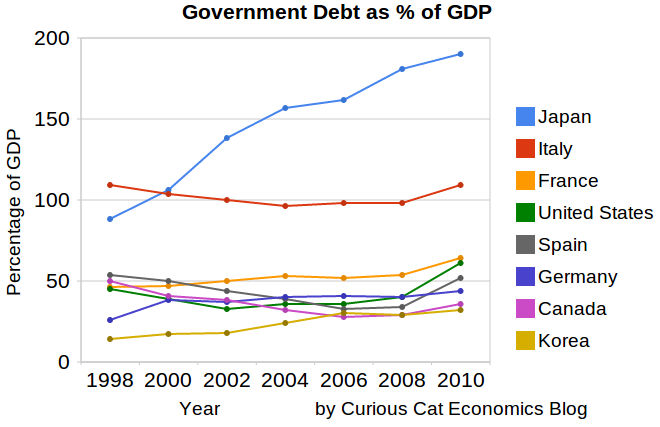
  • Government Debt as Percent of GDP 1998-2010 for OECD

    This chart shows government debt as a percent of GDP based on OECD data. The chart is limited to central government debt issuance and excludes therefore state and local government debt and social security funds.

    Economic data is always a bit tricky to understand. It makes some sense that excluding social security would reduce the USA debt percentage a bit. But these debt as a percentage of GDP are lower than other sources show. There are obviously many tricks that can be used to hide debt and my guess is the main thing going on with this data is OECD intentionally trying to make things look as good as possible.

    Still looking at historical trends in data is useful. And I believe looking at data from various sources is wise. There has been a dramatic increase from 2008-2010. The USA is up from 41% of GDP to 61%. Spain is up from 34% to 52% (but given all the concern with Spain this doesn’t seem to indicate the real debt problems they have.

    Japan and France don’t have 2010 data, so I used a rough estimate of my own based on 2009 data. Greece has been over 100% since 1998 and now stands at 148%, 2nd worst (to Japan) for any OECD country (Europe, North America, Japan and Korea), Italy is 3rd. Ireland is at 61% (up from 28% in 2008). The UK is at 86%, up from 61%.

    Related: Government Debt as Percentage of GDP 1990-2009: USA, Japan, Germany, China… (based on IMF data)Government Debt as Percentage of GDP 1990-2008Government Debt Compared to GDP 1990-2007Top 15 Manufacturing Countries in 2009

  • Inflation Shows Up in Huge Commodity Price Increases

    Gold and Silver at up dramatically in the last year. Food prices are up dramatically.

    The World Bank Development Prospects Group shows food price changes Q1 2010 to Q1 2011

    Increase
    Maize (corn) 74%
    Wheat 69%
    Soybeans 36%
    Beef 36%
    Rice -2%

    If food is 10% of your expenses and food overall has inflation of 30% that only increases your expenses 3%. If food is 50% of your income and goes up 30% that increases your expenses 15%. In the USA people spend about 10% disposable income on food (much of that though is really processing the food not the raw material). Spending in Japan on food is 19%, France 16%, China 33% and India 46%. 50% if what most of the people in the world spend. Those people are poor and don’t have the resources to pay more. This is why food prices are so critical. Governments fall from such rises in basic food prices. Also remember even in a country like the USA, where the average is 10% nearly 30% of people spend over 20% of disposable income on food. There are large variances not only between countries but within countries.

    What matter most is local food prices, but global food prices impact the prices in countries. Though many governments subsidize food prices – when food costs more than 30% of people’s income I think not doing so (when prices rise dramatically) would be crazy. When food costs 5% the government really doesn’t need to be involved.

    Inflation is a serious threat to economies in the next few years. Food inflation for non-rich countries is a huge problem now.

    Related: Food and Energy Costs July 2008Food Price Inflation is Quite HighYou Can Help Reduce Extreme PovertyCreating a World Without PovertyEthanol: Science Based Solution or Special Interest Welfare

    Food Price Watch by the World Bank
    (more…)

  • The USA Can’t Afford to Pay for the Current Health Care System

    The very frustrating aspect of the broken health care system in the USA is that it has been an enormous problem for decades. It isn’t that we have just discovered we have a fatally poor health care system in the last few years. The broken system has been obvious for decades and keeps getting worse. Thankfully in the last few years more and more of those with clout in the current economic system are standing up to demand improvement.

    Costs need to be removed from the system. Hundreds of billions a years should easily be removable by reducing paperwork and reducing waste in the system. As you say some reduction will also have to come in limiting spending that is being done now for worthwhile and worthless procedures. That should also easily save hundreds of billions a year. However in the decades of allowing this broken system to get worse and worse, it is not at all certain that merely taking $500 billion a year out of the costs will be enough.

    It might well require eliminating even more medical work and reducing the income of those that are taking from the system now. My guess is the most logical places for reducing income come from massively overpriced drugs, overpaid specialists, overpaid executives in insurance companies. I suppose some might think nurses should be paid less, that isn’t my belief, but we will see what happens.

    As sensible management of the system is adopted, over time, increasing the saving from eliminating waste should grow. Unfortunately we have wasted decades and so counting on us acting responsibly and adopting a focus on eliminating waste can’t be expected until we show a good 10-15 years of systemic effort on that front.

    In response to: Paying for health care

    Related: USA Spends Record $2.5 Trillion, $8,086 per person 17.6% of GDP on Health Care in 2009articles on improving the health care system in the USABroken Health Care System: Self-Employed InsuranceHealth Insurers Propose Pricing and Coverage Without Respect to Health

  • Apartment Vacancies Fall to Lowest in 3 Years in the USA

    Apartment Vacancies in U.S. Fall to Lowest in Almost Three Years

    The vacancy rate declined to 6.2 percent from 8 percent a year earlier and 6.6 percent in the fourth quarter of 2010, the New York-based research firm said in a report today. The rate was the lowest since it reached 6.1 percent in the second quarter of 2008.

    Effective rents, or what tenants actually pay, increased in 75 of the 82 markets Reis tracks, to an average $991 a month from $967 a year earlier and $986 in the fourth quarter. Landlords’ asking rents also climbed, to $1,047 from $1,027 a year earlier and $1,043 in the previous quarter, according to the report.

    San Jose, California, had the most growth in effective rents during the past year, with 5.2 percent, followed by suburban Virginia and New York City, according to Reis. Effective rents declined 1.5 percent in Las Vegas during the year and grew the least in Orlando, Florida; and Colorado Springs, Colorado.

    Rents have been slowly recovering the last year, after the economic shocks of the credit crisis. People, moved back into parents house and more people started sharing apartments and houses in the last few years as people where thrown out of jobs due to the after effects of the financial actions by large financial institutions. Slowly the economy has been recovering and jobs have been slowly growing and as a result the rental market has been strengthening .

    Also the decline in construction the last few years has decreased the normal addition to supply. At the same time the population has continued growing. Some areas of the country seem to still have a large overcapacity in housing but areas that are adding jobs (such as Northern Virginia and New York City) are seeing increasing rents.

    I have 2 properties for rent in Arlington, Virginia.

    Related: Landlords See Increase in Apartment Rentals (July 2010)USA Housing Inventory Puts Pressure on Prices (Sep 2010)Apartment Rents Rise, Slightly, for First Time in 5 Quarters (Apr 2010)It’s Now a Renter’s Market (Apr 2009)Housing Rents Falling in the USA (Feb 2009)

  • Executives Again Treating Corporate Treasuries as Their Money

    A huge problem with current practices at American companies is that senior executives believe they personally are due what the company earns. The repeated ethical lapses perpetrated by the senior executives and supported by their well paid board continues to undermine the economy of the country.

    Two events last week illustrate the level of disconnection with reality the current crop of ethically challenged senior executives.

    First, we have the senior executives at the too big to fail financial institutions that did fail and were bailed out by taxpayers. We all know the economic calamity caused by these executives, throwing millions of people out of work, adding huge burdens to already overburdened future taxpayers with the huge spending governments engaged in, in order to successfully avoid what would have been a depression. Fewer people realize the government has been systemically transferring money to these large, too big to fail financial institution from millions of savers with policies directly providing billions in profits to all the large financial institutions that had failed.

    So what did the senior executives that failed as spectacularly as anyone has ever failed economically in history do last week? They paid themselves tens of millions of dollars, paid for by all those who have received artificially lowered rates (through action by the Federal Reserve in order to save the economy and reward their member banks) on their savings which provided billions in profit to the failed large financial institutions. Just like 5 years ago, as they were doing their best to take such detrimental actions that would cause a depression (but for the government saving us from that outcome) they again use the excuse that they are just doing what all their colleagues are doing.

    The lack of honor of these men is amazing. And the lack of honor of those who continue to treat these people as anything but pariahs is amazing. That we continue to pursue policies that enable and enrich too big to fail financial companies on the backs of those that save and in so doing provide billions in profits for the executives to treat as their personal bank accounts is sad.

    The compatriots of those senior executives at Transocean showed the same disregard for honor, accuracy and truth. First, who is Transocean?

    A presidential commission concluded that the explosion [in the Gulf of Mexico last year] had been caused by cost-cutting and directly blamed Transocean, BP and Halliburton for the disaster.

    So with what was one of the worst (if not the worst) economic safety failures ever and 11 deaths in the explosion, this is what Transocean senior executives say, in their SEC filings:

    “Notwithstanding the tragic loss of life in the Gulf of Mexico, we achieved an exemplary statistical safety record as measured by our total recordable incident rate and total potential severity rate,” the report says.

    “As measured by these standards, we recorded the best year in safety performance in our company’s history, which is a reflection on our commitment to achieving an incident free environment, all the time, everywhere,” it adds.

    (more…)