Category: economy

  • USA Adds 216,00 Jobs in March and the Unemployment Rate Stands at 8.8%

    Nonfarm payroll employment increased by 216,000 in March, and the unemployment rate stands at 8.8%, the U.S. Bureau of Labor Statistics reported today. Revisions for January and February were very small (adding 5,000 jobs to the January totals and 2,000 to February). Since a recent low in February 2010, total payroll employment has grown by 1.5 million.

    This is more good news though the economy needs to add jobs more quickly to make a significant dent in the jobs lost since the misdeeds of large financial institutions precipitated the credit crisis and threw so many people out of work.

    Job gains occurred in professional and business services, health care, leisure and hospitality, and mining. Employment in manufacturing continued to trend up.

    Household Survey Data

    The number of unemployed persons (13.5 million) and the unemployment rate (8.8%) changed little in March. Since November 2010, the jobless rate has declined 100 basis points. Among the major worker groups, the unemployment rates are, for adult men, 8.6%; adult women, 7.7%; and for teenagers 24.5%.

    The number of long-term unemployed (those jobless for 27 weeks or more) was 6.1 million in March; their share of the unemployed increased from 43.9 to 45.5% over the month. In November of 2010 they accounted for 41.9% of the unemployed. In March of 2010 there were 6.5 million, which was 44.1% of all unemployed.

    In March, the civilian labor force participation rate held at 64.2%, which was down from 64.9% in March of 2010, and 65.8% in April of 2009.

    Related: Another 663,000 Jobs Lost in March, 2009Global manufacturing employment data 1979-2007Unemployment Rate Increased to 8.9% (May 2009)USA Added 162,000 Jobs in March, 2010

    Establishment Survey Data
    (more…)
  • Top Countries For Renewable Energy Capacity

    I believe it is wise from an environmental and economic viewpoint to invest in renewable energy projects. I believe the costs of fossil fuel based energy will continue to increase. Renewable energy is continuing to improve and when considering the negative externalities caused by oil, gas and coal and the continuing improvement in wind, solar and geothermal generation investment in renewable energy are going to payoff well for countries.

    Top countries for installed renewable energy capacity
    Rank Country Capacity (GigaWatts)
    1 China 103.4
    2 USA 58.0
    3 Germany 48.9
    4 Spain 27.8
    5 Japan 26.0
    6 India 18.7
    7 Italy 16.7
    8 Brazil 13.8
    9 France 9.6

    The largest increases in renewable energy capacity by country from 2005 to 2010 are: China (up 106%), South Korea (up 88%), Turkey (up 85%), Germany (up 67%), Italy and Japan (up 45%). All the data is from the Pew Clean Engery Program report: Who’s Winning the Clean Energy Race? (pdf).

    In 2010, [China] accounted for almost 50 percent of global clean energy superpower. The nation’s all manufacturing of solar modules and wind ascendance has been steady and steep. In turbines. China’s installation of less than 1 GW of 2005, China attracted less than $3 billion worth of private investments in clean energy. In 2009, solar energy capacity demonstrates that most of its production is for export markets. In contrast, 17 GW of wind energy was installed in China in 2010 helping the nation move quickly toward its 2020 target for installing 150 GW of wind. In fact, China accounted for 47 percent of all wind energy investments globally, with $45 billion tallied. Similarly, China led the world in asset financing, with $47.3 billion in private investments directed toward installation of clean energy generating capacity.

    India is poised to take a leadership role in the solar sector, with a target of deploying 20 GW by 2020. In 2010, the country set about getting its National Solar Mission in place by permitting 0.5 GW worth of large solar thermal capacity and a modest 150 MW worth of photovoltaic (PV) solar.

    My guess is that the stimulus packages in several countries contributed greatly to the increases (notably Germany and Italy targeted green investments – as did China to some extent, in Wind Energy). Spain took a hit as debt levels caused the government to cut spending. I would imagine this is likely to happen in Italy (and was expected to happen in Germany – the extent of decreases is less certain after the earthquake in Japan).

    Related: Chart of oil consumption by country from 1990-2009Wind Power Capacity Up 170% Worldwide from 2005-2009Japan to Add Personal Solar Subsidies (2008)Chart of Top Nuclear Power Generating Countries from 1985 to 2009Wind Power has the Potential to Produce 20% of Electricity Supply by 2030

    (more…)

  • Consumer and Real Estate Loan Delinquency Rates 2000-2010

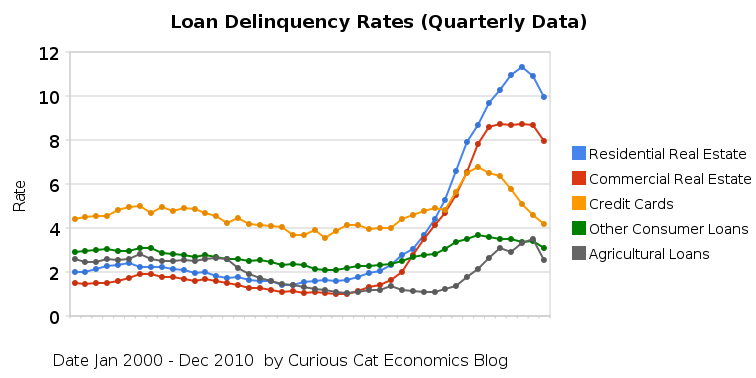
    The chart shows the total percent of delinquent loans by commercial banks in the USA.

    chart showing consumer and real estate loan delinquency rates from 2000 to 2010

    The second half of 2010 saw real estate, agricultural, credit card and other loan delinquencies decrease. The rates are still quite high but at least are moving in the right direction. Residential real estate delinquencies decreased 138 basis points in the second half of 2010, to 9.94%, which brought them to just below the rate at the end of 2009. In the second half of 2010, commercial real estate delinquencies decreased 77 basis points to 7.97% (which was also exactly 77 basis points less than at the end of 2009. Agricultural loan delinquencies decreased 76 basis points, to 2.55% (down 53 basis points from the end of 2009). Consumer loan delinquencies decreased, with credit card delinquencies down 90 basis points to 4.17% and other consumer loan delinquencies down 27 basis points to 3.1%. The credit card delinquency rate decreased a very impressive 219 basis points in 210.

    Related: Real Estate and Consumer Loan Delinquency Rates 2000 through June 2010Real Estate and Consumer Loan Delinquency Rates 1998-2009Bond Rates Remain Low, Little Change in Late 2009posts with charts showing economic data
    (more…)

  • Nuclear Power Production by Country from 1985-2009

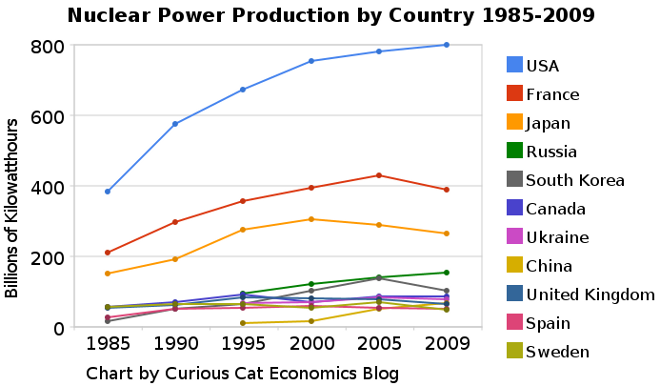
    chart of nuclear power production: 10 largest countries 1985-2009The chart shows the leading nuclear power producing countries from 1985-2009. The chart created by Curious Cat Investing and Economics Blog may be used with attribution. Data from US Department of Energy.
    ___________________

    Nuclear power provided 14% of the world’s electricity in 2009. Wind power capacity increased 170% Worldwide from 2005-2009, to a total of 2% of electricity used (38,025 Megawatts of capacity). The USA produced nearly twice as much electricity using nuclear power than any other country, which surprised me.

    Another view of data on nuclear power shows which of the leading nuclear producing countries have the largest percentages of their electrical generating capacity provided by nuclear power plants (as of 2009). France has 75% of all electricity generated from nuclear power. Ukraine had the second largest percentage at 49%, then Sweden at 37% and South Korea at 35%. Japan is at 28% compared to 20% for the USA (I am surprised these are so close _ would have thought France and Japan would be much closer). Russia is at 18% and China was at just 2%. As of January 2011, 29 countries worldwide are operating 442 nuclear reactors for electricity generation and 65 new nuclear plants are under construction in 15 countries. Source, Nuclear Energy Institute.

    From 1985 to 2009, USA production increased 108%, France 84% and Japan up 77%. South Korea is up 550% (from a very low starting point). Globally nuclear power production increased 80% from 1985 to 2009. From 2000-2009 production increased 5% in the USA and decreased by 1% in France and 13% in Japan. China was up 318% (from a very low level) from 2000-2009 (they did not have nuclear power capacity prior to 1995.

    The global capacity of nuclear power was scheduled to increase more rapidly in the future before the earthquake in Japan and the crisis at the Kashiwazaki-Kariwa Nuclear Power Plant. China was going to add a great deal of capacity and is likely to over the next few years (nuclear power plants take many year to bring online so those coming online in the next few years have already had hundreds of millions invested in building them). Several European countries have already announced temporary closing of some plants (especially some plants nearing the end of their originally scheduled lives – which those countries had been in the process of extending).

    As a comparison global oil production increased by 10.5% from 1999-2009, while nuclear global production increased by 5% from 2000-2009. From 1999-2009 USA oil production decreased 7%. Russia increased production 62% in the decade, moving it into first place ahead of Saudi Arabia that increased production 10%.

    Related: Oil Production by Country 1999-2009Oil Consumption by Country 1990-2009Japan to Add Personal Solar SubsidiesSolar Thermal in Desert, to Beat Coal by 2020

  • Oil Production by Country 1999-2009

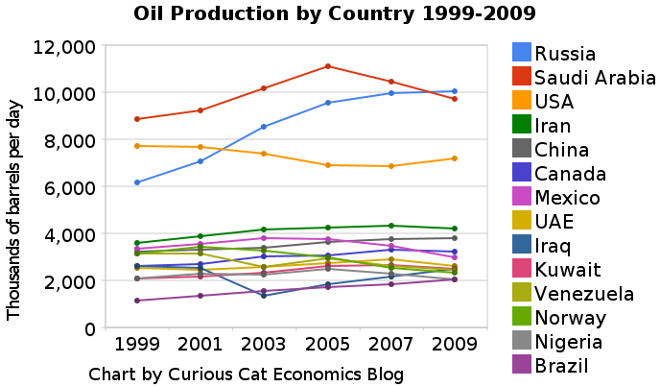
    The chart shows the oil production over the last decade by the top oil producing countries. Production totals include crude oil, shale oil, oil sands and NGLs (the liquid content of natural gas where this is recovered separately). Excludes liquid fuels from other sources such as biomass and coal derivatives.

    chart showing oil production by top producing countries (1999-2009)The chart shows the leading oil producing countries from 1999-2009. The chart created by Curious Cat Investing and Economics Blog may be used with attribution.

    ___________________
    The chart show 3 clear leaders in production Russia, Saudi Arabia and the USA (with the USA firmly in 3rd place). Those 3 were responsible for approximately a third of the total oil production in 2009. Russia greatly increased production. During the last decade world production increased from 72 million barrels a day to 80 million barrels a day. Russia accounted for 51% of the increase, close to 4 million barrels a day.

    The next 11 countries are pretty closely grouped, with slightly increasing production over the period as a group. Brazil, the last country with over 2 million barrels of production a day in 2009, has the largest percentage increase in the period, producing 79% more in 2009 than they did in 1999. Russia increase production 62% over the period. The other countries ranged from a 23% increase (Canada) to a 25% decrease (Norway). The USA increased production 7% and China increased production 18%. World production increased 11%.

    Last year I posted a chart showing oil consumption by the top oil consuming countries over the last 2 decades; showing all countries using over 2 million barrels of oil a day. The USA consumed 18.7 million barrels a day in 2009. Only China was also over 5 million barrels, using 8.2 million in 2009. Japan was next at 4.4 million.
    (more…)

  • USA Added 192,000 Jobs in February

    Nonfarm payroll employment increased by 192,000 in February, and the unemployment rate decreased to 8.9%, the U.S. Bureau of Labor Statistics reported today. Job gains occurred in manufacturing, construction, professional and business services, health care and transportation. Revisions also added 58,000 jobs added in the previous two months. The change in total nonfarm payroll employment for December was revised from +121,000 to +152,000, and the change for January was revised from +36,000 to +63,000.

    The job gains are good news, but job growth has to sustain gains over 175,000 a month for at least 6 months (and gains over 250,000 would be much better) to begin to make a serious dent in the millions of jobs lost in the recession (weather likely restrained January job growth that showed up in the February figures if you take the average for the 2 months you get a gain of 127,500 jobs a month). Since a recent low in February 2010, total payroll employment has grown by 1.3 million, or an average of 106,000 per month. Approximately 125,000 jobs have to be added just to keep up with growth in the population. Until we are consistently adding 230,000+ jobs a months the employment picture is not improving strongly enough given the large number of recent job losses. Adding over 150,000 jobs a month is good, but more is needed to provide jobs for the large number of unemployed.

    The number of long-term unemployed (those jobless for 27 weeks or more) was 6.0 million and accounted for 43.9% of the unemployed. Decreasing the number of long term unemployed is a key measure, as significant gains are made it is a sign pointing to better economic conditions.

    Manufacturing employment rose by 33,000 in February. Almost all of the gain occurred in durable goods industries, including machinery (+9,000) and fabricated metal products (+7,000). Manufacturing has added 195,000 jobs since its most recent trough in December 2009; durable goods manufacturing added 233,000 jobs during this period.

    Construction employment grew by 33,000 in February, following a decline of 22,000 in January that may have reflected severe winter weather. Within construction, specialty trade contractors accounted for the bulk of the February job gain (+28,000).

    Related: USA Economy Adds 151,000 Jobs in October 2010, and Revisions Add 110,000 MoreUSA Unemployment Rate Remains at 9.7% (Feb 2010)USA Unemployment Rate Rises to 8.1% (Feb 2009), Highest Level Since 1983
    (more…)

  • Curious Cat Investing and Economics Carnival #12

    Welcome to the Curious Cat Investing and Economics Carnival: find useful recent personal finance, investing and economics blog posts and articles.

    • The Myth of Japan’s ‘Lost Decades’ by Eamonn Fingleton – “Japan’s surplus is up more than five-fold since 1990. And, yes, far from falling against the dollar, the Japanese yen has actually boasted the strongest rise of any major currency in the last two decades. How can such facts be reconciled with the ‘two lost decades’ story? I don’t think they can.”
    • Investment Risk Matters Most as Part of a Portfolio, Rather than in Isolation by John Hunter – “It is not less risky to have your entire retirement in treasury bills than to have a portfolio of stocks, bonds, international stocks, treasury bills, REITs… This is because their are not just risk of an investment declining in value. There are inflation risks, taxation risks…” (including structural imbalances introduced by the Feb depressing short term yields to provide billions to large banks from the pockets of savers).
    • Cheating Investors As Official Government Policy by Daniel R. Amerman – “When you put your savings into a money market fund, and the policy of the US government is to force interest rates to unnaturally low levels – you are being cheated out of the yield you should be receiving. When you buy a corporate bond or corporate bond fund – you are being cheated by overt government market interventions that have the explicitly stated purpose of lowering corporate borrowing costs.”
    • Force Yourself to Save by – “Save 50% of any bonus or raise… Theoretically you could save 100% of your raise and maintain the same lifestyle, but that’s no fun. What’s the point of a raise if it doesn’t include a new PS3?” (I have long favored putting a portion of each raise toward a saving plan – John)
    • Who holds the most U.S. Treasuries in the world? (Hint: It’s not China.) by James Jubak – “For a while China was the biggest holder of U.S. government debt. But now with $896 billion China has slipped to No. 2. As of last week, the leader of the pack is—the envelope, please–the New York Fed, which holds the Federal Reserve’s Treasury bills, notes, bonds, and TIPs. (TIPS are Treasury Inflation Protected Securities.) As of last week the Fed’s System Open Market Account held $1,108 billion in U.S. government debt. “
    • 15 Things You Need to Do, Before Reading Another Financial Blog – “Set up a system to monitor your next goal – Now that you have a goal, set up a system to monitor your progress. I have Mint email monthly progress reports on my financial goals. Another way is track your goal is by doing a monthly review.”
    • How Much House Can You Afford? by Ryan Guina – “if your mortgage payment is expected to jump $500 a month, set that money aside for a few months as part of your normal budgeting. Do this for other spending categories that may increase, such as utilities, home owner’s insurance, taxes, etc.”
    • MERS: Stop Foreclosing in Our Name by Barry Ritholtz – “Allow me to spell this out for you more specifically: MERS is an abomination, a legal blasphemy that should be destroyed before it unleashes the four horsemen of the apocalypse.”

    Related: investing booksarticles on investingCurious Cat Investing and Economics Search

  • Manufacturers Coming Back to the USA

    An increasing number of news articles are reporting on the increasing strength of manufacturing in the USA (and globally, actually).

    Made (once again) in America

    NovaSom chose Zentech Manufacturing Inc. for two key reasons: Executives here could oversee quality control, and the kits could be shipped to domestic customers in just days, not weeks or months.

    After years of American companies shipping jobs and contracts overseas, some are choosing local manufacturers or even “re-shoring” – bringing those jobs and work back to the United States.

    One-fourth of more than 850 companies surveyed by MFG.com, a global online marketplace for manufacturers looking to source custom parts, returned work to North America from overseas in the last quarter of 2010.

    The “decrease” in manufacturing in the USA has been exaggerated as I written for year (manufacturing has grown steadily over the last few decades in the USA). It is true though manufacturing in some plants has moved overseas. Over the last few years more and more stories report on American companies moving manufacturing back to the USA that they had moved offshore previously.

    The Institute for Supply Management most recent survey reports a surge in US manufacturing to its highest reading in nearly seven years.

    Related: Manufacturing Cars in the USALeading Manufacturing Countries Globally (1980-2009) Global Manufacturing Employment Data – 1979 to 2007

    (more…)

  • Failing to Save for Retirement Has Consequences

    I have posted about the need to save money while you are working numerous times. Here is a good article looking at the large number of people that have failed to do so and are now retiring.

    Retiring Boomers Find 401(k) Plans Fall Short

    The median household headed by a person aged 60 to 62 with a 401(k) account has less than one-quarter of what is needed in that account to maintain its standard of living in retirement, according to data compiled by the Federal Reserve and analyzed by the Center for Retirement Research at Boston College for The Wall Street Journal.

    Vanguard long advised people to put 9% to 12% of their salaries—including the employer contribution—in their 401(k) plans. The current median amount that people contribute is 9%, counting the employer contribution, Vanguard says.

    Recently, Vanguard has begun urging people to contribute 12% to 15%, including the employer contribution, because of the stock market’s weak returns and uncertainty about the future of Social Security and Medicare.

    Experts estimate Social Security will provide as much as 40% of pre-retirement income, or $35,080 a year for that median family. That leaves $39,465 needed from other sources. Most 401(k) accounts don’t come close to making up that gap.

    The median 401(k) plan held $149,400, including plans from previous jobs, according to the Center for Retirement Research. To figure the annual income from that, analysts typically look at what the family would get from a fixed annuity. That $149,400 would generate just $9,073 a year for a couple, according to New York Life Insurance Co., the leading provider of such annuities— less than one-quarter of the $39,465 needed.

    Just 8% of households approaching retirement have the $636,673 or more in their 401(k)s that would be needed to generate $39,465 a year.

    Knowing exactly what is needed for retirement is difficult. But knowing what is a responsible amount is not. It is certainly no less than 8%, and is likely the 12-15% figure Vanguard recommends. If you start at 10% from the time you join the full time workforce (in your 20’s) then you have some flexibility you can see how thing look when you are 30, maybe 12% is sensible, maybe 15%, maybe 10%. If you fail to save for a decade however, you are likely to need to be at 15%, or higher.
    (more…)

  • USA Spends Record $2.5 Trillion, $8,086 per person 17.6% of GDP on Health Care in 2009

    U.S. health care spending increased yet again in 2009, increasing 4%. Total health expenditures reached $2.5 trillion, which translates to $8,086 per person or 17.6% of the nation’s Gross Domestic Product (GDP). This represents yet another record high percentage of GDP taken by health care – for decades, year after year, health care takes more and more of the economic resources of the country. The broken USA health care system costs twice as much as other rich countries for worse results. And those are just the direct accounting costs – not the costs of millions without preventative health care, sleepness nights worrying about caring for sick children without health coverage, millions of hours spent on completing forms to try and comply with the requirements of the health care system’s endless demand for paperwork, lives crippled by health care bankruptcies…

    Medicare spending grew 7.9% in 2009 to $502.3 billion. The senior citizen and health care lobbies have continued to increase spending on medicare. Too bad they can’t work on improvement instead of increased spending. Spending for fee-for-service (FFS) Medicare accelerated in 2009, increasing 5.5%. Medicare Advantage (MA) spending increased 15.8% in 2009 following 21.4% growth in 2008 and was primarily attributable to a continuation of significant increases in MA enrollment. Total Part D spending (which includes spending for benefits, government administration, and the net cost of health insurance) increased 9.3% to $54.5 billion in 2009.

    Medicaid (which is a line item for the cost of medical treatment for the un-insured, though far from the only cost): Total Medicaid spending grew 9.0% in 2009 to $373.9 billion was driven by a 7.4% increase in Medicaid enrollment. Federal Medicaid expenditures increased 22%, while state Medicaid expenditures declined 9.8%. This difference in growth is due to a significant increase in the Federal Medical Assistance Percentages (FMAP) used to determine federal Medicaid payments to states—a provision of the American Recovery and Reinvestment Act of 2009 (ARRA). Essentially the federal government funded the spending since the states were almost all out of money.

    Private Health Insurance: Private health insurance premiums grew 1.3% in 2009 (actually a pretty great figure by itself – unfortunately one lone good piece of data is not enough). Benefit payment growth increased 2.8% in 2009. These trends were heavily influenced by the recession, which resulted in private health insurance enrollment declines (which reminds you why looking at 1 piece of data isn’t a good idea). In 2009, spending for benefits increased faster than premiums, and as a result, the net cost of private health insurance (or the difference between premiums and benefits) fell to an 11.1% share of total private health insurance spending.

    The burden of the large costs of the health care system in the USA are financed by businesses (21%), households (28%), governments (44%), and other private sponsors [foundations, charities and the like] (7%).

    Read the complete National Health Expenditure Data report.

    Related: USA Spends Record $2.3 trillion ($7,681 Per Person) on Health Care in 2008USA Heath Care System Needs ReformResources to Help Improve the Health Care SystemCEOs Want Health-Care Reform