Category: Investing

  • Is the Stock Market Efficient?

    I believe in weak stock market efficiency. And recently the market is making me think it is weaker than I believed :-/ I believe that the market does a decent job of factoring in news and conditions but that the “wisdom of crowds” is far from perfect. There are plenty of valuing weaknesses that can lead to inefficient pricing and opportunities for gain. The simplest of those are spotted and then adopted by enough money that they become efficient and don’t allow significant gains.

    And a big problem for investors is that while I think there are plenty of inefficiencies to take advantage of finding them and investing successfully is quite hard. And so most that try do not succeed (do not get a return that justifies their time and risk – overall trying to take advantage of inefficiencies is likely to be more risky). Some Inefficiencies however seem to persist and allow low risk gains – such as investing in boring undervalued stocks. Read Ben Graham’s books for great investing ideas.

    There is also what seems like an increase in manipulation in the market. While it is bad that large organizations can manipulate the market they provide opportunities to those that step in after prices reflect manipulation (rather than efficient markets). It is seriously annoying when regulators allow manipulators to retroactively get out of bad trades (like when there was that huge flash crash and those engaging in high frequency “trading” front-running an manipulation in reality but not called that because it is illegal). Those that were smart enough to buy stocks those high frequency traders sold should have been able to profit from their smart decision. I definitely support a very small transaction tax for investment trades – it would raise revenue and serve reduce non-value added high frequency trading (which just seems to allow a few speculators to siphon of market gains through front running). I am fine with speculation within bounds – I don’t like markets where more than half of the trades are speculators instead of investors.

    Related: Market Inefficiencies and Efficient Market TheoryLazy Portfolios Seven-year Winning Streak – investing in stocksNaked Short Selling

  • Economic Consequences Flow from Failing to Follow Real Capitalist Model and Living Beyond Our Means

    The current frustration with economic conditions in the USA and Europe has at its core two main elements. First the anti-capitalist concentration of power in a few monopolistic and oligopolistic corporations (along with the support and encouragement of governments and the governments failure to regulate markets to encourage capitalist practices). And second the consequences of living beyond our means finally becoming much more challenging.

    What we have had has been very questionably capitalist. The largest reason for this “questionable” nature is not related to labor but instead to the inordinate power given to a limited number of large corporations. The corporations are suppose to not have “market power” in real capitalism. They have huge and growing market power. To me the main problem is that power disruption to the functioning of capitalist free markets.

    There is also the problem that we have been living far beyond our means. This has nothing to do with capitalism or not capitalism. It is as simple as you produce 100 units of goods and use 110 that can’t continue forever. The USA started building a surplus in the 1940’s, I imagine Europe did in the 1950’s. Since about the 1980’s both areas have been living far beyond their means. While they were consuming what they saved over the previous decades it wasn’t so bad. While they mortgaged their future to live lavishly today that was worse. We continue to live beyond our means and are beginning to see some consequences but we haven’t come close to accepting the lavish lifestyles we enjoyed (while Europe and the USA lived off past gains and off very advantageous trade with the rest of the world) is not possible any longer. We can’t just have everyone in Europe and the USA live exceeding well and the rest of the world support us. Eventually we have to realize this (or in any event we will experience it, even if we don’t realize it).

    Those 2 factors need to be addressed for our economic future to be as bright as it should be.

    Related: Too big too fail, too big to existUsing Capitalism in Mali to Create Better LivesCreating a World Without Poverty

  • The Economy is Weak and Prospects May be Grim, But Many Companies Have Rosy Prospects

    The fundamental truth right now is that the overall economy in Europe, the USA and Japan is weak and has some serious long term problems. But the connection between that and company weakness is not incredibly strong. Many companies have huge cash hoards, built up through the large profits they continue to make. Yes, the economy entering a serious downturn will hurt many companies. A railroad is going to lose some sales if retail sales decline (and so they don’t have to be shipped). Airlines (historically problematic companies to begin will) will struggle. Banks that pay exorbitant amounts to senior staff have trouble making money without handouts of taking huge risks that then result in more handouts once the risks fail (as usually a bad economy will expose the risks they have taken). Companies that can only do well based on large top line growth will suffer. But that isn’t all companies.

    When you look at companies like Google, Apple, Tesco, Danaher, Amazon even Toyota I really don’t see many problems looking forward. They seem perfectly capable of staying profitable, even growing profits, even in the face of economic decline in Europe, the USA and Japan (if that happens: it is possible, but not certain – very low growth is possible). Companies that have very good prospects at staying profitable, even getting more profitable going forward are hardly the type of investment I want to sell. Especially not to put it in the bank and get 0%, or a money market fund and pay someone for the privilege of having my money.

    The options for investing today don’t look so great. But I really don’t see any reason to be concerned about owning stocks that have good prospects to do well even if the quite a few large economies do poorly in the next decade. In fact I am happy to own them. Frankly the biggest worry I have is that the senior executives will loot the owners profits with exorbitant pay (this is not a worry at Toyota and less of one at Amazon). I would worry more about owning index funds in such an environment. But even as bad as things look now, I am not sure they will really turn out as bad as we fear – especially for many companies, for some yes, but many are well prepared for change).

    And the prospects in emerging markets look incredibly good to me. Yes they will slow their growth a bit if the large economies stall, but I think it is foolish to avoid investments in China, Singapore, Brazil, Korea, India, Ghana, Malaysia, Indonesia. In fact that is where companies like Google, Tesco, Apple, Toyota and Amazon are going to be making lots of money. Emerging markets are volatile and the companies in them are too. This will continue.
    (more…)

  • Ken Fisher Disputes Some Investing Tips

    His point on dollar cost averaging is sensible. Markets go up, more than down, overall [the statistically best approach] if you have a lump sum to invest the best strategy would be to invest it all now. There is added risk with this however, which he would accept. Also it doesn’t change the main reason people end up dollar cost averaging (by default, with retirement savings from each paycheck).

    over long time horizons bonds are actually riskier than stocks… [also] there are more rolling 3 year periods where bonds lose money than there are where stocks lose money.

    He discusses these ideas, and many more in his book: Debunkery: Learn It, Do It, and Profit from It-Seeing Through Wall Street’s Money-Killing Myths.

    Related: Curious Cat investment booksInvestment Risk Should be Evaluated as Part of a Portfolio, Rather than Risk of Each Individual InvestmentSave Some of Each Raise

  • Curious Cat Investing and Economic Carnival #14

    Welcome to the Curious Cat Investing and Economics Carnival: find useful recent personal finance, investing and economics blog posts and articles. If you want to have an post considered for the next carnival please submit it to quixperito: money.

    • A Retailer’s Perspective on Amazon’s Amazingly Awesome Quarter by Scot Wingo – “This quarter provided more mounting evidence that Amazon is essentially running away with market share in e-commerce. Consequently, we believe retailers urgently need to think of an Amazon Strategy – partner, compete, co-opetition? Amazon is becoming so big and growing so fast, you almost can’t afford not get on this train.”
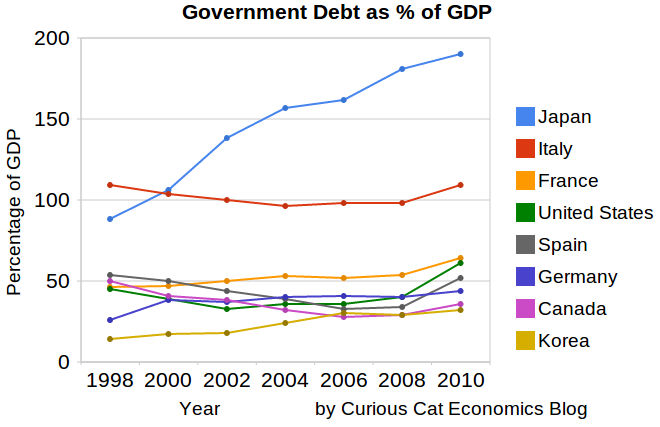
    • Government Debt as Percent of GDP 1998-2010 for OECD countries by John Hunter – There has been a dramatic increase from 2008-2010. The USA is up from 41% of GDP to 61%. Spain is up from 34% to 52% (but given all the concern with Spain this doesn’t seem to indicate the real debt problems they have. Economic data contains quite of bit of noise, unfortunately.

      graph of government debt for OECD countries from 1998-2010

    • Cause of Decline in U.S. Financial Position by Barry Ritholtz – “The Pew Center reported in April 2011 the cause of a $12.7 trillion shift in the debt situation, from a 2001 CBO forecast of $2.3 trillion cumulative surplus by 2011 versus the estimated $10.4 trillion public debt in 2011. The major drivers were:
      Revenue declines due to two recessions, separate from the Bush tax cuts of 2001 and 2003: 28%
      Defense spending increases: 15%
      Bush tax cuts of 2001 and 2003: 13%
      Increases in net interest: 11%
      Other non-defense spending: 10%
    • How This Blog Earns Full-Time Income from Part-Time Work by David Weliver – “for the most part, I’ve tried to focus on simply writing on topics that are unique, helpful, that answer specific questions. (It’s easy enough to be helpful, I think, but with billions of web pages out there, being unique is a never-ending challenge).”
    • How to live off investment income – 1. Set up a cash buffer account between your regular monthly spending, and your income-spewing engines. 2. Work out how much of your annual investment income you will/can spend. The rest of the money you will reinvest…
    • A Risky Investment Isn’t a Bad Investment by Kevin McKee – “If you want all the potential for Apple-esque gains, you need to be prepared to accept Enron-esque results. That’s the magic of risk; it goes both ways. Would I hold 100% of my portfolio in company stock? No.”
    • (more…)

  • Top USA Markets for Buying Rental Property

    Buying investments when prices are low is often a good investment strategy. Sometimes the prices just get lower, so it doesn’t always work. But, most likely the USA housing market will turn around, at some point. Buying real estate before prices start to rise may well be a very profitable investment. And rental property can be a very good investment, even without price appreciation, if the rental income provides a nice cash flow. This is especially true with interest rates so low (so a decent cash flow is very attractive compared to other investments). Of course, real estate investing also has challenges.

    The HomeVestors-Local Market Monitor Best Markets to Invest in Rental Property ranking forecasts the expected performance of rental real estate properties, specifically single-family homes maintained as rental properties. The rankings show the extra return, or risk-return premium, that an investor must demand from rental property in a local market. The risk-return premium can be added to the regular capitalization rate to produce a risk-adjusted cap rate at full occupancy for a local market. The ranking is calculated based on three-year forecasts of home prices (reflecting underlying home-price appreciation potential) and gross rents (as a proxy for potential investor cash flow). Of course, this is based on the creators expectation (and therefore hardly to be relied upon – they have no track record to measure against yet) but it is interesting.

    The Top 10 markets in the new ranking are:

    • Las Vegas, Nevada
    • Detroit, Michigan
    • Warren, Michigan
    • Orlando, Florida
    • Bakersfield, California
    • Tampa-St. Petersburg, Florida
    • Phoenix, Arizona
    • Ft. Lauderdale, Florida
    • Rochester, New York
    • Stockton, California

    Obviously their expectations favor cities that have seen drastic price declines. And that makes sense, as long as those cities rental markets are steady and housing prices stabilize.

    An interesting piece of data: HomeVestors and Local Market Monitor estimate that approximately 14% of single-family homes in the USA are maintained as rental properties.

    I do believe rental property investments in many markets in the USA may well be quite wise. Investing in rental properties is much more difficult than say stocks and has some high costs (if you chose to higher a property manager, for example). Real estate also requires a long term (5+ year commitments) to have reasonable expectations of successful investing results.

    Related: Apartment Vacancies Fall to Lowest in 3 Years in the USA (April 2011)Home Values and Rental RatesLandlords See Increase in Apartment Rentals (June 2010)

  • Movies About the Financial Crisis

    Although we usually write about investing advice, today we’re going to head in a slightly different direction and look at some entertaining films about the financial credit crisis. Hollywood was a bit slow, to get these movies released but now the movies on the crisis are coming quickly. Attempting to recover from the credit crisis is still dominating the economies of Europe and the USA.

    Gold has been performing quite well as the markets worry about the aftermath of the credit crisis and the large amount government debt in many rich countries. Movies can provide some distraction from the worries about whether we should avoid risks in of the the stock market at the moment, if it’s a good idea to invest in gold via bullionvault.com or whether BRIC countries might really be where the action is. Movies certainly will have their version of action.

    A popular movie about the financial crisis is ‘Inside Job’ (clip above). Directed by Charles Ferguson, who’d previously made the highly acclaimed ‘No End In Sight’ about the Iraq war, and given a voiceover by Matt Damon, the film won the Oscar for documentaries in 2011. It gained positive reviews all over the world for it’s simple explanations of a very complex topic.

    Meanwhile on the other side of the Atlantic ocean, British director David Sington made ‘The Flaw’. This flaw in question refers to the admission by Alan Greenspan (former Federal Reserve Chairman) that his model of how the world works did not match up to the weird and wonderful nature of reality. Greenspan admitted that had mistakenly put too much faith in the self-correcting power of free markets. The film has not been as widely reviewed as Inside Job, but The Economist said that while it is unbalanced, it is worth a watch.

    Wherever there is an obvious political point to be made, there is sure to be Oliver Stone not far behind yelling it out. ‘Wall Street: Money Never Sleeps’ stars young Shia LaBeouf as a Wall Street trader learning from the master: Gordon Gecko. The film even has a few cameos from figures from the financial world and is generally thought of as a good beginners guide to the crisis.

    Finally, two films currently in production that look at the crisis. Firstly, Paul Giamatti will be starring in the fictionalization of Andrew Sorkin’s best selling investigation into the crisis, Too Big To Fail. George Clooney is also reportedly getting in on the act with ‘700 Billion Man’, centred on Neel Kashkari, a one time Goldman Sachs executive who helped build the gigantic Troubled Asset Relief Program, aka the financial bailout.

    We can’t guarantee these films will be balanced, but they should be interesting. Enjoy.

  • 12 Stocks for 10 Years: July 2011 Update

    The 12 stock for 10 years portfolio consists of stocks I would be comfortable putting into an IRA for 10 years. The main criteria is for companies with a history of large positive cash flow, that seemed likely to continue that trend. I continue to be very satisfied with the portfolio and don’t see any reason for changes.

    The current Marketocracy* calculated annualized rate or return (which excludes Tesco) is 7.2% (the S&P 500 annualized return for the period is 4.7%). Marketocracy subtracts the equivalent of 2% of assets annually to simulate management fees – as though the portfolio were a mutual fund – so without that (it is not like this portfolio takes much management), the return beats the S&P 500 annual return by about 4.5% annually (it would be a bit less with Tesco, but still close to 4%, I would think).

    The current stocks, in order of return:

    Stock Current Return % of sleep well portfolio now % of the portfolio if I were buying today
    Amazon – AMZN 410% 11% 7%
    Google – GOOG 184% 16% 14%
    PetroChina – PTR 125% 8% 6%
    Templeton Dragon Fund – TDF 100% 9% 9%
    Templeton Emerging Market Fund – EMF 74% 6% 6%
    Danaher – DHR 47% 9% 10%
    Apple – AAPL 40% 6% 7%
    Toyota – TM 14% 10% 11%
    Intel – INTC 6% 5% 6%
    Tesco – TSCDY -3%** 0%* 10%
    Cisco – CSCO -15% 4% 5%
    Pfizer – PFE -17% 5% 7%

    The current marketocracy results can be seen on the Sleep Well marketocracy portfolio page.

    Related: 12 Stocks for 10 Years: Feb 2011 Update11 Stocks for 10 Years, July 2010 Update12 Stocks for 10 Years, July 2009 Updatehand picked articles on investing
    (more…)

  • Google up 13% on Great Earnings Announcement

    Google is up over 13% in after hours trading on the great earnings announced last night.

    We had a great quarter, with revenue up 32% year on year for a record breaking over $9 billion of revenue,’ said Larry Page, CEO of Google. “I’m super excited about the amazing response to Google+ which lets you share just like in real life.”

    That is the start of the earnings release. You can sure tell Larry Page is interested in Google+ success.

    More significantly, Google web site revenue up 39% increase over second quarter 2010 revenues of $4.50 billion. Google Network Revenues (Google’s partner sites, through AdSense programs), $2.48 billion, which was 28% of total revenues, in the second quarter of 2011 (up 20% from 2010 – good, but, Google up 39% on their own sites is amazing).

    GAAP earnings per share increased 35% compared to 2010. Margins did decrease, but not a huge amount: and less than many feared (Google continues to invest large amounts in future prospects).

    GAAP operating income in the second quarter of 2011 was $2.88 billion, or 32% of revenues. This compares to GAAP operating income of $2.37 billion, or 35% of revenues, in the second quarter of 2010.

    Those are great results anytime. When you remember that money in saving accounts get less than 1% now that type of growth is even more impressive. And when you consider how large Google is now it is even more impressive. Apple is achieving similarly impressive growth as a huge company – but it is very rare.

    Google ended the last quarter with over $39 billion in cash. I do think they should pay a dividend (I worry they will feel pressure to spend the cash they have and due to the large amount of cah make some foolish decisions). I continue to own Google stock. And it is the largest holding in my 12 stocks for 10 years portfolio.

    Related: Google’s Earnings Grow 17%, but Investors Unhappy (last quarter)Google Posts Good Earning But Not Good Enough for ManyGreat Google Earnings (March 2007)

  • Curious Cat Investing and Economics Carnival #13

    photo of house in green valley in Norway
    Photo of house in Norway, 1977 by Bill Hunter.

    The Curious Cat Investing and Economics Carnival has been published infrequently over the last few years. My plan is to start publishing it much more frequently starting now.

    • Personal Finance Basics: Long Term Disability Insurance by John Hunter – “people are much less aware of the importance of long term disability insurance. The census bureau estimates that you have a 20% chance you will be disabled in your lifetime.”
    • Fed’s Low Interest Rates Crack Retirees’ Nest Eggs by Mark Whitehouse – “A long spell of low interest rates has created a windfall worth billions to banks, mortgage borrowers and others it was designed to benefit. But for many people who were counting on their nest eggs, those same low rates can spell trouble.”
    • How to profit from the coming Greek default by Matthew Lynn – “Sell the U.S. banks but buy the dollar. If everyone knows Greece will have to default, what’s keeping them from pulling the plug? That’s easy. The Germans and the French won’t want to ‘re-profile’ all that Greek debt until they know their banks have largely sold both the debt and the credit-default swaps associated with it to someone else.”
    • Buy Cheap Bonds with Safe Spread by Bill Gross – “Investors shouldn’t give their money away, and at the moment, the duration component of a bond portfolio comes close to doing just that – not because a bear market is just around the corner come July 1, but because it doesn’t yield enough relative to inflation.”
    • How to retire with no savings – “Once you hit age 50, your chances of being jobless start to rise rapidly. You don’t get to choose when you retire. The job market or your ailing body will decide for you. Most retired Americans are getting by on incomes that you’d probably consider appropriate for the Third World. And even if they wanted to work until they died, they can’t.”
    • Words of wisdom from Warren Buffett’s legendary sidekick – “You have to be a lifelong learner to appreciate this stuff. We think of it as a moral duty. Increasing rationality and improving as much as you can no matter your age or experience is a moral duty. Too many people graduate from Wharton today and think they know how to do everything. It’s a considerable mistake.
    • (more…)