Category: Investing

  • 401(k) Options – Seek Low Expenses

    401(k), IRAs and 403(b) retirement accounts are a very smart way to invest in your future. The tax deferral is a huge benefit. And with Roth IRAs and Roth 401(k)s you can even get tax exempt distributions when you retire – which is a huge benefit. Especially if you don’t retire before the bill for all the delayed taxes of the last 20 years starts to be paid. The supposed “tax cuts” that merely shifted taxes from those spending money the last 10 years to those that have to pay for all the stuff the government spent on them has to be paid for. And that will likely happen with higher tax rates courtesy of the last 10 years of not paying the taxes to pay for what the government was spending.

    When looking at your 401(k) and 403(b) investment options be sure to pay close attention to expenses for the funds. Some fund families try to get people to investing in high expense funds, that are nearly identical to low expense funds. The investor losses big and the fund companies take big profits. Those people serving on the boards of those funds should be fired. They obviously are not managing with the investors interests at heart (as they are obligated to do – they are suppose to represent the investors in the funds not the friends they have making money off the investors).

    Here is an example (that I ran across last week) expense differences for funds that have essentially identical investment objectives and plans in the same retirement plan options: .39% (a respectable rate, though more than it really should be) for [seeks a favorable long-term rate of return from a diversified portfolio selected to track the overall market for common stocks publicly traded in the U.S., as represented by a broad stock market index.], .86% [for “The account seeks a favorable long-term total return, mainly from capital appreciation, by investing primarily in a portfolio of equity securities selected to track the overall U.S. equity markets based on a market index.”]. Do not rely on your fund provider to have your interests at heart (and unfortunately many companies don’t seek the best investment options for their employees either).

    The .47% added expense isn’t much to miss for 1 year. However, over the life of your retirement account, this is tens of thousands of dollars you will lose just with this one mistake. Personal financial literacy is an easy way to make yourself large amounts of money over the long term. It isn’t very sexy to get .47% extra every year but it is extremely rewarding.

    $200,000 at 6% for 25 years grows to $858,000
    $200,000 at 6.47% for 25 years grows to $958,000

    So in this case, $100,000 for you, instead of just paying the fund company a bit extra every year to let them add to their McMansions. In reality it will be much more than a $100,000 mistake for you if you save enough for retirement. But if you save far too little (as most people do) one advantage is the mistake will be less costly because your low retirement account value reduces the loss you will take.

    Related: 401(k)s are a Great Way to Save for RetirementRetirement Savings Allocation for 2010Many Retirees Face Prospect of Outliving Savings
    (more…)
  • Fixed Mortgage Rates Reach New Low

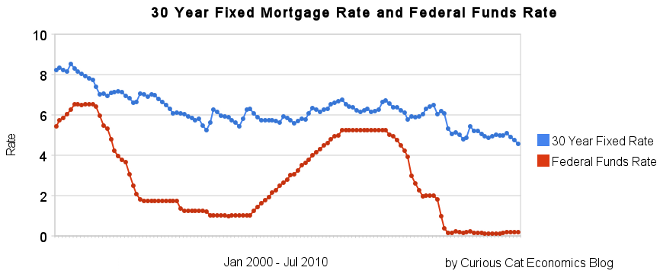
    30 year fixed mortgage rates have declined sharply recently to close to 4.5%.

    chart showing 30 year fixed mortgage rates: 2000 to July 2010

    If you are considering refinancing a mortgage now may well be a very good time. If you are not, you maybe should consider it. If so look to shorten the length. If you originally took out a 30 year mortgage and now have, for example, 24 years let, don’t add 6 years to your repayment term by getting a new 30 year mortgage. Instead, look to shorten your pay back period with a 20 year mortgage. The 20 year mortgage will have an even lower rate than the 30 year mortgage.

    If you plan on staying in the house, a fixed rate mortgage is definitely the better option, in my opinion. If you are going to move (and sell your hose) in a few years, an adjustable rate mortgage may make sense, but I would learn toward a fixed rate mortgage unless you are absolutely sure (because situations can change and you may decide you want to stay).

    The poor economy, unemployment rate still at 9.5%, has the Fed continuing massive intervention into the economy. The Fed is keeping the fed funds rate at close to 0%.

    If you are looking at a new real estate purchase, financing a 30 year mortgage sure is attractive at rates under to 4.5%.

    Related: historical comparison of 30 year fixed mortgage rates and the federal funds rate30 Year Fixed Mortgage Rates Remain Low (Dec 2009)Lowest 30 Year Fixed Mortgage Rates in 37 YearsWhat are mortgage definitions

    For more data, see graphs of the federal funds rate versus mortgage rates for 1980-1999. Source data: federal funds rates30 year mortgage rates

  • Curious Cat Investment Books

    cover image for Intelligent Investor by Ben Graham

    We have created a new and improvement Curious Cat Investment book site. Find great resources for your investing and personal finance needs. We have selected the best books by authors including: Benjamin Graham, Warren Buffett, John Bogle, Nicolas Darvas, Peter Lynch and William O’Neil.

    Try out our recommended picks.

    View the books by category including: investing, economics, retirement, real estate and personal finance.

    Related: Curious Cat investing articlesCurious Cat management booksTeaching Children About Money MattersBogle on the Retirement Crisis

  • More than half of the USA Federal Government Debt Held in USA Again

    U.S. Investors Regain Majority Holding of Treasuries

    For the first time since the start of the financial crisis in August 2007, U.S. investors own more Treasuries than foreign holders.

    Mutual funds, households and banks have boosted the domestic share of the $8.18 trillion in tradable U.S. debt to 50.2 percent as of May, according to the most recent Treasury Department data.

    The biggest jump in demand this year among domestic buyers of Treasuries has been commercial lenders. Bank holdings of Treasury and agency securities increased 5 percent to $1.57 trillion last month, according to the latest data available from the Fed.

    The Fed’s decision to hold its target for the overnight lending rate at a record low has made it possible for banks to borrow at near-zero interest rates to finance purchases of longer-term and higher-yielding Treasuries while lending less.

    I must say, unless you are getting special government interest free loans to invest in treasuries (like those that caused the credit crisis are) it seems crazy to me to invest at these low rates. In retirement, it probably does make sense to have some just as a diversification measure but other than that I would certainly reduce my holdings from what they would have been 10 years ago.

    If politicians or the fed would just give special favors to me to borrow billions and essentially 0% and then lend it back for more I would take that deal.

    But if I am not granted the welfare Chase, Goldman Sachs, Citibank and the rest are (with huge amounts of free money and bailouts if their bets fail) buying extremely low yield government debt is not an investment I want. I don’t think betting on deflation is not a bet I want to take. Inflation seems a bigger risk to me. But people get to make their own decisions, and we will see which investors are right.

    Related: Paying Back Direct Cash from Taxpayers Does not Excuse Bank MisdeedsCan Bankers Avoid Taking Responsibility Again?What the Financial Sector Did to Us

  • Consumers Continue to Slowly Reduce Their Debt Level

    Consumer debt decreased at an annual rate of 3.25% in the second quarter. Revolving credit (credit card debt) decreased at an annual rate of 9.5%, and nonrevolving credit (car loans…) was about unchanged.

    Revolving consumer debt now stands at $827 billion down $39 billion this year. That is on top of a $92 decline in 2009. Hopefully we can continue this success.

    Through June of 2010 total outstanding consumer debt was $2,419 billion, a decline of $30 billion ($21 billion of the decline was in the 2nd quarter). This still leaves over $8,000 in consumer debt for every person in the USA and $20,000 per family.

    Consumer debt grew by about $100 billion each year from 2004 through 2007. In 2009 consumer debt declined over $100 billion so far: from $2,561 billion to $2,449 billion.

    The huge amount of outstanding consumer and government debt remains a burden for the economy. At least some progress is being made to decrease consumer debt.

    Those living in USA have consumed far more than they have produced for decades. That is not sustainable. You don’t fix this problem by encouraging more spending and borrowing: either by the government or by consumers. The long term problem for the USA economy is that people have consuming more than they have been producing.

    Thankfully over the last year at least consumer debt has been declining, but it needs to decline more. I disagree with those that want to see short term improvement in the economy powered by consumer debt. It would be nice to see improvement to the current economy. But we can’t afford to achieve that with more debt. Government debt has been exploding so unfortunately that problem has continued to get worse.

    Data from the federal reserve.

    Related: Consumer Debt Declined a Record $21.5 Billion in JulyThe USA Economy Needs to Reduce Personal and Government Debt

  • Curious Cat Investing and Economics Carnival #9

    Welcome to the Curious Cat Investing and Economics Carnival: we highlight recent personal finance, investing and economics blog posts I found interesting.

    • “New Normal” math: How your investing plans must change – “I don’t think the implications of changing stocks’ rate of return from 10% to 5% have sunk in. We acknowledge that stock returns will be poor, and yet all of our retirement advice – save 10% of your income… withdraw 4% in retirement – stays the same.”
    • Manufacturing Output as a Percent of GDP by Country by John Hunter – “For the 14 biggest manufacturing countries in 2008, the overall manufacturing GDP percentage was 23.7% of GDP in 1980 and dropped to 17% in 2008… USA economy dropped from 21% in 1980 to 18% in 1990, 16% in 2000 and 13% in 2008.”
    • Masters of Earning More – “Ben actually loves his full-time job, but still freelances on the side. Earning more isn’t just for people who hate their job or are in severe credit-card debt. He freelances because he enjoys it.”
    • Five plays on the China Middle Class Explosion by Cody Willard – “The middle class in China now stands at nearly 25% of the population (which is 50 million new members a year!).”
    • Who Educates The Investors? by Bill Waddell – “Who would want to listen to the insights of someone concerning a manufacturing investment who knows so little about the current state of manufacturing that he thinks Toyota introduced lean to reduce working capital over a five year period?”
    • Refinance Now, If You Can by David Weliver – “If you currently owe $200,000 on your mortgage at 5.75%, refinancing could save you more than $100 a month on your payment and reduce the interest you pay over the life of the loan.” (rates are down a bit more since this example was posted – John)
    • A Cheap Internet Stock With High Dividend Yield – “stock offers an impressive 6.8% dividend yield and yet the stock only trades at 5x consensus 2011 earnings estimates.”
    • Personal Finance Basics: Avoid Debt by John Hunter – “Debt is often toxic to personal financial success. The simple step you can take to avoid the problems many face is to just not buy things until you save up for them. If you want some new shoes or new Droid Incredible or to go see a football game (American or World Cup style) that is fine. Just save up the money and then spend it.”

    Related: Curious Cat investing articlesCurious Cat Investing and Economics Custom Search EngineCurious Cat Investing and Economics Carnival #5

  • 10 million More Renters In the Next 5 Years

    Renter Nation by Gene Epstein

    From now through 2015, the long slog that will unfortunately characterize the economic expansion will bring slow growth in jobs and wages. That pace of improvement should be just strong enough to permit new households to form, but not robust enough for the members of those households to afford to own homes

    Demographics also will deal home sellers and builders a clear blow. Not surprisingly, the home-ownership rate tends to rise with age. For example, while the overall U.S. rate is 67.2%, the rate for households headed by someone under 35 is just 38.9%.

    Thus, whenever the age distribution of households tilts in favor of younger adults, the overall home-ownership rate declines.

    Largely because the echo boomers are more numerous than the baby busters, there are now more U.S. residents aged 15 to 29 than 30 to 44. So five years from now, the nation will have more 20-to-34-year-olds than 35-to-49-year-olds.

    Dallas-based Axiometrics tracks monthly price and occupancy data on apartments in 305 markets around the country. Its research chief, Jay Denton, reports that, on new leases written through this year’s first six months, effective rents—those after all concessions are taken into account—rose a robust 3.2%, after declining through 2009 and much of 2008. And occupancy growth, adds Denton, is close to the best he’s seen in the past 13 years.

    Related: articles on real estate investingReal Estate and Consumer Loan Delinquency Rates 1998-2009Apartment-vacancy Rate is 7.8%, a 23-year High (Nov 2009)

  • Landlords See Increase in Apartment Rentals

    Apartment Rentals Surge in U.S. on Foreclosures, Jobs

    The number of occupied apartments increased by 215,000 in the 64 largest U.S. markets in the first half, according to MPF Research. That’s almost double the units added in all of 2009 and the most since the firm began tracking the data in 1992. The vacancy rate declined to 6.6 percent last month from 8.2 percent in December.

    The Bloomberg REIT Apartment Index has gained 28 percent this year, double the 14 percent advance in the broader Bloomberg REIT Index.

    Finances for homeowners didn’t improve fast enough to prevent more than 1.65 million foreclosure filings in the first half, an increase of 8 percent from the same period in 2009, RealtyTrac Inc., a data company in Irvine, California, said July 15. A record 269,962 U.S. homes were seized from delinquent owners in the second quarter as lenders set a pace to claim more than 1 million properties by the end of 2010.

    The U.S. homeownership rate fell to 66.9 percent in the second quarter, the lowest since 1999, the U.S. Census Bureau said today. The rate peaked at 69.2 percent in the fourth quarter of 2004.

    Effective rents, or what tenants pay after concessions or breaks from landlords, increased 1.4 percent in the biggest markets in the first half, according to MPF Research. Rents may rise 4 percent to 6 percent in both 2011 and 2012, compared with a gain of about 2 percent this year, Willett said.

    Rentals are picking up partially due to the economy picking up allowing some who moved into their parents house to move back out. Also the continued numbers of people losing their houses increases the ranks of potential renters. The market is still absorbing many people reducing their housing footprint (people joining up with others to save on expenses). This is one of several important areas to watch (job growth is still probably the most important). As large numbers of apartment are rented and houses are rented or bought it is a strong indicator people are gaining some financial stability.

    Related: Apartment Rents Rise, Slightly, for First Time in 5 Quarters (April 2010)Apartment-vacancy Rate is 7.8%, a 23-year High (Nov 2009)Sales of New Homes Plunged in USA in May to Record Low

  • United Online: High Dividend Yield

    A Cheap Internet Stock With High Dividend Yield

    The internet stock offers an impressive 6.8% dividend yield and yet the stock only trades at 5x consensus 2011 earnings estimates.

    Bears will point out that United Online’s dial-up internet business is declining. No argument there, other than it is dying much, much more slowly than most prognosticators had expected. Dial-up also represents only 18% of UNTD’s revenues, so its importance is often overstated.

    The vast majority of UNTD’s revenues come from FTD. The floral retailer posted a 6% growth last quarter, while competitor 1-800 Flowers saw a decline of 6%. The company also operates Classmates.com. This forgotten social network generates $200M per year

    Finally, United Online generated nearly $50 million in free cash flow last quarter which was a 28% growth over the previous year. The company’s cash balances continue to grow (currently at $121M or $1.39 per share) and Wall Street expects the internet stock to earn $1.09 per share next year.

    The company also has a fairly large debt burden, $305 million in long term debt, and the current ratio (current assets/current debt) is .88 (which is not strong). Stocks paying high dividends in this market (low interest rates) are attractive but not without risk. United Online is certainly risky but the high yield sure is attractive. I do not own stock in United Online (I will watch it though).

    Related: Where to Invest for Yield (March 2010)S&P 500 Dividend Yield Tops Bond Yield: First Time Since 1958 (Nov 2008)More Companies Cutting Dividends Than Any Year Since Before 1954 (Feb 2009)10 Stocks for Income Investors (Dec 2008)

  • 11 Stocks for 10 Years – July 2010 Update

    I created the 10 stocks for 10 years portfolio in April of 2005. The current marketocracy* calculated annualized rate or return (which excludes Tesco) is 4.2% (the S&P 500 annualized return for the period is 1.1%) – marketocracy subtracts the equivalent of 2% of assets annually to simulate management fees – as though the portfolio were a mutual fund – so without that (it is not like this portfolio takes much management), the return beats the S&P 500 annual return by about 5.1% (it would be a bit less with Tesco – maybe beating the S&P 500 by 4%).

    The current stocks, in order of return:

    Stock Current Return % of sleep well portfolio now % of the portfolio if I were buying today
    Amazon – AMZN 241% 9% 8%
    Google – GOOG 127% 16% 15%
    PetroChina – PTR 80% 9% 8%
    Templeton Dragon Fund – TDF 76% 10% 10%
    Templeton Emerging Market Fund – EMF 41% 5% 6%
    Cisco – CSCO 21% 7% 8%
    Danaher – DHR 9% 9% 10%
    Toyota – TM -3% 8% 10%
    Intel – INTC -6% 5% 8%
    Tesco – TSCDY -9%** 0%* 10%
    Pfizer – PFE -42% 4% 8%
    Dell -60% 3% 0%

    The current marketocracy results can be seen on the Sleep Well marketocracy portfolio page.

    Related: 12 Stocks for 10 Years – July 2009 UpdateRetirement Savings Allocation for 2010Investing, My Thoughts at the End of 2009posts on stocksinvesting books
    (more…)