Category: Investing

  • 12 Stocks for 10 Years: Oct 2010 Update

    The 12 stock for 10 years portfolio consists of stocks I would be comfortable putting into an IRA for 10 years. My main criteria was companies with a history of large positive cash flow, that seemed likely to continue that trend.

    In the original portfolio I created in April of 2005, I included Dell. Apple was one of the stocks I was considering but I chose not to include it. That has turned out to be a very bad mistake (though even with that the annualized return for the portfolio is beating the S&P 6%). As I have said the last few updates, I was considering dropping Dell. Since the last update, Dell has been dropped and replaced with Apple. This is the first decision to drop an original selection (First Data restructured and so it was removed).

    The current marketocracy* calculated annualized rate or return (which excludes Tesco) is 6.8% (the S&P 500 annualized return for the period is 2.6%) – marketocracy subtracts the equivalent of 2% of assets annually to simulate management fees – as though the portfolio were a mutual fund – so without that (it is not like this portfolio takes much management), the return beats the S&P 500 annual return by about 6.2% (it would be a bit less with Tesco, but still close to 6%).

    The current stocks, in order of return:

    Stock Current Return % of sleep well portfolio now % of the portfolio if I were buying today
    Amazon – AMZN 330% 11% 7%
    Google – GOOG 184% 17% 15%
    PetroChina – PTR 102% 7% 6%
    Templeton Dragon Fund – TDF 100% 11% 10%
    Templeton Emerging Market Fund – EMF 76% 6% 6%
    Danaher – DHR 22% 9% 10%
    Cisco – CSCO 18% 6% 7%
    Apple – AAPL 12% 5% 6%
    Tesco – TSCDY -2%** 0%* 10%
    Toyota – TM -5% 7% 10%
    Intel – INTC -8% 5% 8%
    Pfizer – PFE -27% 5% 7%

    The current marketocracy results can be seen on the Sleep Well marketocracy portfolio page.

    Related: 11 Stocks for 10 Years, July 2010 Update12 Stocks for 10 Years, July 2009 UpdateRetirement Savings Allocation for 2010posts on stocksinvesting books
    (more…)

  • Selling Covered Call Options

    Options strike most as exotic investment transactions. And some option strategies can be risky. But stock options can also be used in ways that are not risky. Call options give you the right to buy a stock at a certain price (the strike price) on, or before, a certain date (the expiration date). So if you want to speculate that a stock will go up in a short period of time you can buy call options. This is a risky investment strategy – though it can pay off well if you speculate correctly.

    Someone has to sell the call option. The seller gives the buyer the right to buy a stock at a certain price by a certain date. A speculator can do this and take the risk that the price will not rise to the level where a person chooses to exerciser their option. The also carries a significant risk, as if the stock price rises the speculator that sold the option has to either buy the option back (at a significant cost) or provide the stock (which they would have to purchase on the market). In order to trade in options you must be approved by the broker (at least in the USA) as an investor with the knowledge, finances and goals for which options trading is appropriate.

    An investor can also sell an option to buy a stock they own – this is called selling a covered call option. This means you get the price the speculator is willing to pay to buy the option and may have to sell the stock you own if the person holding the option chooses to exercise it.

    Lets look at an example. Lets say you own some Amazon stock. (more…)

  • Curious Cat Investing and Economics Carnival #10

    Welcome to the Curious Cat Investing and Economics Carnival: find useful recent personal finance, investing and economics blog posts.

    • Global Aging – “Over time, low birth rates lead not only to fewer children, but also to fewer working-age people just as the percentage of dependent elders explodes. This means that as population aging runs its course, it might well go from stimulating the economy to depressing it. Fewer young adults means fewer people needing to purchase new homes, new furniture, and the like, as well as fewer people likely to take entrepreneurial risks. ” (The economic consequences of demographic changes are enormous. Investors often fail to appreciate how important they are – John)
    • Google: A Free Cash Flow Analysis by Peter Mycroft Psaras – “I learned this trick by analyzing Warren Buffett’s purchase of International Dairy Queen and noticed that many of the investments he was making then were low capital expenditure/ high free cash flow machines.”
    • Oil Consumption by Country 1990-2009 by John Hunter – “The USA consumed 18.7 million barrels a day in 2009. Only China was also over 5 million barrels, they reached 8.2 million in 2009. Japan is next at 4.4 million.”
    • 9 lazy portfolios for UK investors – “You don’t need to pay for black box analytics that spit out your fully personalized, mean variance optimised, risk calibrated portfolio. You can just keep things simple and do it yourself.”
    • Where corn prices go (and that’s UP), meat prices will follow by Jim Jubak – “But it is good news for farm incomes as higher prices for corn and other commodities push up revenues. That’s good news for the stocks of Mosaic (MOS) and Agrium (AGU) in the fertilizer group, seed companies Monsanto (MON) and Syngenta (SYT), and farm equipment makers Deere (DE) and AGCO (AGCO).”
    • Three Small Financial Tweaks You Should Make Before Winter by Mark Riddix – “At a minimum, try to increase your [retirement] contribution 1% every year. Although you shouldn’t miss 1% every time you add it, over time those small increases become 5% and 10%, which means a big long-term boost to your investments.”
    • How to Avoid Lifestyle Inflation by Ryan Guina – “Live beneath your means. An increase in income does not change the fact that living beneath your means is the single most important step in financial independence.”
    • How to keep yourself from retiring broke – ” According to the Center for Retirement Research, Americans, who are between 32 and 64 years old now, will be short about $90,000 on average to retire comfortably and ‘on time’.”
    • Yield Curve by Robert Wasilewski – “You’ll find today’s spread is historically steep… The spread is the compensation that investors get for taking on price risk for buying longer maturities. Bond investors constantly assess whether the additional yield, i.e. spread, compensates for the incremental risk.”
    • Asset Allocation In A Rising Interest Rate Environment by Gaétan Ruest – “Typically, a shorter term bond will be less impacted in a rising interest rate environment than a long term bond. But this is only true if the increase in the short term interest rates is the same as at the long term.”

    Related: investing booksarticles on investingCurious Cat Investing and Economics Search

  • More Kiva Entrepreneur Loans: Kenya, Honduras, Armenia…

    I made several more Kiva loans to entrepreneur in Kenya, Lebanon, Nicaragua, Kenya, Honduras and Armenia (brining my total loans to 251). It really is great to see real people using capitalism to improve their lives. And being able to help by lending some money is wonderful. When looking for loans I give preference to loans that improve productivity and increasing capacity of the entrepreneur. If they use the proceeds of the loan to increase their capacity to produce they can pay off the loan and find themselves much better off.

    photo of Douglas Osusu and posho grinding millsDouglas Osusu, Kisii, Kenya, in front of his posho mill (used for grinding maize into flour).
    A nice example of this is the loan to Douglas Osusu (pictured). He has requested this loan of 80,000 KES to purchase a dairy cow and a posho mill. This loan also has a portfolio yield (Kiva’s equivalent of an annual percentage rate) of 19%. 19% is very loan for loans on Kiva (remember there are significant costs to servicing micro-loans) – I like the rate to be under 30% but sometimes accept rates up to 40% (or even higher occasionally). I also give great preference to low rates, as the lower the rate the better for the entrepreneur. The 3rd factor I consider is the history of the field partner bank (default rate, delinquency rate and currency exchange loss rate). In this case the field partner is new and carries risk because of that. Still in this case I really like the loan and I like that this lender is charging low rates so I want to take the risk and see how they can do. The amount I lend is based on the combination of these factors – I lend more when I have several reasons to really like the loan.

    Join other readers by making loans and joining the Curious Cats Lending Team: 8 members, 213 loans totaling $8,775. Comment with the link to your Kiva page and I will add a link on Curious Cat Kivans.

    My current default rate is 1.39% and the delinquency rate is 8.49% (see chart of USA general delinquency rates). The delinquency rate is exaggerated due to technical details (some difficulties in reporting in various countries and such things). Agricultural loans often become delinquent on Kiva but still are paid in full (in my experience). While the defaulted loan rate is 1.39% if you look at the percent of dollars lost I have a rate of 1.2% (this is nearly all due to a bank that failed over a year ago to which I had 2 loans where I lost $87.50 of $100 – there are also 2 other losses for under $5). I add to my total loan amount a couple times a year but also I get to keep relending as money is paid back.

    Some of my favorite ways to help reduce extreme poverty are Trickle Up, Kiva and using Global Giving to find small organizations.

    Related: 100th Entrepreneur LoanMore Kiva Entrepreneur Loans: Kenya, El Salvador (June 2010)Kiva Opens to USA Entrepreneur LoansMicroFinance Currency Risk – Kiva Fellows Blog: Nepalese Entrepreneur Success

  • Homes for Half Price to Teachers, Law Enforcement and Emergency Workers

    Law enforcement officers, pre-Kindergarten through 12th grade teachers and firefighters/emergency medical technicians can contribute to community revitalization while becoming homeowners through HUD’s Good Neighbor Next Door Sales Program. HUD (United States Department of Housing and Urban Development) offers a substantial incentive in the form of a discount of 50% from the list price of the home. In return you must commit to live in the property for 36 months as your sole residence.

    Eligible Single Family homes located in revitalization areas (there are hundreds of revitalization areas across the country. HUD is always working with localities to designate new areas) are listed exclusively for sales through the Good Neighbor Next Door Sales program. Properties are available for purchase through the program for five days.

    Check the listings for your state. Follow the instructions to submit your interest in purchasing a specific home. If more than one person submits on a single home a selection will be made by random lottery. You must meet the requirements for a law enforcement officer, teacher, firefighter or emergency medical technician and comply with HUD’s regulations for the program.

    HUD requires that you sign a second mortgage and note for the discount amount. No interest or payments are required on this “silent second” provided that you fulfill the three-year occupancy requirement.

    Related: Fixed Mortgage Rates Reach New LowYour Home as an Investmentarticles on home ownership

  • Current Mortgage Refinance Options

    I am looking at mortgage refinance options now (with rates being so low). I am looking at 20 year fixed rate loans with cash out (with over 20% down). The 20 year term will reduce my loan term a bit, and the final monthly cost should actually be not much higher than my current payment (with taking some cash out), I think. Do any readers have opinions on these lenders (or others with competitive offers – low rates and low expenses)?

    Total Mortgage – 20 year fixed rate 3.875%, total fees and points not provided :-(, apr 4.15%

    American United Mortgage – 20 year fixed rate 4% [same as 30 year rate :-(], fees $2,995 (0 points), apr 4.26%

    Aim Loan – 20 year fixed rate 3.875%, fees (about $4,100 I think), apr 4.02%

    These are some of the best deals I have been able to find. However, companies can play games with fees and hide excessive costs in requirements they don’t consider fees (appraisal costs…). Rates can bounce around for a specific lender, so I think it make sense to watch several (not just pick out he lowest one on whatever date you first look).

    Suggestions on how to tell whether specific lenders good faith estimates are accurate and comparable would be especially appreciated.
    Edits:
    RoundPoint – looks good, low rates, low fees, good reviews on Zillow.
    Amerisave – 20 year fixed rate 3.75%, total fees and points $3,418, apr 3.87% (removed as an option – they don’t respond to customer have tons of negative reviews online about problems, poor service, etc.

    Related: Fixed Mortgage Rates Reach New LowLow Mortgage Rates Not Available to Everyone30 Year Fixed Mortgage Rates and the Fed Funds RateMortgage terms

  • USA Housing Inventory Puts Pressure on Prices

    U.S. Home Prices Face Three-Year Drop as Supply Gains

    The slide in U.S. home prices may have another three years to go as sellers add as many as 12 million more properties to the market. Shadow inventory — the supply of homes in default or foreclosure that may be offered for sale — is preventing prices from bottoming after a 28 percent plunge from 2006, according to analysts from Moody’s Analytics Inc., Fannie Mae, Morgan Stanley and Barclays Plc.

    Sales of new and existing homes fell to the lowest levels on record in July as a federal tax credit for buyers expired and U.S. unemployment remained near a 26-year high.

    There were 4 million homes listed with brokers for sale as of July. It would take a record 12.5 months for those properties to be sold at that month’s sales pace, according to the Chicago- based Realtors group.

    In addition to the as many as 8 million properties vacant or in foreclosure, owners of another 3.8 million homes — 5 percent of U.S. households — said they are “very likely” to put their properties on the market within six months if there is improvement, according to a survey by Seattle-based Zillow.

    Owners of about 11 million homes, or 23 percent of households with a mortgage, owed more than their property was worth as of June 30, according to CoreLogic. Another 2.4 million borrowers had less than 5 percent equity in their houses and probably would lose money on a sale after paying broker fees and closing costs, CoreLogic said Aug 25.

    The shadow inventory, poor job market and low net home equity positions continue to put a huge amount of pressure on the housing market. Very low interest rates help support the market but not much else does. In some locations the rental market is starting to help. But the tightening of credit standards is reducing the pool of potential buyers. While it is a good thing (because credit standards were far too loose) it still will extend the duration of a bear housing market.

    I would be looking to buy now, if I didn’t own a house already (and was planning on staying long term).

    Related: Real Estate and Consumer Loan Delinquency Rates 2000-201010 million More Renters In the Next 5 YearsThe Value of Home OwnershipNearly 10% of Mortgages Delinquent or in Foreclosure (Dec 2008)

  • Buffett Does’t See Double-Dip Recession for USA

    Buffett Rules Out Double-Dip Recession Amid Growth

    “We will not have a double-dip recession at all. I see our businesses coming back almost across the board.”

    “I’ve seen sentiment turn sour in the last three months or so, generally in the media,” Buffett said. “I don’t see that in our businesses. I see we’re employing more people than a month ago, two months ago.”

    [GE CEO] Immelt said. “We need people to be able to feel like they’re going to get loans, the process is going to work and that they understand the rules,” Immelt said. Signs across the world show growth improving as evidenced by a rise in GE’s orders

    Related: Warren Buffet Webcast to MBAsGlobal Economy Prospects Look Good But Also at Risk (June 2010)Auto Manufacturing in 2009: USA 5.7 million, Japan 7.9 million, China 13.8 million

  • Earnings and Dividends Grow, Bond Yields Sink

    Dividends Beating Bond Yields by Most in 15 Years

    More U.S. stocks are paying dividends that exceed bond yields than any time in at least 15 years as profits rise at the fastest pace in two decades.

    Kraft Foods Inc. and DuPont Co. are among 68 companies in the Standard & Poor’s 500 Index with payouts that top the 3.78 percent average rate in credit markets, based on data since 1995 compiled by Bloomberg and Bank of America Corp. While Johnson & Johnson sold 10-year debt at a record low interest rate of 2.95 percent last month, shares of the world’s largest health products maker pay 3.66 percent.

    The combination of record-low interest rates, potential profit growth of 36 percent this year and a slowing economy has forced investors into the relative value reversal. For John Carey of Pioneer Investment Management and Federated Investors Inc.’s Linda Duessel, whose firms oversee $566 billion, it means stocks are cheap after companies raised payouts by 6.8 percent in the second quarter

    S&P 500 companies’ cash probably has grown to a record for a seventh straight quarter, according to S&P. For companies that reported so far, balances increased to $824.8 billion in the period ended June 30 from the first three months of the year, based on data from the New York-based firm.

    Cash represents 10.2 percent of total assets at S&P 500 companies, excluding banks and financial firms, according to data compiled by Bloomberg. That’s higher than the 9.5 percent at the end of the second quarter last year, 8.4 percent in 2008 and 7.95 percent in 2007.

    “The economy is slowing down, but productivity has been so great in this country and companies have been able to make good profits,”

    10-year Treasury note yields were as low as 2.42% last month. The combination of continued extraordinarily low interest rates and good earnings increase this odd situation where dividends increase and interest yields fall. Extremely low yields aimed at by the Fed continue to aid banks and those that caused the credit crisis a huge deal and harm investors.

    Money markets and bonds are not attractive places to invest now. Putting money in those places is still necessary for diversification (and as a safety net – especially in cases like 401-k plans where options are often very limited). Seeking out solid companies with strong long term prospects that pay reasonable dividends is a very sensible strategy today.

    Related: Where to Invest for Yield TodayS&P 500 Dividend Yield Tops Bond Yield: First Time Since 195810 Stocks for Income InvestorsBond Yields Show Dramatic Increase in Investor Confidence (Aug 2009)

  • Real Estate and Consumer Loan Delinquency Rates 2000-2010

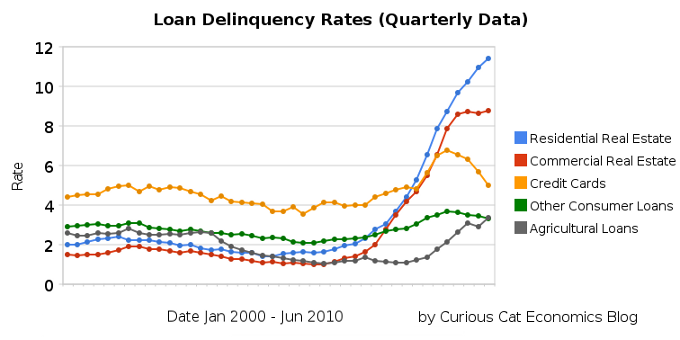
    The chart shows the total percent of delinquent loans by commercial banks in the USA.

    chart showing loan delinquency rates 2000-2010

    The first half of 2010 saw residential real estate delinquencies continue to increase and other consumer loan delinquencies decreasing (both trends continue those of the last half of 2009). Residential real estate delinquencies increased 118 basis points to 11.4%. Commercial real estate delinquencies increased just 7 basis points to 8.79%. Agricultural loan delinquencies also increased (25 basis points) though to just 3.35%. Consumer loan delinquencies decreased, with credit card delinquencies down 131 basis points to 5.01% and other consumer loan delinquencies down 15 basis points to 3.34%.

    Related: Real Estate and Consumer Loan Delinquency Rates 1998-2009Bond Rates Remain Low, Little Change in Late 2009Government Debt as Percentage of GDP 1990-2008 – USA, Japan, Germany…posts with charts showing economic data
    (more…)