Tag: Economics

  • Leading Economic Freedom: Hong Kong, Singapore, New Zealand, Switzerland

    Hong Kong again topped the rankings, followed by Singapore, New Zealand, and Switzerland. Australia and Canada tied for fifth, of the 144 countries and territories in the Fraiser Institute’s 2012 Economic Freedom of the World Report.

    “The United States, like many nations, embraced heavy-handed regulation and extensive over-spending in response to the global recession and debt crises. Consequently, its level of economic freedom has dropped,” said Fred McMahon, Fraser Institute vice-president of international policy research.

    The annual Economic Freedom of the World report uses 42 distinct variables to create an index ranking countries around the world based on policies that encourage economic freedom. The cornerstones of economic freedom are personal choice, voluntary exchange, freedom to compete, and security of private property. Economic freedom is measured in five different areas: (1) size of government, (2) legal structure and security of property rights, (3) access to sound money, (4) freedom to trade internationally, and (5) regulation of credit, labor, and business.

    Hong Kong offers the highest level of economic freedom worldwide, with a score of 8.90 out of 10, followed by Singapore (8.69), New Zealand (8.36), Switzerland (8.24), Australia and Canada (each 7.97), Bahrain (7.94), Mauritius (7.90), Finland (7.88), Chile (7.84).

    The rankings and scores of other large economies include: United States (18th), Japan (20th), Germany (31st), South Korea (37th), France (47th), Italy (83rd), Mexico (91st), Russia (95th), Brazil (105th), China (107th), and India (111th).

    When looking at the changes over the past decade, some African and formerly Communist nations have shown the largest increases in economic freedom worldwide: Rwanda (44th this year, compared to 106th in 2000), Ghana (53rd, up from 101st), Romania (42nd, up from 110th), Bulgaria (47th, up from 108th), and Albania (32nd, up from 77th). During that same period the USA has dropped from 2nd to 19th.

    The rankings are similar to the World Bank Rankings of easiest countries in which to do business. But they are not identical, the USA is still hanging in the top 5 in that ranking. The BRICs (Brazil, Russia, India and China) do just as poorly in both. The ranking due show the real situation of economies that are far from working well in those countries. China and Brazil, especially, have made some great strides when you look at increasing GDP and growing the economy. But there are substantial structural changes needed. India is suffering greatly from serious failures to improve basic economic fundamentals (infrastructure, universal education, eliminating petty corruption [China has serious problems with this also]…).


    (more…)

  • US Treasury Yield Fall to New Record Low

    Us treasury yield hit a incredibly low level years ago and they have continued to fall further. Granted this is mainly due to the bailout of the economy necessitated by the politicians favors to the too-big-too-fail financial institutions that have given those politicians so much cash over the years. Other factors are at play but the extent of the excessive punishment of savers is mainly due to political bailouts of bankers and bailouts of the economy caused by the bankers actions.

    This extremely low rate environment is crippling to many retirees. The small percentage that actually did what they were told to have been blindsided by years of artificially low rates (and it is likely to continue for years). This has pushed some that would have been comfortable in retirement into an uncomfortable one an has pushed some from a challenging balancing act to essentially having to eliminate every possible expense (and even that may not be enough).

    I can’t believe long term bonds are a sensible investment now. Of course I haven’t thought they were for 10 years, but they are even worse now. Bonds of “strong” governments (USA, Germany, Japan) are paying less than inflation (sometimes even less than 0 nominally – I think this has just been for short term issues so far).

    I cannot see putting more than token amounts into long term bonds at these rates. Corporate bonds are not much better. The economic damaged caused by out of control too-big-too-fail institution is huge and continuing. And the politicians that have been paid lots of cash by those too-big-too-fail institutions continue to treat the too-big-too-fail players are favored friends. The yields are corporate bonds are not good for companies that are strong.

    The alternatives are not great. But real assets, strong dividend stocks, strong company stocks, and short term bonds seem like better options to me in many cases. And hope we elect people that will put the economic interest of the country ahead of a few well paid friends at too-big-too-fail institution. They also need to eliminate the captured “regulators” that have facilitated the continued wrecking of the global economy. I don’t hold out much hope for this though. We keep re-electing those given lots of cash by the too-big-too-fail crowd and they continue giving them favors. We are getting what we deserve given this poor performance on our part but it is pretty annoying having to watch us vote ourselves into economic calamity.

    Related: Buffett Cautions Against Buying Long Term USD BondsIs Adding More Banker and Politician Bailouts the Answer?Bill Gross Warns Bond InvestorsCongress Eases Bank Laws (1999)

  • Curious Cat Investing, Economics and Personal Finance Carnival #35

    The Curious Cat Investing, Economics and Personal Finance Carnival is published twice each month with links to new, related, interesting content online. Also see related books and articles.

    • A Nation of Public Housing by Neal Peirce – “One government agency manages 80 percent of the housing stock — all called public housing. It checks your age and whether you’re married to decide whether and when you’re eligible for an apartment.” Racial quotas are used, unmarried people can’t apply until they turn 35. Any guess on what country this is? The same country is ranked as the easiest, or close to it, country run business in the world.
    • China’s end game:the dark side of a great deleveraging by Dee Woo – “The dilemma is that business entities will need more and more credit to achieve the same economic result, therefore will be more and more leveraged, less and less able to service the debt, more and more prone to insolvency and bankruptcy. It will reach a turning point when the increasing number of insolvencies and bankruptcies initiate an accelerating downward spiral for underling assets prices and drive up the non-performing loan ratio for the banks. And then the over-stretched banking system will implode. A full blown economic crisis will come in full force. The chain of reaction is clearly set in the motion now.

      The biggest problem for China is the state, central enterprises and crony capitalists wield too much power over national economy, have too much monopoly power over wealth creation and income distribution, and much of the GDP growth and vested interest groups’ economic progress are made on the expanse of average consumers stuck in deteriorating relative poverty.”
    • Challenges faced by middle-class L.A. families by Meg Sullivan – “Managing the volume of possessions was such a crushing problem in many homes that it actually elevated levels of stress hormones for mothers. Only 25 percent of garages could be used to store cars because they were so packed with stuff.” (read the book: Life at Home in the Twenty-First Century)
    • USA Social Security Disability Insurance (SSDI) by John Hunter – Benefits have a maximum of $2,346/month (in 2011). The average benefit payment now is $1,111. More than 8.7 million people are received disability benefits currently (partially disabilities are not eligible for SSDI.
    • (more…)

  • Working Less: Better Lives and Less Unemployment

    The average worker in Germany and the Netherlands puts in 20% fewer hours in a year than the average worker in the United States. This means that if the US adopted Germany’s work patterns tomorrow, it would immediately eliminate unemployment.

    I do think there is merit to reducing yearly hours worked in the USA. The problem is this is all within a larger system. The USA’s broken health care system makes it extremely expensive to hire workers. One way to deal with the health care system failure is maximizing hours worked to spread out the massively expensive USA health care costs.

    Also the USA standard of living is partially based on long hours (it is but one factor). We also have to work quite a few hours (about 5% of the total hours) to just bring us equal with other rich countries, in order to pay for our broken health care system.

    Still reducing our purchases by cutting out some fancy coffee, a few pairs or shoes, a few cable channels (or all of them), text messages from overcharging phone companies… in order to have a couple more weeks of vacation would be a great tradeoff in my opinion. And one I have made with my career.

    I have changed to part time in 2 of my full time jobs (to make my own sensible yearly hour model even if the bigger system can’t. Another time I bargained for more vacation time over more $. It isn’t easy to do though, most organizations are not willing to think and accommodate employees (hard to believe they respect people in this case, right?). The system is not setup to allow people to adjust total hours to maximize their well being.

    Another option in the USA is to live within your means and then make your own sabbaticals during your career. Take a year off and travel the world, or hike the Appalachian Trail, or read trashy novels, or whatever you want.

    Related: Medieval Peasants had More Vacation Time Than We DoDream More, Work LessVacation: Systems Thinking

  • Curious Cat Investing, Economics and Personal Finance Carnival #33

    Welcome to the Curious Cat Investing, Economics and Personal Finance Carnival. The carnival is published twice each month with links to new, related, interesting content online. Greece just voted for the party that wants to attempt to keep Greece in the Eurozone. We will see how that works. I don’t think the odds are great unless Greece is willing to substantially change their recent (last few decades) running of their economy.

    • Big Investors Don’t Know Where to Put Their Cash by Sven Böll and Martin Hesse – “‘In the past, we searched for risk-free returns.’ He pauses for effect. ‘Today we know that what we mainly have are investments with return-free risk.’… Corporate bonds and the sovereign debt of emerging economies, once something for the intrepid, are suddenly seen as safe havens.”
    • Are More Bailouts to Banker and Politicians the Answer to the Credit Crisis Aftermath? by John Hunter – “It feels to me similar to a situation where I have maxed out 8 credit cards and have a little bit left on my 9th. You can say that failing to approve my 10th credit card will lead to immediate pain. Not just to me, but all those I owe money to. That is true. But wasn’t the time to intervene likely when I maxed out my 2nd credit card and get me to change my behavior of living beyond my means then?”
    • my parents in front of the Acropolis in Athens, Greece
      My parents in front of the Acropolis in Athens, Greece. Photo by John Hunter, see more of my photos.
    • The Great Recession is changing our behavior–in ways that point to slower growth for a longer period of time by Jim Jubak – “The third, most powerful in its effects and the least obvious, is the way that the Great Recession has undermined existing belief in financial security. That decline in real and perceived security is likely to change where people put their money, what kinds of returns they think they can count on, and, therefore, how much money they think they can spend and how much they have to put away.”
    • A Global Perfect Storm by Nouriel Roubini – “To prevent a disorderly outcome in the eurozone, today’s fiscal austerity should be much more gradual, a growth compact should complement the EU’s new fiscal compact, and a fiscal union with debt mutualization (Eurobonds) should be implemented. In addition, a full banking union, starting with eurozone-wide deposit insurance, should be initiated, and moves toward greater political integration must be considered, even as Greece leaves the eurozone.
      CommentsUnfortunately, Germany resists all of these key policy measures…”
    • (more…)

  • Is Adding More Banker and Politician Bailouts the Answer?

    When critics say that Europe is running out of time to deal with the financial crisis I wonder if they are not years too late. Both in Europe responding and those saying it is too late.

    It feels to me similar to a situation where I have maxed out 8 credit cards and have a little bit left on my 9th. You can say that failing to approve my 10th credit card will lead to immediate pain. Not just to me, but all those I owe money to. That is true.

    But wasn’t the time to intervene likely when I maxed out my 2nd credit card and get me to change my behavior of living beyond my means then? If you only look at how to avoid the crisis this month or year, yeah another credit card to buy more time is a decent “solution.”

    But I am not at all sure that bailing out more bankers and politicians for bad financial decisions is a great long term strategy. It has been the primary strategy in the USA and Europe since the large financial institution caused great recession started. And, actually, for long before that the let-the-grandkids-pay-for-our-high-living-today has been the predominate economic “strategy” of the last 30 years in the USA and Europe.

    That has not been the strategy in Japan, Korea, China, Singapore, Brazil, Malaysia… The Japanese government has adopted that strategy (with more borrowing than even the USA and European government) but for the economy overall in Japan has not been so focused on living beyond what the economy produces (there has been huge personal savings in Japan). Today the risks of excessive government borrowing in Japan and borrowing in China are potentially very serious problems.

    I can understand the very serious economic problems people are worried about if bankers and governments are not bailed out. I am very unclear on how those wanting more bailout now see the long term problem being fixed. Unless you have some system in place to change the long term situation I don’t see the huge benefit in delaying the huge problems by getting a few more credit cards to maintain the fiction that this is sustainable.

    We have seen what bankers and politicians have done with the trillions of dollars they have been given (by governments and central banks). It hardly makes me think giving them more is a wonderful strategy. I would certainly consider it, if tied to some sensible long term strategy. But if not, just slapping on a few more credit cards to let the bankers and politicians continue their actions hardly seems a great idea.

    Related: Is the Euro Going to Survive in the Long Run? (2010)Which Currency is the Least Bad?Let the Good Times Roll (using Credit)The USA Economy Needs to Reduce Personal and Government Debt (2009 – in the last year this has actually been improved, quite surprisingly, given how huge the federal deficit is) – What Should You Do With Your Government “Stimulus” Check?Americans are Drowning in DebtFailure to Regulate Financial Markets Leads to Predictable Consequences

  • Curious Cat Investing, Economics and Personal Finance Carnival #31

    Welcome to the Curious Cat Investing, Economics and Personal Finance Carnival. The carnival is published twice each month with links to new, related, interesting content online.

    • Long Term Care Insurance – Financially Wise but Current Options are Less Than Ideal by John Hunter – “The questions about long term care insurance are not about the sensibility of the coverage abstractly, it is very wise. But the complexities, today, in the real world make the question of buying more a guess about what coverage you will actually receive if you need it.”
    • Figuring Out The Real Price Of College by Jacob Goldstein – “For the current school year, the average sticker price for tuition and fees at a private, nonprofit college is $28,500, according to a report from the College Board.

      The average price students actually pay is less than half that — $12,970. That’s almost identical to the $12,650 that students paid, on average, in the 2001-2002 school year. (These are inflation-adjusted dollars.) Of course, this is just the average. What students actually pay varies wildly.”

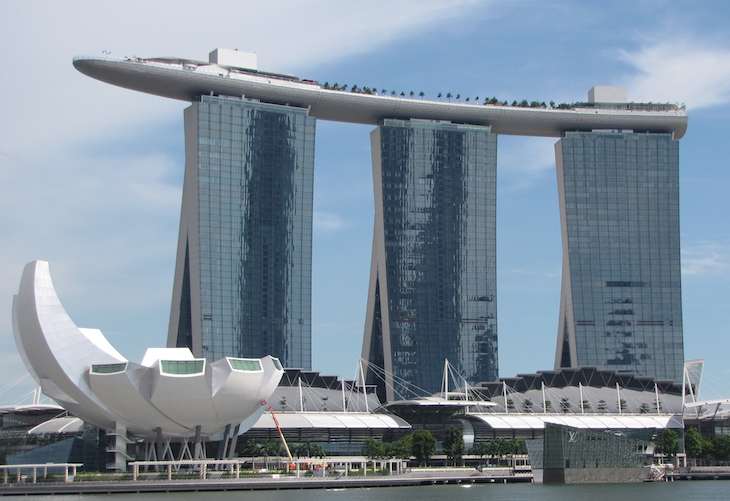
    • photo of Marina Bay Sands Casino in Singapore
      Marina Bay Sands Casino, Singapore. Singapore added their first two casinos in 2010 and have already the 2nd most gambling revenue of any area: after Macau and ahead of Las Vegas.
    • The Philippines Astounds the Skeptics by Bruce Einhorn – “Much of the credit for the good feeling should go to Aquino and his efforts to tackle corruption and improve the country’s infrastructure… As wages rise in China, the Philippines has a chance to attract investment from companies looking for low-wage alternatives, but the country’s notorious culture of bribery remains a major obstacle to growth”
    • Periodic Table Of Dividend Champions by David Van Knapp – the post looks at the 105 stocks raising dividends 25 straight years and looking at current yield and dividend growth rate highlights 34 for further study by an investor “Similarly, some investors may be interested in stocks that have a low current yield coupled with a high rate of dividend growth.”
    • (more…)

  • Curious Cat Investing, Economics and Personal Finance Carnival #29

    Welcome to the Curious Cat Investing, Economics and Personal Finance Carnival. The carnival is published twice each month with links to new, related, interesting content online.

    • For Capitalism to Survive, Crime Must Not Pay by Bruce Judson – “Justice must be blind so that both parties — whether weak or powerful — can assume that an agreement between them will be equally enforced by the courts.

      There is a second, perhaps even more fundamental, reason that equal justice is essential for capitalism to work. When unequal justice prevails, the party that does not need to follow the law has a distinct competitive advantage. A corporation that knowingly breaks the law will find ways to profit through illegal means that are not available to competitors. As a consequence, the competitive playing field is biased toward the company that does not need to follow the rules.” (the crony capitalism that has grown in the last few decades in the USA is poisoning the country with a failure to justly prosecute those that break laws if they are rich and connected to the other powerful cronies. This is a serious problem. – John).

    • Don’t Expect to Spend Over 4% of Your Retirement Investment Assets Annually by John Hunter – “This is likely one of the top 5 most important things to know about saving for retirement (and just 10% of the population got the answer right). You need to know that you can safely spend 5%, or likely less, of your investment assets safely in retirement (without dramatically eating into your principle.”
    • What America Pays In Taxes – In 2011 the USA government collected $1,100 billion in personal income taxes, $741 billion in payroll taxes (social security and medicare) [this should be a hint that look only at income taxes paid it might be very misleading – John], $200 billion in corporate taxes, $10 billion in estate and gifts taxes and $268 billion in other taxes (customs duties, excise taxes on products such as gasoline…).
    • Value Investing is Not Necessarily Buy and Hold Investing by Shailesh Kumar – “Value investors choose to buy a stock when it is cheaper than the intrinsic value of the stock and sell it when it becomes more expensive.”
    • (more…)

  • Investing in the Poorest of the Poor

    I have donated more to Tricke Up than any other charity for about 20 years now. There is a great deal of hardship in the world. It can seem like what you do doesn’t make a big dent in the hardship. But effective help makes a huge difference to those involved.

    My personality is to think systemically. To help put a band aid on the current visible issue just doesn’t excite me. Lots of people are most excited to help whoever happens to be in their view right now. I care much more about creating systems that will produce benefits over and over into the future. This view is very helpful for an investor.

    Trickle Up invests in helping people create better lives for themselves. It provides some assistance and “teaches people to fish” rather than just giving them some fish to help them today.

    The stories in this video show examples of the largest potential for entrepreneurship. While creating a few huge visible successes (like Google, Apple…) is exciting the benefits of hundreds of millions of people having small financial success (compared to others) but hugely personally transforming success is more important. Capitalism is visible in these successes. What people often think of as capitalism (Wall Street) has much more resonance with royalty based economic systems than free market (free of market dominating anti-competitive and anti-market behavior) capitalism.

    Related: Kiva Loans Give Entrepreneurs a Chance to SucceedMicro-credit ResearchUsing Capitalism in Mali to Create Better Lives

  • Curious Cat Investing, Economics and Personal Finance Carnival #27

    Welcome to the Curious Cat Investing, Economics and Personal Finance Carnival. The carnival is published twice each month. This carnival is different than others in two significant ways. First, I select posts from the blogs I read (instead of just posting those that submit to the carnival). I think this provides readers a better selection of valuable material (many of the best blogs don’t take time to submit to carnivals). And second, I include articles when I think they are interesting. If you are interested in hosting the carnival, add a comment including a link to your blog.

    • Savers, who did nothing to create the financial crisis, are being punished – “Our policy makers do need to think about what we are transferring to the banks,” Mr. Todd said. “Why is the public obligated to provide them with all those subsidies? Nobody will ask these questions.” [I agree, the large financial institutions are most responsible for the credit crisis and what they get is welfare paid for by others and they don’t even admit to their welfare status, pretending that the large financial institutions are not getting billions of dollars in direct and indirect aid from the rest of us]
    • You’d Be A Fool To Hold Anything But Cash Now, interview with David Stockman – “Q: You sound as if we’re facing a financial crisis like the one that followed the collapse of Lehman Brothers in 2008.
      A: Oh, far worse than Lehman. When the real margin call in the great beyond arrives, the carnage will be unimaginable.”
    • The end of cheap China – “Labour costs have surged by 20% a year for the past four years… Labour costs are often 30% lower in countries other than China, says John Rice, GE’s vice chairman, but this is typically more than offset by other problems, especially the lack of a reliable supply chain.”
    • Killing the competition: How the new monopolies are destroying open markets by Barry Lynn – “the basic characteristics shared by all real markets. Most important is an equality between the seller and the buyer, achieved by ensuring that there are many buyers as well as many sellers.” [this is fundamental to how capitalism provides benefits to the society. As markets are made less free (think of any market with very few buyer or sellers – that is lots of them today) the risks increase that society will lose to those few players who can extract monopolistic rents from the broken markets. The concept that free markets result in benefit to society through competition require real markets and competition, just using the word capitalism doesn’t bring the benefits, the system must have capitalistic traits – John]
    • What Portion Of Your Portfolio Should You Invest In Bonds? – “The universal rule is quite simple. If you own 100% of your portfolio in stocks and bonds you would invest so that: Bond proportion = your age %; Stock proportion = 100% – bond proportion” [I have a long comment on the post, I disagree with this specific advice today, the concept is sound, but bonds are not the right investment to balance the portfolio – John]
    • Adam Smith versus Business by Sheldon Richman – “Smith knew the difference between being sympathetic to the competitive economy – which he called the ‘system of natural liberty’ — and being sympathetic to owners of capital (who might well have acquired it by less-than-kosher means, that is, through political privilege). He knew something about business lobbies.”
    • USA Consumer and Real Estate Loan Delinquency Rates from 2001 to 2011 by John Hunter – “Residential real estate delinquency rates fell just 25 basis points (to a still extremely large 9.86%). Commercial real estate delinquency rates fell an impressive 186 basis points (to a still high 6.12%). Credit card delinquency rates fell 86 basis points to a 17 year low, 3.27%.”