Welcome to the Curious Cat Investing, Economics and Personal Finance Carnival: find useful recent personal finance, investing and economics blog posts and articles. The carnival is published twice each month. This carnival is different than others in two significant ways. First, I select posts from the blogs I read (instead of just posting those that submit to the carnival). I think this provides readers a better selection of valuable material (many of the best blogs don’t take time to submit to carnivals). And second, I include articles when I think they are interesting. I figure the primary purpose is to provide links to good recent content, so just because something isn’t a blog post doesn’t exclude it from inclusion.
|
 |
Tag: Economics
-
Curious Cat Investing, Economics and Personal Finance Carnival #26
-
Which Currency is the Least Bad?
I really can’t figure out which currency is something I would want to hold if I had the option. It doesn’t really matter, since I am not going to act on it in a very direct way (maybe if I felt very strongly I would do something but it would probably be pretty limited), but I still keep thinking about this issue out of curiosity.
The USA dollar seems lousy to me. Huge debt (both government and consumer). Government debt is huge on the books and huge off the books (state and local retirement – and federal medical care [social security is really in much better shape than people think, though it also has issues 30 + years out}).
The Euro seemed a bit lame 3 years ago. Today it seems crazy to think at least one Euro country won’t default in the next 3 years – and likely more. And if they take steps to avoid that it seems like it is going to make the case for the Euro worse).
The Japanese Yen is much stronger than makes any sense to me. I think it is mainly because of how lousy all the options are. The huge government debt (worse than almost anywhere) and lousy demographics (and the refusal to deal with demographics with immigration or something) are big problems. The biggest reason for strength is that the individuals have huge savings (when your citizens own the debt it is much less horrible than when others do – especially when you are looking at currency value).
The Chinese Yuan is the best looking at the economic data. The problem is economic data is questionable for the best cases (looking at the USA, Japan…). China’s economic data is far from transparent. There is also great political and social risk. The current worries of a real estate bubble seems justified to me and China just this week took exactly the wrong action – trying to prop up the bubble (in order to decrease the economic slowdown). I can see either of these cases playing out 10 years from now: It was obvious the Yuan was the strongest currency you are an idiot for not being able to see that or It was obvious China was a bubble with unsustainable policies and likely social upheaval thinking that was anything but a sign to sell the Yuan was foolish.
Given all this I think I weakly come down on the side that the Yuan is likely to be the strongest.
The safest play I think is the US dollar (as lousy as it is on an absolute basis the options make it look almost good). It could get clobbered. But that seems less likely than the others getting clobbered.
Smaller currencies have some promise but they can be swamped by global moves. I really have no idea about the Brazilian Real. That might actually be a really good option. The Australian Dollar and Canadian Dollar may also. But those economies are really small. I don’t trust India: they have many good macro-economic factors but the climate for business leaves far too much to be desired (as does the pace of progress fixing those weaknesses). Many economist like them due to demographic factors. I understand that demographic factors will help, but without systemic reform I question how well India can do (it certainly has the potential to do amazingly well, but they seem to be significantly farther away from reaching their potential compared to many countries).
The Singapore Dollar seems good on many levels, but the economy is small. I am not really sure about emerging economies, there currencies can get swamped in a hurry. Thailand and Indonesia experienced this recently. Thailand, Indonesia and Malaysia are interesting to me in thinking about what their currencies may experience, I would like to read more on this.
This is more an intellectual and curiosity exercise than something I see directly tied to my investing strategy. But having clear answers of what I thought reasonable scenarios were for currencies going forward that would factor into my investing decisions. Right now, the confusing this causes me, leads me to favor companies that should be fine whatever happens: Apple, Google, Toyota, Intel (I don’t really like Facebook overall but in this way they fit). Lots of the stocks in my 12 stocks for 10 years portfolio, you might notice.
Related: Is the Euro Going to Survive in the Long Run? – Why the Dollar is Falling – Strong Singapore Dollar – Warren Buffett Cautions Against Buying Long Term USD Bonds
-
Leasing or Purchasing a Solar Energy System For Your House
The economics of solar energy make sense today. The main stumbling block is financing the initial purchase (for homeowners, businesses or utilities). For new power generation solar is economically competitive in many locations today and prices continue to decline. One aspect that has harmed financing is the historical depreciation has been high (assuming a short lifespan of solar panels) but the panels now have much longer lifespans, meaning that when computing the return of solar investments you can expect a longer payback period. Combine that with falling prices and the economic case is great.
For a homeowner there is still the problem of financing what could be a $30,000 installation. Of course, the extremely low interest rates help here. First you have low cost capital (when calculating your return). Second, your alternative yields are very low (so it isn’t like you would earn 8% on your money just buying a CD). But for those that don’t want to take on the loan many companies are being formed to work on the financing for you (they deal with financing and then sell you the electricity they generate with panels on your home). It is a good business model I think. I personally think you are better off cutting out the intermediary and financing it yourself, but if you don’t want to, you can get cheaper electricity and help the environment.
In the USA there is a 30% federal tax credit for solar installation. Several states also offer tax credits for solar installation. There are also incentives in many other countries including Japan, Germany, Spain, Italy…
Where the U.S. Solar Industry Is Shining
The residential market for solar is still nascent, with less than 0.1 percent of U.S. homes outfitted with panels. That number could climb to 2.4 percent by 2020, estimates Bloomberg New Energy Finance. Prices for solar cells fell 51 percent in 2011, to 88¢ a watt, according to data compiled by Bloomberg.
…
Developers in the U.S. added 449.2 megawatts of solar-generating capacity in the third quarter of 2011, the latest data available, up 140 percent from the same quarter a year earlier.
…
SunRun hires local companies in 10 states to install solar arrays on customers’ roofs. The company charges clients for the electricity they generate— at monthly rates as much as 15 percent below those of regular utilities. Jurich says she expects SunRun to have a presence in 15 to 20 states within five years.I own JinkoSolar stock which manufactures solar panels. This is based on the belief that solar has reached a point where it is a good way to generate electricity and we have huge needs for electrical power generation world wide.
Related: Top Countries For Renewable Energy Capacity – Global Wind Energy Capacity Exceeds 2.5% of Global Electricity Needs – Solar Energy: Economics, Government and Technology – Oil Consumption by Country 1990-2009
-
Curious Cat Investing, Economics and Personal Finance Carnival #25
Welcome to the Curious Cat Investing, Economics and Personal Finance Carnival: find useful recent personal finance, investing and economics blog posts and articles. The carnival is published twice each month.
- India’s panel price crash could spark solar revolution – “In India, electricity from solar supplied to the grid has fallen to just 8.78 rupees per kilowatt-hour compared with 17 rupees for diesel.”
- Buffett Says Bonds Among Most Dangerous Assets on Inflation – “Over the past century these instruments have destroyed the purchasing power of investors in many countries, even as these holders continued to receive timely payments of interest and principal… Current rates… do not come close to offsetting the purchasing-power risk that investors assume.”
- How much should you save with each paycheck to reach retirement goals? – “For many, saving 10-15% will indeed be enough. If you find that you’re not currently on track for the retirement you envisioned, you can take steps now to change that.” [10-15% of income for retirement probably can be about right if you plan on working a standard 40-50 years and start adding close to 10% before you reach 30, and investment results are decent, and … and … and … Obviously if you don’t add at those levels starting earlier you will need to save more later. – John
- Why Spain’s Unemployed Are Heading For Germany – “Spain’s near-23 percent unemployment rate is driving highly educated people like Fuente and Sandino abroad by the tens of thousands. This year more people left Spain than moved there for the first time in more than a generation. And Germany’s a principal destination.”
- We Prefer Being Forced To Save – “Employers can do a number of things in addition to automatically enrolling employees and increasing their contributions amounts. They can make the websites easy to understand and be proactive about forcing the providers of the plans to make things less complicated. Even something so simple as having the retirement account website automatically bookmarked on work computers could go a long way.”
- Why Has the Baltic Dry Index Collapsed? by Steven Hansen – “just a small increase in the supply of ships can make a major difference in a very competitive marketplace. It makes the BDI an inoperative economic indicator, and one less tool which can be used as an economic metric.”
- Looking for higher dividend yields–and dividend growth? Here are three picks by Jim Jubak – “Pipeline master limited partnership Kinder Morgan Energy Partners (KMP). The partnership paid $4.32 a unit in 2010 and $4.58 in 2011 and thanks to new pipelines serving the U.S. energy boom and the likely drop down of assets from general partner Kinder Morgan’s (KMI) acquisition of El Paso (EP), I think the partnership will see growing cash flows that it can pass through to unit holders.”
- 5 Big Car Buying Mistakes by David Weliver – “We ignore financing terms. This makes no sense: Fighting tooth and nail with a car salesman for three hours to get an extra $500 off the price, and then financing the car with no money down at 6.0% for four years at a cost of over $2,000.”
For the second time in 2 weeks WordPress just completely failed to save a post I wrote 🙁 this is my second creation of this post.
-
Curious Cat Investing, Economics and Personal Finance Carnival #22
Welcome to the Curious Cat Investing, Economics and Personal Finance Carnival: find useful recent personal finance, investing and economics blog posts and articles. The carnival is published twice each month.
The new year starts with markets still highly uncertain due to the after affects of the too-big to fail credit crisis and the Euro-zone crisis. Job markets leave many people’s personal finances is trouble and those that are in good shape have a much greater challenge determining what are optimal personal financial strategies.
And markets embody the uncertainty. Investing strategies are also made more difficult by the current uncertainties. Continuing with long held strategies seems wise, but less comforting in these troubled times.
- 32 Best Dividend Stocks for 2012 by Shailesh Kumar – “The following table lists the best dividend stocks for 2012 based on dividend yields, dividend growth rate and dividend sustainability. All the stocks in this list have a P/E ratio of 15 or below.”
- How I Switched to Long Term Thinking – “I started spending some time each day thinking about the decisions I made that day, particularly ones I would often see myself repeating. Outside of the moment, I’d look at the short term benefits of my options as well as the long term benefits and I’d decide independently what the best long-term choice was.”
- A Country In Denial About Its Fiscal Future by Robert Samuelson – “Political leaders assume that financial markets won’t ever choke on U.S. debt and force higher interest rates, stiff spending cuts and tax increases. At best, this is wishful thinking. At worst, it’s playing Russian roulette with the country’s future.”
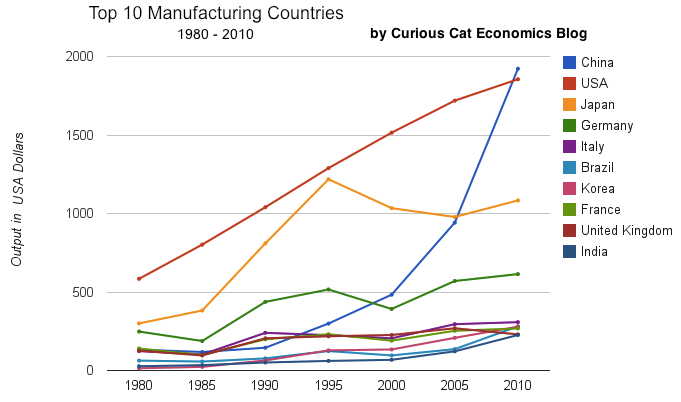
Top 10 Countries for Manufacturing Production in 2010: China, USA, Japan, Germany… by John Hunter. China took over first place from the USA in manufacturing output in 2010. From 1980 to 2010 China increased output 1345%. The total top 10 group of countries increased output 302%. From 1995 to 2010 China increased output 543%. The group increased 64%.
-
Simple Explanation of the Fractional Reserve Banking System
The webcast is by the great Kahn Academy which produces simple educational content (like the above) on all sorts of topics. I find this too slow but I think it might be good for people that are not really sure how the banking system works. There is a group of people that are very apposed to fractional reserved banking, as a principle. I actually am fine with it, but it needs to be regulated much better than we have done.
I suppose it might be true that our political leaders are much too subservient to those giving them lots of cash to regulate in a manner even close to acceptable: and therefore fractional reserve banking is dangerous. I am not sure that they are so hopeless that this is the case, though the more I see of how much they don’t know, and how often they seem to just vote based on what those giving them cash want it gets to be harder to believe they can be trusted to act close to properly (this is extremely sad). And it is mainly an indictment of ourselves: we keep putting people back in power that act mainly to reward those giving them cash and don’t seem interested in actually what is important for the long term interests of the country.
I believe the FDIC actually does quite a good job of providing a solution to manage some issues with a fractional reserve banking system and people being able to rely on getting their money back.
Related: Charlie Munger’s Thoughts on the Credit Crisis and Risk – Leverage, Complex Deals and Mania – Lobbyists Keep Tax Off Billion Dollar Private Equities Deals and On For Our Grandchildren
-
Curious Cat Investing, Economics and Personal Finance Carnival #21
Welcome to the Curious Cat Investing, Economics and Personal Finance Carnival: find useful recent personal finance, investing and economics blog posts and articles.
- Why Financial Literacy Fails (and What to Do About It) by JD Roth – “‘For years, I struggled with money,’ I told my interviewer today. ‘I knew the math, but I still couldn’t seem to defeat debt. It wasn’t until I started applying psychology to the situation that I was able to make changes.’”
- Get ready for the three big financial crises of 2012 by Jim Jubak – “So in 2012 Ireland—and Greece and Portugal—are going to face a huge choice. They can either try to grind out more austerity in the midst of a EuroZone recession or they can try to renegotiate some of that debt. If you remember, the battle over Greek bank debt almost scuttled the euro this year. Well, we’re going to see the same problem again in 2012…”
- How Long Would It Take To Build A $5000/Year Dividend Cash Flow? – John is able to investing $1000 per month in a portfolio now yielding 2.86% and dividends increasing 9% a year (under historical level for the stocks included)… a bit over 7 years…
-
Mark Cuban, invest in yourself. Keep your cash – wait to get a bargin based on the cash your have which allows you to take advantage of market opportunities.
-
Relocating to Another Country
There is an increasing trend to move from the USA to another country to work and live. This is not surprising to me. Recently this has picked up quite a bit; I am surprised by the velocity at which this interest in moving (I figured it would be a long term mega trend but not so drastic, so quickly). Economic changes are often quite surprising in how rapidly they move forward.
An interesting survey shows USA investors have become much more interested in relocating in the last two years (the data they show though has tremendous volatility over time, so I am not really sure this means much). I wonder how much of it can be explained by investors wanting to get a deep understanding of very promising markets. I wouldn’t image the actual number that do this is huge, but maybe the number considering it is significant. Billionaire investor, Jim Rodgers moved to Asia because he sees Asia as key to the future. One of the reasons I moved to Malaysia this year was to get a in depth understanding of what South East Asia is like (it is not a deciding reason, at all but maybe the 4th or 5th reason).
I believe the globalization of the employment market is a long term trend that will continue – especially for “knowledge workers.” The USA rested on the post WW II economic domination for nearly 50 years. The policies also helped this continue: investing in science and engineering, favoring entrepreneurship… But other countries have realized the value of these things (and the USA is slipping – not investing nearly as much in science and engineering and favoring large corporations that give politicians large amounts of cash over innovation – see things like the incredibly outdated “intellectual property” system, SOPA, favoring huge financial institutions…
The combination of long term policy weakness, the inevitable decline in the USA to world ratio of economic wealth, and the financial crisis caused by the policy weaknesses have seemingly greatly accelerated the trend. The next 2 or 3 years will determine if that is a permanent acceleration or if we go back to a slower pace – but on the same path. My guess is that we will stay on this path but the pace will not follow the level surveys might indicate (showing interest in such a big change is far different from actually moving).
There don’t seem to be any decent estimates of Americans living abroad. The US State Department claims releasing their estimates would be a national security risk? And the Census bureau says it would cost too much to try. Wild guesses seem to be between 4 and 6 million.
Related: I want out (subreddit) – Why Investing is Safer Overseas – USA Heath Care System Needs Reform – Copywrong
-
We Need to be More Capitalist and Less Cronyist
I am frustrated that we have largely allowed those that don’t believe in capitalism to claim their beliefs are capitalist. I believe capitalism is the best system to provide economic gain to human society. When we allow non-capitalist to claim their ideas are capitalist we often lose by allowing bad policies to be adopted and failing to adopt more capitalist ideas.
Robber barons and their ilk are not capitalists. Those attacked today as capitalists are much more like European nobility that fought to let the nobility take most of the economic profit from everyone else.
Capitalism is a wonderful thing.The foolish economic policies the politicians we have elected over and over again for decades are idiotic and not capitalist (they are somewhat capitalist but the things people are complaining about are not capitalism but the corruption of the system by those subverting capitalism). They are the result of favoring cronyism and bribery over capitalist regulated markets.
What we need to do is not throw out the capitalists. We need to actually throw out those that say their cronyistic policies are capitalist.
Capitalism is an economic system designed to achieve economic gain for a society. Adam Smith (and others) understood that if those with power to destroy the functioning of markets (for personal gain) were allowed to do so then the benefits capitalism can produce are reduced. And they definitely would try to (according to the believes fundamental to the capitalist model) so a capitalist system has to account for that.
“Free” markets are good. But in capitalism “free” markets means markets where no entity has “market” power – that is the ability to move the market. This is the idea of perfect competition. In the real world this doesn’t happen but capitalist understand the weakness of unfree markets and that has to be dealt with. Things start to get messy here. There is no perfect way to do this and I don’t know of anyone (that I don’t think is naive) that thinks this can be done in some way that avoid economic friction (loss to the society from what is possible in some ideal state).
Now those that like cronyism and letting whoever has the clout do whatever they want have tried to say capitalism means doing whatever you want to get as much capital as you want. It doesn’t. Capitalism isn’t about letting whoever has the gold get more. It is an economic system to provide gain to society by setting up rules that result in market forces brining benefit to society.
Those thinking about setting up the rules for a capitalist system understood that many people are going to try and get away with taking what isn’t theirs. So you have to enforce the rule of law. You have to prevent those that seek to destroy markets and take personal gains they should not be able to (due to being allowed to collude with other market players, collude with politicians to gain political concessions that destroy market functions…).
I happen to believe capitalism is the best economic system we have by far.
I happen to believe those that have increasingly turned out system into one where croynism is destroying markets to give gains to a few parties dominates are creating great damage. But the problem is not that these people show capitalism is bad. Instead these people show the dangers of not putting in the effort to retain capitalist ideas: your economy suffers and people suffer.
-
Curious Cat Investing, Economics and Personal Finance Carnival #20
Welcome to the Curious Cat Investing, Economics and Personal Finance Carnival. Investing markets continue to move in seemingly haphazard ways. The risks from excessive debt, failure to regulate financial institutions, political weakness (both of politicians and of populaces electing such incapable politicians), financial fraud and more make this a very difficult time to invest. We hope to help find useful recent personal finance, investing and economics blog posts and articles.
- The Unemployment Plan – “I just found out that I’m being “downsized” at the end of the year. While I have a small emergency fund, I do have a mortgage and a bit of credit card debt. I also have three kids at home. My wife will continue to work, but she has only a part-time job with minimal benefits. I am receiving a pretty good severance package, though.
Rather than panicking, I’m trying to be calm and rational about figuring out what’s next…” - Choosing Between An Annuity And A Dividend Portfolio – “Personally, I consider the choice between an annuity or a dividend portfolio to be a no-brainer. I think a systematic, sustainable and disciplined approach to dividend investing will outperform in almost all cases and while it will require a bigger time investment, that is a small price to get more flexibility, better returns and a much stronger growth potential.”
- From the webcast (see above) with Jim Rodgers. He sees a difficult period worldwide the next 2 years. He is short many shares everywhere (including emerging market). He also owns some shares. But overall he sees a difficult few years for stock markets.
He says China has a price bubble in real estate and many bankruptcies will take place. But it is not as bad as the USA problems where there was a credit bubble (you have to have a job to get real estate loans, while in the USA and UK you didn’t have too). Chinese banks are is less bad shape than the USA and Europe. - Manufacturing Employment Data: USA, Japan, Germany, UK… 1990-2009 by John Hunter – “Compensation in the countries currency is remarkably consistent across all countries from 1990-2009. Japan shows the only significant divergence in the period of 2002 – 2009 actually decreasing pay in real terms (a small amount – from 100 to 98) while the average increases to about 110.”
- The Unemployment Plan – “I just found out that I’m being “downsized” at the end of the year. While I have a small emergency fund, I do have a mortgage and a bit of credit card debt. I also have three kids at home. My wife will continue to work, but she has only a part-time job with minimal benefits. I am receiving a pretty good severance package, though.