Tag: economy

  • “What the Financial Sector Did to Us”

    Nobel Prize winning economist Joseph Stiglitz explores the current financial system and the damage done to the economy due to that system. As he states in the video the credit crisis is not something that happened to the financial institutions. The credit crisis caused recession is something the financial sector did to us.

    He covers the topics he discusses in the video in his new book: Freefall

    Related: There is No Invisible HandFailure to Regulate Financial Markets Leads to Predictable ConsequencesMarket Inefficiencies and Efficient Market TheoryCongress Eases Bank Laws (1999)Volcker on the Great Recession and Need for Reform

  • USA Unemployment Rate Remains at 9.7%

    The slow recovery from the massive credit crisis caused recession remains underway. Nonfarm payroll employment declined 36,000 in February, and the unemployment rate held at 9.7%, the U.S. Bureau of Labor Statistics reported today. Employment fell in construction and information, while temporary help services added jobs. Severe winter weather in parts of the country may have affected, negatively, payroll employment and hours.

    In February, the number of unemployed persons, at 14.9 million, was essentially unchanged. Among the major worker groups, the unemployment rates for adult men (10.0%), adult women (8.0%), whites (8.8%), African-Americans (15.8%), Hispanics (12.4%), Asians was 8.4%, and teenagers (25.0%) showed little to no change in February.

    The number of long-term unemployed (those jobless for 27 weeks and over) was 6.1 million in February and has remained stable since December. About 4 in 10 unemployed persons have been unemployed for 27 weeks or more.

    In February, the civilian labor force participation rate (64.8%) and the employment-population ratio (58.5%) were little changed.

    The number of persons working part time for economic reasons (sometimes referred to as involuntary part-time workers) increased from 8.3 to 8.8 million in February, partially offsetting a large decrease in the prior month. These individuals were working part time because their hours had been cut back or because they were unable to find a full-time job.

    Since the start of the recession in December 2007, payroll employment has fallen by 8.4 million.
    Related: Unemployment Rate Reached 10.2%Another 450,000 Jobs Lost in June 2009Can unemployment claims predict the end of the American recession?
    (more…)

  • Manufacturing Driving USA Recovery

    Durables Orders, Home Sales Probably Rose: U.S. Economy Preview

    “Manufacturing is coming back pretty solidly and there is some strength in capital spending,” said Mark Vitner, a senior economist at Wells Fargo Securities LLC in Charlotte, North Carolina. “Housing is definitely a laggard. Until we get job growth and lending eases up, we’re not going to get a whole lot of lift.”

    Federal Reserve Bank of New York President William Dudley last week indicated policy makers are more concerned about maintaining growth than they are about immediate inflation threats.

    Manufacturing, which accounts for 12 percent of the economy, expanded in January at the fastest pace since August 2004, according to the Institute for Supply Management’s factory index released Feb. 1.

    Some manufacturers are also beginning to bring back workers or hire. Caterpillar, the world’s largest maker of bulldozers and excavators, is recalling about 100 laid-off technicians at an Indiana plant because of increased demand and may be hiring more, Bridget Young, a Caterpillar spokeswoman, said Feb. 18.

    “Caterpillar may be recalling or hiring employees in business units at various facilities this year based on demand fluctuation,” Young said.

    Factories added 11,000 workers to payrolls in January, the first increase in three years and the most since April 2006, the Labor Department said on Feb. 5. Overall, payrolls declined by 20,000, and the unemployment rate fell to 9.7 percent.

    Obviously the economic disaster we had been poised to experience due to failed government action the last 10 years and excessive speculation by bankers and wall street has been averted in the short term. But the failure to take seriously the huge risks failed policies (bought by special interests from politicians) put our economy in leaves us at great risk for future problems. The ability to avert disaster so far has been very successful but the danders are still large. But right now the 2010 economy is looking much better than anyone could have hoped for a year ago when disaster seemed likely.

    The problem is that now those politicians, that collected huge payments for the last 20 years for those they have provided huge benefits to (allowing them to carry out strategies that risk the economic well being of the country, bailing them out if the gamblers lose, allowing tens of billion of dollars is profits due to extremely low short term interest rates, that allow dishonest credit card practices, providing tax benefits to the rich that pay the politicians well…), are acting as though the disastrous practices of those they are in bed with are fine. They are setting us up to repeat the same thing again. Which is really not that big a surprise given the lack of character of those we chose to elect.

    Manufacturing has been a strong part of why the economy has been so strong the last few decades. But the politicians has sought to allow those that pay them well to engage in practices that ruin the economy for the benefit of a few speculators.

    Related: Global Manufacturing Employment Data from 1979 to 2007Corrupt Officials Have Fled China With As Much As $100 billionWhy Pay Taxes or be HonestEstate Tax Repeal (another payoff to the rich paying politicians for favors)

  • Mortgage Delinquencies and Foreclosures Data Indicates 2010 Could Show Improvement

    The delinquency rate for mortgage loans on one-to-four-unit residential properties fell to a seasonally adjusted rate of 9.5% of all loans outstanding as of the end of the fourth quarter of 2009, down 17 basis points from the third quarter of 2009, and up 159 basis points from one year ago, according to the Mortgage Bankers Association’s (MBA) National Delinquency Survey. The non-seasonally adjusted delinquency rate increased 50 basis points from 9.9% in the third quarter of 2009 to 10.4% this quarter.

    The delinquency rate includes loans that are at least one payment past due but does not include loans in the process of foreclosure. The percentage of loans in the foreclosure process at the end of the fourth quarter was 4.6%, an increase of 11 basis points from the third quarter of 2009 and 128 basis points from one year ago. The combined percentage of loans in foreclosure or at least one payment past due was 15% on a non-seasonally adjusted basis, the highest ever recorded in the MBA delinquency survey.

    The percentage of loans on which foreclosure actions were started during the fourth quarter was 1.2 percent, down 22 basis points from last quarter and up 12 basis points from one year ago.

    The percentages of loans 90 days or more past due and loans in foreclosure set new record highs. The percentage of loans 30 days past due is still below the record set in the second quarter of 1985.

    The data is far from good but it could well signal the situation is improving. The next few quarters seem poised to start showing better results. Granted given how bad these results are we have a long way to go before the data is actually good. “We are likely seeing the beginning of the end of the unprecedented wave of mortgage delinquencies and foreclosures that started with the subprime defaults in early 2007, continued with the meltdown of the California and Florida housing markets due to overbuilding and the weak loan underwriting that supported that overbuilding, and culminated with a recession that saw 8.5 million people lose their jobs,” said Jay Brinkmann, MBA’s chief economist.

    “The continued and sizable drop in the 30-day delinquency rate is a concrete sign that the end may be in sight. We normally see a large spike in short-term mortgage delinquencies at the end of the year due to heating bills, Christmas expenditures and other seasonal factors. Not only did we not see that spike but the 30-day delinquencies actually fell by 16 basis points from 3.79% to 3.63%. Only three times before in the history of the MBA survey has the non-seasonally adjusted 30-day delinquency rate dropped between the third and fourth quarter and never by this magnitude.

    “This drop is important because 30-day delinquencies have historically been a leading indicator of serious delinquencies and foreclosures. With fewer new loans going bad, the pool of seriously delinquent loans and foreclosures will eventually begin to shrink once the rate at which these problems are resolved exceeds the rate at which new problems come in. It also gives us growing confidence that the size of the problem now is about as bad as it will get.

    “Despite the drop in short-term delinquencies, foreclosure rates could continue to climb, however, based on the ability of borrowers 90 days or more delinquent to solve their problems. A sizable number of the loans in the 90+ day delinquent bucket are in loan modification programs. They are carried as delinquent until borrowers demonstrate they will make the payments agreed to in the plans.

    Related posts: Mortgage Delinquencies Continue to Climb (Nov 2009)USA Housing Foreclosures Slowly Declining (Dec 2009)Nearly 10% of Mortgages Delinquent or in ForeclosureHow Not to Convert Equity (Jan 2006)
    (more…)

  • USA State Governments Have $1,000,000,000,000 in Unfunded Retirement Obligations

    There was a $1 trillion gap at the end of fiscal year 2008 between the $2.35 trillion states had set aside to pay for employees’ retirement benefits and the $3.35 trillion price tag of those promises, according to a new report released by the Pew Center on the States. The shortfall, which will have to be paid over the next 30 years by state and local governments, amounts to more than $8,800 for every household in the United States.

    The figures detailed in Pew’s report, The Trillion Dollar Gap, include pension, health care and other non-pension benefits promised to both current and future retirees in states’ and participating localities’ public sector retirement systems.

    Pew’s numbers likely underestimate the bill coming due because the most recent available data do not account for the second half of 2008, when states’ pension fund investments were particularly affected by the financial crisis. Additionally, most states’ accounting methods spread the investment declines over a period of time–meaning states will be dealing with their losses for several years.

    “While the economic crisis and drop in investments helped create it, the trillion dollar gap is primarily the result of states’ inability to save for the future and manage the costs of their public sector retirement benefits,” said Susan Urahn, managing director, Pew Center on the States. “The growing bill coming due to states could have significant consequences for taxpayers—higher taxes, less money for public services and lower state bond ratings. States need to start exploring reforms.”

    In fiscal year 2008, states’ pension plans had $2.8 trillion in long-term liabilities, with more than $2.3 trillion reserved to cover those costs. Overall, states’ pension systems were 84 percent funded—above the 80 percent funding level recommended by experts. Still, the unfunded portion–$452 billion–is substantial, and states’ performance is down slightly from an 85 percent combined funding level in fiscal year 2006. Pension liabilities have grown by $323 billion since 2006, outpacing asset growth by almost $87 billion.

    Retiree health care and other non-pension benefits, such as life insurance, create another huge bill coming due: a $587 billion total liability to pay for current and future benefits, with only $32 billion–or just over 5 percent of the cost–funded as of fiscal year 2008. Half of the states account for 95 percent of the liability. Because of a 2004 Governmental Accounting Standards Board rule, the full range of non-pension liabilities was officially reported in fiscal year 2008 for the first time across all 50 states.

    Many state and local governments continue to provide very large pay to state and local government employees and often use very generous retirement packages as a way of disguising the true cost of the pay packages they provide.

    Related: NY State Raises Pension Age to Save $48 BillionTrue Level of USA Federal DeficitCharge It to My KidsUSA Federal Debt Now $516,348 Per HouseholdPoliticians Again Raising Taxes On Your ChildrenConsumer Debt Reduced below $2.5 Trillion
    (more…)

  • USA, China and Japan Lead Manufacturing Output in 2008

    Once again the USA was the leading country in manufacturing in 2008. And once again China grew their manufacturing output amazingly. In a change with recent trends Japan grew output significantly. Of course, the 2009 data is going to show the impact of a very severe worldwide recession.
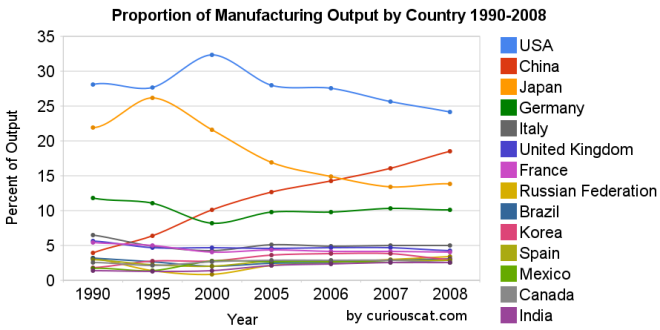
    Chart showing percent of output by top manufacturing countries from 1990 to 2008Chart showing the percentage output of top manufacturing countries from 1990-2008 by Curious Cat Management Blog, Creative Commons Attribution.

    The first chart shows the USA’s share of the manufacturing output, of the countries that manufactured over $185 billion in 2008, at 28.1% in 1990, 27.7% in 1995, 32% in 2000, 28% in 2005, 28% in 2006, 26% in 2007 and 24% in 2008. China’s share has grown from 4% in 1990, 6% in 1995, 10% in 2000, 13% in 2005, 14% in 2006, 16% in 2007 to 18% in 2008. Japan’s share has fallen from 22% in 1990 to 14% in 2008. The USA has about 4.5% of the world population, China about 20%. See Curious Cat Investment blog post” Data on the Largest Manufacturing Countries in 2008.

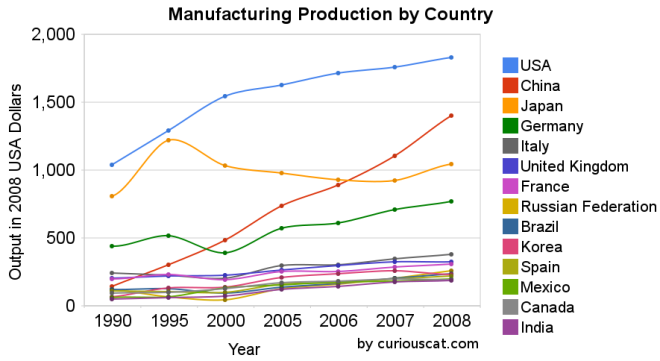
    Even with just this data, it is obvious the belief in a decades long steep decline in USA manufacturing is not in evidence. And, in fact the USA’s output has grown substantially over this period. It has just grown more slowly than that of China (as has every other country), and so while output in the USA has grown the percentage with China has shrunk. The percentage of manufacturing output by the USA (excluding output from China) was 29.3% in 1990 and 29.6% in 2008. The second chart shows manufacturing output over time.

    charts showing the top manufacturing countries output from 1990-2008Chart showing the output of the top manufacturing countries from 1990-2008 by Curious Cat Management Blog, Creative Commons Attribution.

    The 2008 China data is not provided for manufacturing alone (the latest UN Data, for global manufacturing, in billions of current USA dollars). The percentage of manufacturing (to manufacturing, mining and utilities) was 78% for 2005-2007 (I used 78% of the manufacturing, mining and utilities figure provided in the 2008 data). There is a good chance this overstates China manufacturing output in 2008 (due to very high commodity prices in 2008).

    Hopefully these charts provide some evidence of what is really going on with global manufacturing and counteracts the hype, to some extent. Global economic data is not perfect. These figures are an attempt to capture the economic reality in the world but they are not a perfect proxy. This data is shown in 2008 USA dollars which is good in the sense that it shows all countries in the same light and we can compare the 1995 USA figure to 2005 without worrying about inflation. However foreign exchange fluctuations over time can show a country, for example, having a decline in manufacturing output in some year when in fact the output increased (just the decline against the USA dollar that year results in the data showing a decrease – which is accurate when measured in terms of USA dollars).

    If the dollar declines substantially between when the 2008 data was calculated and the 2009 data is calculated that will give result in the data showing a substantial increase in those countries that had a currency strengthen against the USA dollar. At this time the Chinese Renminbi has not strengthened while most other currencies have – the Chinese government is retaining a peg to a specific exchange rate.

    Korea (1.8% in 1990, 3% in 2008), Mexico (1.7% to 2.6%) and India (1.4% to 2.5%) were the only countries to increase their percentage of manufacturing output (other than China, of course, which grew from 3.9% to 18.5%).

    Related: posts on manufacturingGlobal Manufacturing Data by Country (2007)Global Manufacturing Employment Data – 1979 to 2007Top 10 Manufacturing Countries 2006Top 10 Manufacturing Countries 2005

  • Personal Savings Increased Again In December

    Once again the personal savings increases point to healthier economic choices being made by individuals.

    Personal saving was $534.2 billion in December, compared with $506.3 billion in November. Personal saving as a percentage of disposable personal income was 4.8%.

    Personal income increased $44.5 billion, or 0.4%, in December, according to the Bureau of Economic Analysis. Personal consumption expenditures increased $22.6 billion, or 0.2%, the 3rd straight month of increased spending.

    Related: Increasing USA Saving Rate is a Good SignSaving Spurts as Spending SlashedChanging Shopping Habits

  • China GDP up 8.7% in 2009

    China’s GDP Growth Accelerates to Fastest Since 2007

    Gross domestic product rose 10.7 percent from the same period a year ago, more than the median forecast of 10.5 percent in a Bloomberg News survey, a statistics bureau report showed in Beijing today. For the full year, GDP gained 8.7 percent, beating Premier Wen Jiabao’s 8 percent target.

    The report may stoke speculation the central bank will start raising its benchmark interest rate and tighten restrictions on the nation’s lenders. Minutes after the release, traders said the People’s Bank of China guided three-month bill yields higher at an auction for the second time in two weeks.

    Fourth-quarter economic growth was driven by an unprecedented $586 billion stimulus package, subsidies for consumer purchases and a credit-fueled investment boom. The property market has rebounded and a 13-month slump in exports ended last month.

    Industrial production grew 18.5 percent in December from a year earlier and retail sales climbed 17.5 percent, the statistics bureau said today.

    In 2008 China’s GDP was up 9.6%. The economy there obviously continues to do amazing things. Also there are plenty of signs of crazy spending building huge amounts of housing and office space that lies vacant and questionable infrastructure projects. There is certainly a risk of bubbles bursting in China but the long term strength of the economy seems real. The danger is first political with financial bubbles being the second risk – I think.

    Related: Japanese Economy Shrinks 12.7% in the 4th Quarter of 2008Data on the Largest Manufacturing Countries in 2008Oil Consumption by Country in 2007

  • Investing – My Thoughts at the End of 2009

    In December 2008 I decided to substantially increase my investments in the stock market. This turned out to be quite successful. As I said at the time, the economy continues to struggle and the prospects for 2009 did not look good. And I even guessed the stock market (in the USA) would be lower 12 months from now. But, I also said I was far from certain, in that guess and that I had been increasing my stock investment and would continue to do so.

    At this time my retirement contributions are going 100% to stock investments (if I were close to retirement I would not do this). I am likely going to reduce the contributions going forward (maybe 75% stocks – 25% money market). Unfortunately my retirement fund does not have great alternatives – it has very good real estate options but I am not ready to start putting new funds there (though I likely will during 2010, at some point).

    I did sell reduce my equity exposure in a retirement account that I am not adding to this month. It reduced my overall equity exposure of my portfolio by a couple percentage points, at most. It is still significantly higher than a year ago, due to the incredible gains for 2009 in my stock investments.

    Last year I fully fund my Roth IRA, in January and bought Amazon (AMZN), Templeton Emerging Market Fund (EMF) and PetroChina (PTR). I will fully fund the Roth IRA in January again. I am leaning toward some combination of Templeton Emerging Market Fund (EMF), Vanguard Emerging Markets Stock (VWO), Toyota (TM) and maybe Danaher (DHR). I purchased all of those in my non-retirement account in 2009.

    Investing well is not easy. Saving money is though, sometime people get these confused. You need to save money for retirement – aim for 10% of your income and invest that conservatively if you do not wish to focus on investing. I have no question fully funding your Roth IRA is a wise move for almost everyone. How to invest once you do that is a bit trickier but funding it is not a difficult question to answer. It was not easy to increase investments into stocks last year, when so many others were selling (and the press is full of stories reinforcing the bad news, bad prospects and risks). You can get great opportunities when others are panicking, but things do not always recovery so nicely.

    What the next year holds, again for 2010, if very difficult to see. The economy looks to be in much better shape than a year ago. But it is far from strong. And the recovery in the stock market means the higher prices stocks command today leave more downside risk for stocks, if things do not go well. I am more concentrated in stocks now than I was a year ago, but I am not comfortable with that. I don’t see bonds, even short term bonds, as an acceptable alternative. The risks are not at all justified by the returns in my opinion. I am happy with my real estate investments and may even look to increase that area though I think it may be too early for commercial real estate. I think individual companies may well prosper even if the economy falters – such as Google, Amazon, Danaher, Toyota, Tesco (though Amazon’s price increases may already have more than accounted for this) – all of these are in my 12 stocks for 10 years portfolio.

    Related: Save Some of Each RaiseIt is Never to Late to InvestDoes a Declining Stock Market Worry You?Uncertain Economic Times

  • China Forecasts 9.6% GDP Growth, Close to Becoming 2nd Largest Economy

    China has been growing incredibly quickly for years. The credit crisis slowed things down. But unlike so many other governments that spent all their resources and more in good times, China has plenty of cash and spent a great deal on large projects. That spending has boosted their economy. And with that encouragement their economy has continued to grow, including consumer spending. As I posted earlier, China May Take Car Sales Lead from USA in 2009.

    China Raises GDP Growth Estimates, Narrowing Gap With Japan

    China’s expansion will be more than 8 percent in 2009, according to government officials, and the nation is poised to overtake Japan [in GDP] next year, International Monetary Fund projections show.

    China’s expansion in 2008 compares with U.S. growth of less than 1 percent. Japan’s gross domestic product shrank 1.2 percent. The Indian economy expanded 6.7 percent in the fiscal year ended March 2009.

    Economic data always has some errors within, and from China the data is even less reliable. But the overall strength seem very real and significant.

    Related: Government Debt Compared to GDP 1990-2007Japanese Economy Grew at 3.7% Annual Rate (Aug 2009)