Tag: economy

  • Global Economy Prospects Look Good But Also at Risk

    Fear returns

    The MSCI index of global stocks has fallen by over 15% since mid-April. Treasury yields have tumbled as investors have fled to the relative safety of American government bonds.

    Fears are growing that the global recovery will falter as Europe’s debt crisis spreads, China’s property bubble bursts and America’s stimulus-fuelled rebound peters out.

    Fears about the fragility of the global recovery are exaggerated. Led by big emerging economies, the world’s output is probably growing at an annual rate of more than 5%, far swifter than most seers expected.

    America’s structural budget deficit will soon be bigger than that of any other OECD member, and the country badly needs a plan to deal with it. But for now, lower bond yields and a stronger dollar are the route through which American spending will rise to counter European austerity. Thanks to its population growth and the dollar’s role as a global currency, America has more fiscal room than any other big-deficit country. It has been right to use it.

    The world is nervous for good reason. Although the fundamentals are reasonably good, the judgment of politicians is often unreasonably bad. Right now that is what poses the biggest risk to the world economy.

    Some very good thoughts from the Economist. As always there are plenty of risks to focus on today. There are also plenty of reasons to be optimistic. It looks like globally we are in for a good economy in 2010-2011 but those prospects could worsen fairly easily.

    Related: India Grew GDP 8.6% in First QuarterConsumer Debt Needs to Decline Much MoreGovernment Debt as Percentage of GDP 1990-2008 – USA, Japan, Germany…
  • Unemployment Rate Drops to 9.7% But Job Gains Disappoint

    Total nonfarm payroll employment grew by 431,000 in May but that total includes the hiring of 411,000 temporary employees to work on Census 2010, the U.S. Bureau of Labor Statistics reported today. Private-sector employment changed little (+41,000). Manufacturing, temporary help services, and mining added jobs, while construction employment declined. Economists were predicting over 500,000 job gains (given the large number of temporary census hires).

    In order to substantially increase the job prospects going forward we need to average over 250,000 new jobs a month to make up for the lost jobs due to the credit crisis. The economy needs to gain about 125,000 jobs a month to keep up with population growth. The temporary census jobs help but those jobs are temporary so can’t be counted on for long term improvement in the job picture.

    The number of unemployed persons was 15.0 million in May. The unemployment rate edged down to 9.7 percent, the same rate as in the first 3 months of 2010. The unemployment rates for adult men stand at 9.8%, 8.1% for adult women and 26.4% for teenagers.

    In May, the number of long-term unemployed (those jobless for 27 weeks and over) was about unchanged at 6.8 million. These individuals made up 46.0 percent of unemployed persons, about the same as in April.

    In May, the civilian labor force participation rate edged down by 20 basis points to 65%. The employment-population ratio was about unchanged over the month at 58.7%.

    Among the marginally attached, there were 1.1 million discouraged workers in May, up by 291,000 from a year earlier. (The data are not seasonally adjusted.) Discouraged workers are persons not currently looking for work because they believe no jobs are available for them. The remaining 1.1 million persons marginally attached to the labor force had not searched for work in the 4 weeks preceding the survey for reasons such as school attendance or family responsibilities.

    Manufacturing employment has risen by 126,000 over the past 5 months. Within manufacturing, both fabricated metals and machinery added jobs in May. Temporary help services added 31,000 jobs over the month; employment in the industry has risen by 362,000 since September 2009.

    Government employment rose by 390,000 in May. The Federal government hired 411,000 temporary workers for Census 2010, bringing total temporary census staffing during the payroll survey reference period to 564,000. Employment in state government excluding education decreased by 13,000.

    In May, the average workweek for all employees on private nonfarm payrolls increased by 0.1 hour to 34.2 hours. The manufacturing workweek for all employees increased by 0.3 hour to 40.5 hours. The average workweek for production and nonsupervisory employees on private non-
    farm payrolls increased by 0.1 hour to 33.5 hours over the month.

    Average hourly earnings of all employees in the private nonfarm sector increased by 7 cents, or 0.3 percent, to $22.57 in May. Over the past 12 months, average hourly earnings have increased by 1.9 percent. In May, average hourly earnings of private-sector production and nonsupervisory employees increased by 4 cents, or 0.2 percent, to $18.99.

    The change in total nonfarm payroll employment for March was revised from +230,000 to +208,000, while the change for April remained at +290,000.

    Related: USA Added 290,000 Jobs In AprilUnemployment Rate Reached 10.2% (Nov 2009)Another 663,000 Jobs Lost in March, 2009 in the USA

  • Forum on the Future of Manufacturing in the US and Europe

    The Future of Manufacturing in the US and Europe, The German Marshall Fund. Speakers: Ron A. Bloom, Simon Fraser, Wilfried Porth and Philip Stephens. I must admit I didn’t find this to be the most useful webcast but for those interested it may be worth watching.

    Related: Manufacturing Driving USA RecoveryUSA Manufacturing Output Continues to Increase (over the long term)Manufacturing Output in Historically by USA, Europe and AsiaCapacity Utilization Rate Up Slightly From All Time Low (Aug 2009)

  • USA Added 290,000 Jobs In April

    The stock market showed again yesterday how non-efficient it can be at times. Several stocks fell to pennies a share for awhile before returning to tens of a dollars a share. While the markets continue to react violently, the economy appears to be gaining more strength.

    Nonfarm payroll employment rose by 290,000 in April, the unemployment rate increase to 9.9%, and the labor force increased sharply, the U.S. Bureau of Labor Statistics reported today. Job gains occurred in manufacturing, professional and business services, health care, and leisure and hospitality. Federal government employment also rose, reflecting continued hiring of temporary workers for Census 2010. Since December, nonfarm payroll employment has expanded by 573,000, with 483,000 jobs added in the private sector. The vast majority of job growth occurred during the last 2 months.

    Household Survey Data

    In April, the number of unemployed persons was 15.3 million, and the unemployment rate edged up to 9.9%. The rate had been 9.7% for the first 3 months of this year.

    The number of long-term unemployed (those jobless for 27 weeks and over) continued to trend up over the month, reaching 6.7 million. In April, 45.9% of unemployed persons had been jobless for 27 weeks or more.

    In April, the civilian labor force participation rate increased by 0.3 percentage point to 65.2 percent, as the size of the labor force rose by 805,000. Since December, the participation rate has increased by 0.6 percentage point. The employment-population ratio rose to 58.8 percent over the month and has increased by 0.6 percentage point since December.

    Manufacturing added 44,000 jobs in April. Since December, factory employment has risen by 101,000. Over the month, gains occurred in several durable goods industries, including fabricated metals (9,000) and machinery (7,000). Employment also grew in nondurable goods manufacturing (14,000).

    Related: USA Added 162,000 Jobs in MarchUnemployment Rate Reached 10.2% (Oct 2009)USA Unemployment Rate Rises to 8.1%, Highest Level Since 1983 (March 2009)Over 500,000 Jobs Disappeared in November, 2008
    (more…)

  • Middle Class Families from 1970-2005

    As I have said before, Elizabeth Warren is one of the people I find most informative on the economy we have created. This lecture (from January 31, 2008) is very interesting: The Coming Collapse of the Middle Class: higher risks, lower rewards and a shrinking safety net. It is important for us to realize that the decisions we make have consequences. If we allow corruption to grow and grow in the USA we will suffer more and more. If we continue to elect people that give away society wealth to those the pay them to the detriment of society (investment banks, drug companies, “intellectual property” lawyers, retail banks, farmers, trial lawyers, hedge fund managers, trust fund babies, physicians…) that naturally means their is less wealth for the rest of society.

    Interesting data. Looking at standard family (Mom, Dad and 2 kids from 1970 to 2005), in inflation adjusted dollars: earnings increased a great deal (due to women working much more) but disposable income decreased. This is because basic expenses increased: health care, housing, transportation… (and this is with assuming employer provided health care – which has really been decreasing in likelihood over time). Those families are also more deeply in debt and reliant on 2 incomes. And if either income producer losses their jobs the economics of the family fail. Which means the family is much more at risk.

    It really is great that lectures like this are available to us now.

    Related: Elizabeth Warren Webcast On Failure to Fix the SystemIn the USA 43% Have Less Than $10,000 in Retirement SavingsFailure to Regulate Financial Markets Leads to Predictable ConsequencesLobbyists Keep Tax Off Billion Dollar Private Equities Deals and On For Our Grandchildren

  • Apartment Rents Rise, Slightly, for First Time in 5 Quarters

    Apartment Rents Rise as Sector Stabilizes

    Nationally, effective rents, which include concessions such as one month of free rent, rose 0.3% during the quarter compared with a 0.7% decline in the fourth quarter of last year and a 1.1% drop in the first quarter of 2009.

    enters are also staying put longer: the average renter now stays for 19 months, up from an average of 14 months, said Mr. Friedman, and despite low mortgage rates and greater home affordability, fewer renters are leaving to buy homes. “This is the first time in many, many years that it feels like even people who could afford to buy are making the investment decision not to,” Mr. Friedman said.

    Portland, Ore., posted the largest rent decline, at 0.7%, followed by Las Vegas, San Diego, and Southern California’s Inland Empire. Those three markets have all seen an uptick in home-buying activity, particularly among the low end from first-time buyers and investors.

    Colorado Springs had the largest rent increases, 2.5%, followed by Washington DC, 2% and San Antonio 1.5%. There is a very nice new online tool, Padmapper, for renters or landlords. It is a mashup on Google Maps of rental listings by location from Craigslist and other sources. Very good search options. Easy to use. Find more real estate links on the Curious Cat Cool Connections Directory.

    Related: It’s Now a Renter’s Market (April 2009)Housing Rents Falling in the USA (February 2009)Apartment-vacancy Rate is 7.8%, a 23-year High

  • Real Estate and Consumer Loan Delinquency Rates 1998-2009

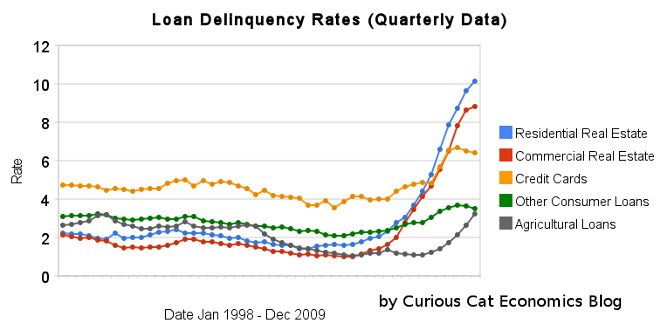
    The chart shows the total percent of delinquent loans by commercial banks in the USA.

    charts showing loan delinquency rates in the USA, 1998-2009

    That last half of 2009 saw real estate delinquencies continue to increase. Residential real estate delinquencies increased 143 basis points to 10.14% and commercial real estate delinquencies in 98 basis points to 8.81%. Agricultural loan delinquencies also increased (112 basis points) though to just 3.24%. Consumer loan delinquencies decreased with credit card delinquencies down 18 basis points to 6.4% and other consumer loan delinquencies down 19 basis points to 3.49%.

    Related: Loan Delinquency Rates Increased Dramatically in the 2nd QuarterBond Rates Remain Low, Little Change in Late 2009Government Debt as Percentage of GDP 1990-2008 – USA, Japan, Germany… posts with charts showing economic data
    (more…)

  • 50% of Commercial Real Estate Mortgages Will be Underwater

    Half of Commercial Mortgages to Be Underwater

    By the end of 2010, about half of all commercial real estate mortgages will be underwater, said Elizabeth Warren

    We now have 2,988 banks – mostly midsized, that have these dangerous concentrations in commercial real estate lending.” As a result, the economy will face another “very serious problem” that will have to be resolved over the next three years, she said, adding that things are unlikely to return to normalcy in 2010.

    Warren said it’s time for the government to “pull the plug” on mortgage lenders Fannie Mae and Freddie Mac. “I’m one of those people who never liked public-private partnership to begin with. I think what they did was use public when public was useful and private when private was useful,” she said. “And I think we’ve got to rethink that whole thing.”

    “There is no implicit guarantee anymore,” she added. “I don’t care how big you are, if you make serious enough mistakes, then your business can be entirely wiped out.”

    Financially literate people should know that the current commercial real estate market is in serious trouble. I still figure it will rebound well. I just want to wait and see how far prices fall and then try to buy when people are so frustrated they will sell at very low prices.

    Related: Commercial Real Estate Market Prospects Remain DimMortgage Delinquencies and Foreclosures Data Indicates 2010 Could Show ImprovementJumbo Loan Defaults Rise at Fast Pace (Feb 2009)

  • How the New Health Care Law May Affect You

    10 Ways the New Healthcare Bill May Affect You by Katie Adams

    Starting this year, if you have an adult child who cannot get health insurance from his or her employer and is to some degree dependent on you financially, your child can stay on your insurance policy until he or she is 26 years old.

    Starting this fall, your health insurance company will no longer be allowed to “drop” you (cancel your policy) if you get sick.

    Starting this year your child (or children) cannot be denied coverage simply because they have a pre-existing health condition. Health insurance companies will also be barred from denying adults applying for coverage if they have a pre-existing condition, but not until 2014.

    If you currently have pre-existing conditions that have prevented you from being able to qualify for health insurance for at least six months you will have coverage options before 2014. Starting this fall, you will be able to purchase insurance through a state-run “high-risk pool”, which will cap your personal out-of-pocket expenses for healthcare. You will not be required to pay more than $5,950 of your own money for medical expenses; families will not have to pay any more than $11,900.

    Under the new law starting in 2014, you will have to purchase health insurance or risk being fined.

    Starting in 2018, if your combined family income exceeds $250,000 you are going to be taking less money home each pay period. That’s because you will have more money deducted from your paycheck to go toward increased Medicare payroll taxes. In addition to higher payroll taxes you will also have to pay 3.8% tax on any unearned income, which is currently tax-exempt.

    Related: How the health care bill could affect youAnswers About Health Care BillWhy the Health Care Bill May Eventually Curb Medical Costspost on health careUSA Consumers Paying Down DebtPersonal Finance Basics: Long-term Care Insurance

  • Government Debt as Percentage of GDP 1990-2008 – USA, Japan, Germany…

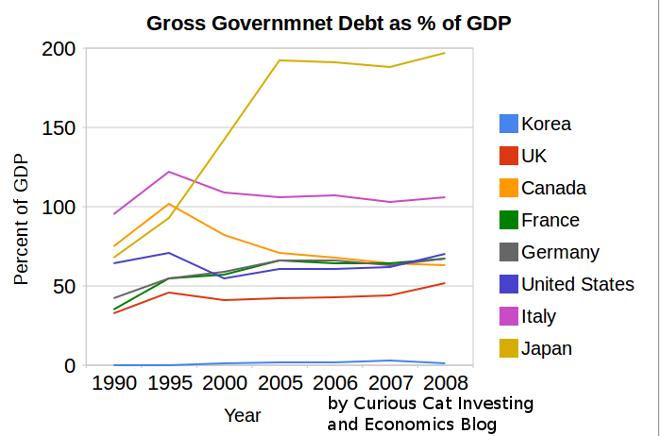
    Recently Greece and the huge USA federal deficits have highlighted the problem of excessive government debt. The above chart shows gross government debt by country from the IMF.

    Korea has essentially no gross government debt (under 2% of GDP for the entire period). At the other end of the spectrum Japan has seen gross government debt rise to 197% (Japan’s 2008 figure is an IMF estimate). The IMF did not have data for Greece (which would likely look very bad) or China (which I would think would be very low – maybe even negative – the government having more assets than debt).

    The USA debt stood at 64% in 1990, 71% in 1995, 55% in 2000, 61% in 2005 and 70% in 2008. Most countries are expected to see significant increases in 2009. The IMF sees the USA going to 85% in 2009 and 100% in 2012. They see Germany at 79% in 2009 and 90% in 2012. They See the UK at 69% in 2009 and 94% in 2012. They see Japan at 237% in 2012.

    Government debt as percentage GDP 1990-2008The chart shows gross government debt as percentage GDP 1990-2008. By Curious Cat Investing and Economics Blog, Creative Commons Attribution.

    ___________________________

    The data here is very similar to the OECD data I provided earlier, Government Debt Compared to GDP 1990 to 2007, though with some notable differences. In the OECD data was still in the best shape, but is seen as having 29% debt to GDP in 2007. The IMF data attempts to avoid issues where some countries have debt of non-federal governments that are hidden when looking just at federal government debt.

    Data source: IMF data (for some countries the data is also from that site but at different urls).

    Related: The Long-Term USA Federal Budget OutlookUSA, China and Japan Lead Manufacturing Output in 2008Oil Consumption by Country in 2007Saving Spurts as Spending Slashed