Tag: Personal finance

  • Are Municiple Bonds Safe?

    Municipal bonds seem safe. But the incredible long period of irresponsible spending and taking on long term liabilities (pensions, health care costs, infrastructure to maintain) and low taxes and selling off future income streams (to consume today) leaves those bonds with questionable financial backing in many locations. Municipal bond investments should be examined more closely today in light of the problems in the market.

    Video shows the State Budgets: The Day of Reckoning by 60 minutes.

    Wave of Muni Defaults to Spur Layoffs, Social Unrest: Whitney

    Responding to the uproar over her “60 Minutes” interview broadcast on CBS Sunday night, Whitney defended her prediction that at least 50 to 100 cities and towns could default on their debt as states and the federal government cut back on financial support.

    Muni experts, including an analyst from Standard & Poor’s, dismissed her predictions, saying the numbers don’t add up.

    “States clearly have been funding municipal governments—for now up to 40 percent of their total expenditures,” she explained. “As the states become more compromised from a fiscal standpoint, that funding is going to end.”

    Whitney added that it’s way too soon to see muni bonds as a buying opportunity. But she said that can change quickly.

    “When you start to see the first major defaults in this area [the states and cities], when you see more defaults and indiscriminate selling—if you do your research now and figure out who’s protected where and which revenues are protected, there will be great buying opportunities,” Whitney said.

    “People are complacent about these defaults. The news about all this isn’t out there yet,” Whitney went on to say. “And only when it is out there, then there will be a buying opportunity [for munis].”

    Related: USA State Governments Have $1,000,000,000,000 in Unfunded Retirement ObligationsNY State Raises Pension Age to Save $48 BillionWhat the Bailout and Stimulus Are and Are Notposts on bonds

  • Picking the Right Bank Can Eliminate ATM Fees

    Unfortunately large banks have a very strong tendency to try to take as much of your money as they can get away with. Rather than having to stay ultra-vigilante (as though I am in business with a thief that I have to watch ever minute or expect my money to be stolen) I would rather pick those I going into business with to avoid those seeking to rip me off. Credit unions are usually the best bet. Some credit unions join nationwide ATM networks, so if ATMs are important to you check this out before selecting a credit union.

    Hate ATM fees? Try these fee-friendly banks

    In fact, if you frequent an out-of-network ATM once a week, you could end up paying more than $200 in ATM fees a year.

    If you’re looking to avoid those fees, Ally, Charles Schwab (SCHW, Fortune 500) and USAA not only let all of their customers use out of network ATMs free of charge, but they also refund the fees that their customers are charged by other banks. State Farm Bank doesn’t charge you for going out of network and reimburses fees of up to $10 charged by other banks.

    In general, the best advice is to avoid large banks like you would someone with a dangerous communicable disease.

    BankSimple is a very promising new offering from Alex Payne, one of Twitter’s first employees and CTO of BankSimple, that promises “to simply put people first. Real customer service, no surprise fees, and a deep desire to help people is what makes BankSimple different.” Now the large banks are perfectly comfortable saying they try to help while trying to find any way possible to trick customers out of money. So Banksimple’s words don’t mean much. but I think there is a real chance they will be different. It is a great market to be in, huge amounts of money to be made and your competitors all treat customers egregiously poorly. That should give you a great opportunity to gain a huge market share.

    They are not yet open for business but it might open in early 2011. They are not actually going to be a bank, but instead provide the customer value and partner with existing banks (so we can deal with someone that isn’t trying to rip us off and they can let some bank deal with the administration of managing the money.

    Related: Worst Business Practices: Fees to Pay Your BillsCredit Card Regulation Has Reduced Abuse By BanksFDIC Study of Bank Overdraft FeesSneaky Fees

  • Consumer Debt Down, but Still Over $2.4 Tillion in the USA

    Consumers debt decreasing very slowly. In the 3rd quarter it decreased at an annual rate of 1.5%, after decreasing at a 3.25% rate in the second quarter. Revolving credit (credit card debt) decreased at an annual rate of 8.5% (compared to 9.5% in the second quarter), and nonrevolving credit (car loans…, not including mortgages) was up 2.5% (versus essentially unchanged).

    Revolving consumer debt now stands at $814 billion down $52 billion this year. That is on top of a $92 decline in 2009. Hopefully we can increase the size of the decrease going forward. As individuals we should aim to have no consumer debt and build up cash reserves instead (the way the debt figures are calculated though, even if you don’t really have any debt, say you pay off your credit card bill each month, I believe your balance is still seen as “debt”, it is credit extended to you).

    On September 30, 2010 total outstanding consumer debt was $2,411 billion (a decline of just $8 billion in the 3rd quarter, after a decline of $21 billion in the 2nd quarter). This still leaves over $8,000 in consumer debt for every person in the USA and $20,000 per family.

    Consumer debt grew by about $100 billion each year from 2004 through 2007. In 2009 consumer debt declined over $100 billion: from $2,561 billion to $2,449 billion. For the first 3 quarters of 2010 it has declined just $38 billion.

    The huge amount of outstanding consumer and government debt remains a burden for the economy. At least some progress is being made to decrease consumer debt. Credit card delinquency rates have actually been decreasing the last couple of year (from a high of 6.75% in the 2nd quarter of 2009 to 5% in the 2nd quarter of 2010 (I would guesstimate the average for the decade was 4.5%).

    Those living in USA have consumed far more than they have produced for decades. That is not sustainable. You don’t fix this problem by encouraging more spending and borrowing: either by the government or by consumers. The long term problem for the USA economy is that people have consuming more than they have been producing.

    We can’t afford to seek even more short term spending powered by more debt. Government debt has been exploding so unfortunately that problem has continued to get worse.

    Data from the federal reserve.

    Related: Consumers Continue to Slowly Reduce Their Debt LevelThe USA Economy Needs to Reduce Personal and Government DebtConsumer debt needs to decline much more.

  • Avoiding Withdrawing Retirement Savings Starts Early

    In the USA we fail to save nearly enough for retirement by and large. And fail to save emergency funds or prepare for economically difficult times. We by and large chose to spend today and hope tomorrow will be good rather than first establishing a good financial safety net before expanding spending.

    When people are debating withdrawing from their retirement account it is actually not the important decision it seems to be (normally). Normally the important decision was years before when they chose to take on consumer debt and not to build up an emergency fund. And when they failed to just build up saving beyond that which could be used for nice vacations, a new car, or to live on in economically challenging times.

    If someone had been saving 15% of their salary in retirement since they started working if they took an amount that left them at 10% that is hardly a horrible result. While someone that was already behind by say adding just 3% to retirement savings and they took out all of it that would be much worse.

    And we should remember even having a retirement account to withdraw from might put you ahead of nearly 50% of the population (and our state and federal governments, by the way). If you have to resort to withdrawing from your retirement account don’t think of that as the failure. The failure was most likely the lack of savings for years prior to that. And as soon as possible, re-fund your retirement account and build up a strong emergency fund, even if that means passing spending on things you want.

    Related: Retirement Savings Allocation for 2010401(k)s are a Great Way to Save for RetirementSave Some of Each Raise

  • Google Finance Portfolio Charting

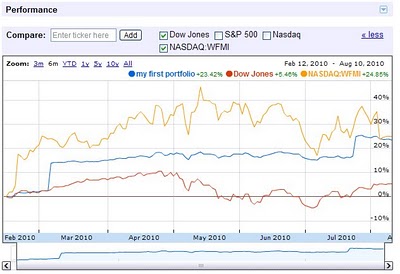
    investment portfolio charting from Google Finance
    Google finance has a nice new feature to let you chart your entire portfolio. You can then compare it to the S&P 500 or other stocks. This is a very nice feature. Yahoo Finance is about the only part of Yahoo I still use. I do use Google Finance some but they still fall short and I use Yahoo Finance much more. This feature will at least encourage me to put my portfolio in Google and start tracking it.

    It would be great if this could give you portfolio annual rates of return (including factoring in cash additions and withdraws and keeping track of sales over time to show a true view of the portfolio). It does look like it will factor in stock purchases and sales which is very nice. You can import csv files with transaction history – another nice feature.

    It also strikes me as a very smart move (as a Google stockholder that is nice to see) as advertising rates around investing are high. The more time Google can provide financial advertisers the more income they can make.

    Related: Lazy Portfolios Seven-year Winning StreakGoogle Posts Good Earning But Not Good Enough for Many (April 2010)Dollar Cost AveragingCurious Cat Investing Books

  • Bond Yields Stay Very Low, Treasury Yields Drop Even More

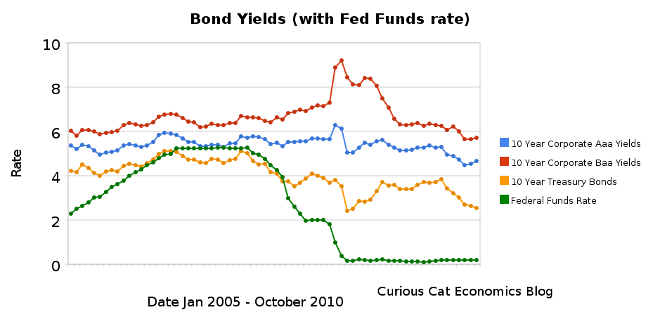
    chart showing corporate and government bond yields 2005-2010Chart showing corporate and government bond yields from 2005-2010 by Curious Cat Investing Economics Blog, Creative Commons Attribution, data from the Federal Reserve.

    Bond yields have dropped even lower over the last 6 months, dramatically so for treasury bonds. 10 year Aaa corporate bonds yields have decreased 61 basis points to 4.68%. 10 year Baa yields have decreased 53 basis points to 5.72%. 10 year USA treasury bonds have decreased an amazing 169 basis points to a incredibly low yield of %2.54. The federal funds rate remains under .25%.

    The Fed continues to try and discourage saving and encourage spending by punishing savers with policies to drive interest rates far below what the market alone would set. Partially this is a continuation of their subsidy to the large banks that caused the credit crisis. And partially it is an attempt to find a way to encourage spending to try and build job creation in the economy. The Fed announced they are taking huge steps to purchase $600 billion more bonds in an attempt to lower rates even further (much of the impact has been priced into the market as they have been saying they will take this action – but the size is larger than the consensus expectation). I do not think this is a sensible move.

    Savers do not have many good options for safely investing retirement assets for a reasonable income. The best options are probably to hold short term bonds and money markets and hope that the Fed finally stops making things so difficult for them. But that will take awhile. I think investing in medium or long term bonds (over 4 years) is crazy at these rates (especially government bonds – unless you are a large bank that can get essentially free money from the Fed to then loan the government and make a profit). Dividends stocks may be a good alternative for some more yield (but this needs to be done carefully to not take unwise risks). And I think you to look at investing overseas because these fiscal policies are just too damaging to savers to continue to just wait for a decent rate of return in bonds in the USA. But there are not many good options. TIPS, inflation protected bonds, are another option to consider (mainly as a less bad, of bad choices).

    It is a great time to take on debt however (as often is the case, there are benefits and costs to economic conditions). If you have a mortgage, and can qualify, or are looking to buy a home, mortgage rates are amazingly low.

    Related: Bond Rates Remain Low, Little Change in Last 6 Months (April 2010)Bond Yields Change Little Over Previous Months (December 2009)Chart Shows Wild Swings in Bond Yields in Late 2008Government Debt as Percentage of GDP 1990-2009 in USA, Japan, Germany, China…

  • Selling Covered Call Options

    Options strike most as exotic investment transactions. And some option strategies can be risky. But stock options can also be used in ways that are not risky. Call options give you the right to buy a stock at a certain price (the strike price) on, or before, a certain date (the expiration date). So if you want to speculate that a stock will go up in a short period of time you can buy call options. This is a risky investment strategy – though it can pay off well if you speculate correctly.

    Someone has to sell the call option. The seller gives the buyer the right to buy a stock at a certain price by a certain date. A speculator can do this and take the risk that the price will not rise to the level where a person chooses to exerciser their option. The also carries a significant risk, as if the stock price rises the speculator that sold the option has to either buy the option back (at a significant cost) or provide the stock (which they would have to purchase on the market). In order to trade in options you must be approved by the broker (at least in the USA) as an investor with the knowledge, finances and goals for which options trading is appropriate.

    An investor can also sell an option to buy a stock they own – this is called selling a covered call option. This means you get the price the speculator is willing to pay to buy the option and may have to sell the stock you own if the person holding the option chooses to exercise it.

    Lets look at an example. Lets say you own some Amazon stock. (more…)

  • Worst Business Practices: Fees to Pay Your Bills

    Some companies (Banks, Verizon, Comcast, credit card insurers, United, car dealers…) continually find new ways to be hostile to customers. It really is amazing people put up with their horrible practices. The latest from the fees to check bags, fees to for paying company expenses, waste your time on voice mail hell if you want to talk to us crowd is fees to pay bills using automated systems.

    The customer hostility of these companies is part of their DNA. We should recognize the new attempts to fleece customers but there is no reason to be surprised by the new, ever more hostile customer behavior of these companies. There are alternatives for consumers, just find them, and support them. Some industries are dominated by customer hostile companies (which can make avoiding them hard): banks (both consumer and investment banks), credit cards, airlines, cable companies, cell phone service. Even in those industries you can find ethical companies: Southwest Airlines, many credit unions, CarMax…

    Paying to pay your bills

    if you are to go Chase, Wells Fargo, Bank of America and you want to use their automated phone system — no human beings within sight — $15.

    And yet these guys are charging $15. I asked Chase, “How can you charge that much for an automated transaction?” They said, “Well, that’s how much we charge.” And you look at some of the other charges out there. For instance, this week Verizon Communications is introducing a new $3.50 charge if you pay your bill online, automated phone system, or to a service rep without using their recurring, automatic bill paying system.


    A fee to pay your bill? Yep

    AT&T is a little better. It charges $5 if you pay by phone with a real, live service rep, but there’s no charge for using the company’s automated system.

    Time Warner Cable charges $4.99 to pay by phone with a human being, but it too charges nothing to use the automated system.

    “People pay for a product or service,” said Doug Heller, executive director of Consumer Watchdog, a Santa Monica advocacy group. “They shouldn’t have to pay again just for the right to pay them.”

    Related: Protect Yourself from 11 Car Dealer TricksPoor Customer Service: Discover CardBest Buy Asks Man to Change His NameIs Poor Service the Industry Standard?

  • Homes for Half Price to Teachers, Law Enforcement and Emergency Workers

    Law enforcement officers, pre-Kindergarten through 12th grade teachers and firefighters/emergency medical technicians can contribute to community revitalization while becoming homeowners through HUD’s Good Neighbor Next Door Sales Program. HUD (United States Department of Housing and Urban Development) offers a substantial incentive in the form of a discount of 50% from the list price of the home. In return you must commit to live in the property for 36 months as your sole residence.

    Eligible Single Family homes located in revitalization areas (there are hundreds of revitalization areas across the country. HUD is always working with localities to designate new areas) are listed exclusively for sales through the Good Neighbor Next Door Sales program. Properties are available for purchase through the program for five days.

    Check the listings for your state. Follow the instructions to submit your interest in purchasing a specific home. If more than one person submits on a single home a selection will be made by random lottery. You must meet the requirements for a law enforcement officer, teacher, firefighter or emergency medical technician and comply with HUD’s regulations for the program.

    HUD requires that you sign a second mortgage and note for the discount amount. No interest or payments are required on this “silent second” provided that you fulfill the three-year occupancy requirement.

    Related: Fixed Mortgage Rates Reach New LowYour Home as an Investmentarticles on home ownership

  • Current Mortgage Refinance Options

    I am looking at mortgage refinance options now (with rates being so low). I am looking at 20 year fixed rate loans with cash out (with over 20% down). The 20 year term will reduce my loan term a bit, and the final monthly cost should actually be not much higher than my current payment (with taking some cash out), I think. Do any readers have opinions on these lenders (or others with competitive offers – low rates and low expenses)?

    Total Mortgage – 20 year fixed rate 3.875%, total fees and points not provided :-(, apr 4.15%

    American United Mortgage – 20 year fixed rate 4% [same as 30 year rate :-(], fees $2,995 (0 points), apr 4.26%

    Aim Loan – 20 year fixed rate 3.875%, fees (about $4,100 I think), apr 4.02%

    These are some of the best deals I have been able to find. However, companies can play games with fees and hide excessive costs in requirements they don’t consider fees (appraisal costs…). Rates can bounce around for a specific lender, so I think it make sense to watch several (not just pick out he lowest one on whatever date you first look).

    Suggestions on how to tell whether specific lenders good faith estimates are accurate and comparable would be especially appreciated.
    Edits:
    RoundPoint – looks good, low rates, low fees, good reviews on Zillow.
    Amerisave – 20 year fixed rate 3.75%, total fees and points $3,418, apr 3.87% (removed as an option – they don’t respond to customer have tons of negative reviews online about problems, poor service, etc.

    Related: Fixed Mortgage Rates Reach New LowLow Mortgage Rates Not Available to Everyone30 Year Fixed Mortgage Rates and the Fed Funds RateMortgage terms