Tag: Personal finance

  • USA Housing Inventory Puts Pressure on Prices

    U.S. Home Prices Face Three-Year Drop as Supply Gains

    The slide in U.S. home prices may have another three years to go as sellers add as many as 12 million more properties to the market. Shadow inventory — the supply of homes in default or foreclosure that may be offered for sale — is preventing prices from bottoming after a 28 percent plunge from 2006, according to analysts from Moody’s Analytics Inc., Fannie Mae, Morgan Stanley and Barclays Plc.

    Sales of new and existing homes fell to the lowest levels on record in July as a federal tax credit for buyers expired and U.S. unemployment remained near a 26-year high.

    There were 4 million homes listed with brokers for sale as of July. It would take a record 12.5 months for those properties to be sold at that month’s sales pace, according to the Chicago- based Realtors group.

    In addition to the as many as 8 million properties vacant or in foreclosure, owners of another 3.8 million homes — 5 percent of U.S. households — said they are “very likely” to put their properties on the market within six months if there is improvement, according to a survey by Seattle-based Zillow.

    Owners of about 11 million homes, or 23 percent of households with a mortgage, owed more than their property was worth as of June 30, according to CoreLogic. Another 2.4 million borrowers had less than 5 percent equity in their houses and probably would lose money on a sale after paying broker fees and closing costs, CoreLogic said Aug 25.

    The shadow inventory, poor job market and low net home equity positions continue to put a huge amount of pressure on the housing market. Very low interest rates help support the market but not much else does. In some locations the rental market is starting to help. But the tightening of credit standards is reducing the pool of potential buyers. While it is a good thing (because credit standards were far too loose) it still will extend the duration of a bear housing market.

    I would be looking to buy now, if I didn’t own a house already (and was planning on staying long term).

    Related: Real Estate and Consumer Loan Delinquency Rates 2000-201010 million More Renters In the Next 5 YearsThe Value of Home OwnershipNearly 10% of Mortgages Delinquent or in Foreclosure (Dec 2008)
  • Earnings and Dividends Grow, Bond Yields Sink

    Dividends Beating Bond Yields by Most in 15 Years

    More U.S. stocks are paying dividends that exceed bond yields than any time in at least 15 years as profits rise at the fastest pace in two decades.

    Kraft Foods Inc. and DuPont Co. are among 68 companies in the Standard & Poor’s 500 Index with payouts that top the 3.78 percent average rate in credit markets, based on data since 1995 compiled by Bloomberg and Bank of America Corp. While Johnson & Johnson sold 10-year debt at a record low interest rate of 2.95 percent last month, shares of the world’s largest health products maker pay 3.66 percent.

    The combination of record-low interest rates, potential profit growth of 36 percent this year and a slowing economy has forced investors into the relative value reversal. For John Carey of Pioneer Investment Management and Federated Investors Inc.’s Linda Duessel, whose firms oversee $566 billion, it means stocks are cheap after companies raised payouts by 6.8 percent in the second quarter

    S&P 500 companies’ cash probably has grown to a record for a seventh straight quarter, according to S&P. For companies that reported so far, balances increased to $824.8 billion in the period ended June 30 from the first three months of the year, based on data from the New York-based firm.

    Cash represents 10.2 percent of total assets at S&P 500 companies, excluding banks and financial firms, according to data compiled by Bloomberg. That’s higher than the 9.5 percent at the end of the second quarter last year, 8.4 percent in 2008 and 7.95 percent in 2007.

    “The economy is slowing down, but productivity has been so great in this country and companies have been able to make good profits,”

    10-year Treasury note yields were as low as 2.42% last month. The combination of continued extraordinarily low interest rates and good earnings increase this odd situation where dividends increase and interest yields fall. Extremely low yields aimed at by the Fed continue to aid banks and those that caused the credit crisis a huge deal and harm investors.

    Money markets and bonds are not attractive places to invest now. Putting money in those places is still necessary for diversification (and as a safety net – especially in cases like 401-k plans where options are often very limited). Seeking out solid companies with strong long term prospects that pay reasonable dividends is a very sensible strategy today.

    Related: Where to Invest for Yield TodayS&P 500 Dividend Yield Tops Bond Yield: First Time Since 195810 Stocks for Income InvestorsBond Yields Show Dramatic Increase in Investor Confidence (Aug 2009)

  • 401(k) Options – Seek Low Expenses

    401(k), IRAs and 403(b) retirement accounts are a very smart way to invest in your future. The tax deferral is a huge benefit. And with Roth IRAs and Roth 401(k)s you can even get tax exempt distributions when you retire – which is a huge benefit. Especially if you don’t retire before the bill for all the delayed taxes of the last 20 years starts to be paid. The supposed “tax cuts” that merely shifted taxes from those spending money the last 10 years to those that have to pay for all the stuff the government spent on them has to be paid for. And that will likely happen with higher tax rates courtesy of the last 10 years of not paying the taxes to pay for what the government was spending.

    When looking at your 401(k) and 403(b) investment options be sure to pay close attention to expenses for the funds. Some fund families try to get people to investing in high expense funds, that are nearly identical to low expense funds. The investor losses big and the fund companies take big profits. Those people serving on the boards of those funds should be fired. They obviously are not managing with the investors interests at heart (as they are obligated to do – they are suppose to represent the investors in the funds not the friends they have making money off the investors).

    Here is an example (that I ran across last week) expense differences for funds that have essentially identical investment objectives and plans in the same retirement plan options: .39% (a respectable rate, though more than it really should be) for [seeks a favorable long-term rate of return from a diversified portfolio selected to track the overall market for common stocks publicly traded in the U.S., as represented by a broad stock market index.], .86% [for “The account seeks a favorable long-term total return, mainly from capital appreciation, by investing primarily in a portfolio of equity securities selected to track the overall U.S. equity markets based on a market index.”]. Do not rely on your fund provider to have your interests at heart (and unfortunately many companies don’t seek the best investment options for their employees either).

    The .47% added expense isn’t much to miss for 1 year. However, over the life of your retirement account, this is tens of thousands of dollars you will lose just with this one mistake. Personal financial literacy is an easy way to make yourself large amounts of money over the long term. It isn’t very sexy to get .47% extra every year but it is extremely rewarding.

    $200,000 at 6% for 25 years grows to $858,000
    $200,000 at 6.47% for 25 years grows to $958,000

    So in this case, $100,000 for you, instead of just paying the fund company a bit extra every year to let them add to their McMansions. In reality it will be much more than a $100,000 mistake for you if you save enough for retirement. But if you save far too little (as most people do) one advantage is the mistake will be less costly because your low retirement account value reduces the loss you will take.

    Related: 401(k)s are a Great Way to Save for RetirementRetirement Savings Allocation for 2010Many Retirees Face Prospect of Outliving Savings
    (more…)

  • Fixed Mortgage Rates Reach New Low

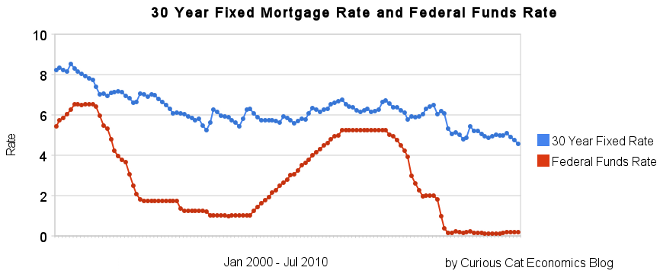
    30 year fixed mortgage rates have declined sharply recently to close to 4.5%.

    chart showing 30 year fixed mortgage rates: 2000 to July 2010

    If you are considering refinancing a mortgage now may well be a very good time. If you are not, you maybe should consider it. If so look to shorten the length. If you originally took out a 30 year mortgage and now have, for example, 24 years let, don’t add 6 years to your repayment term by getting a new 30 year mortgage. Instead, look to shorten your pay back period with a 20 year mortgage. The 20 year mortgage will have an even lower rate than the 30 year mortgage.

    If you plan on staying in the house, a fixed rate mortgage is definitely the better option, in my opinion. If you are going to move (and sell your hose) in a few years, an adjustable rate mortgage may make sense, but I would learn toward a fixed rate mortgage unless you are absolutely sure (because situations can change and you may decide you want to stay).

    The poor economy, unemployment rate still at 9.5%, has the Fed continuing massive intervention into the economy. The Fed is keeping the fed funds rate at close to 0%.

    If you are looking at a new real estate purchase, financing a 30 year mortgage sure is attractive at rates under to 4.5%.

    Related: historical comparison of 30 year fixed mortgage rates and the federal funds rate30 Year Fixed Mortgage Rates Remain Low (Dec 2009)Lowest 30 Year Fixed Mortgage Rates in 37 YearsWhat are mortgage definitions

    For more data, see graphs of the federal funds rate versus mortgage rates for 1980-1999. Source data: federal funds rates30 year mortgage rates

  • Curious Cat Investment Books

    cover image for Intelligent Investor by Ben Graham

    We have created a new and improvement Curious Cat Investment book site. Find great resources for your investing and personal finance needs. We have selected the best books by authors including: Benjamin Graham, Warren Buffett, John Bogle, Nicolas Darvas, Peter Lynch and William O’Neil.

    Try out our recommended picks.

    View the books by category including: investing, economics, retirement, real estate and personal finance.

    Related: Curious Cat investing articlesCurious Cat management booksTeaching Children About Money MattersBogle on the Retirement Crisis

  • 40 Billionaires Pledge to Donate Half Their Wealth

    40 billionaires pledge to give away half of wealth

    In addition to Buffett and Gates – America’s two wealthiest individuals, with a combined net worth of $90 billion, according to Forbes – 38 other billionaires are taking the give-it-away pledge. They include New York Mayor Michael Bloomberg, entertainment executive Barry Diller, Oracle co-founder Larry Ellison, energy tycoon T. Boone Pickens, media mogul Ted Turner, David Rockefeller, film director George Lucas and investor Ronald Perelman.

    This is great news. We need more charity. And we don’t need more trust fund babies. The Giving Pledge was established by Bill Gates and Warren Buffet to encourage this spirit.Charity should be a part of your personal finance plan if you are reading this (if you have access to a computer you are wealthier than most people alive today).

    To many of the rich today act like they made their money by creating it by themselves. You can’t be a billionaire without getting it given to you by your parents or making your wealth from society. It is wonderful when people provide great solutions to society and become wealthy. It is ridicules to think those people’s wealth is not the result of the society others created. Using that wealth to make society better is right. Spoiling kids and grandkids with it is acceptable, to a certain level. After a couple million that is insulting, however.

    Related: House Votes to Restore Partial Estate Tax Very Richest: Those with Over $7 MillionRich Americans Sue to Keep Evidence of Their Tax Evasion From the Justice DepartmentGates Foundation and Rotary Pledge $200 Million to Fight Polio

  • Curious Cat Investing and Economics Carnival #9

    Welcome to the Curious Cat Investing and Economics Carnival: we highlight recent personal finance, investing and economics blog posts I found interesting.

    • “New Normal” math: How your investing plans must change – “I don’t think the implications of changing stocks’ rate of return from 10% to 5% have sunk in. We acknowledge that stock returns will be poor, and yet all of our retirement advice – save 10% of your income… withdraw 4% in retirement – stays the same.”
    • Manufacturing Output as a Percent of GDP by Country by John Hunter – “For the 14 biggest manufacturing countries in 2008, the overall manufacturing GDP percentage was 23.7% of GDP in 1980 and dropped to 17% in 2008… USA economy dropped from 21% in 1980 to 18% in 1990, 16% in 2000 and 13% in 2008.”
    • Masters of Earning More – “Ben actually loves his full-time job, but still freelances on the side. Earning more isn’t just for people who hate their job or are in severe credit-card debt. He freelances because he enjoys it.”
    • Five plays on the China Middle Class Explosion by Cody Willard – “The middle class in China now stands at nearly 25% of the population (which is 50 million new members a year!).”
    • Who Educates The Investors? by Bill Waddell – “Who would want to listen to the insights of someone concerning a manufacturing investment who knows so little about the current state of manufacturing that he thinks Toyota introduced lean to reduce working capital over a five year period?”
    • Refinance Now, If You Can by David Weliver – “If you currently owe $200,000 on your mortgage at 5.75%, refinancing could save you more than $100 a month on your payment and reduce the interest you pay over the life of the loan.” (rates are down a bit more since this example was posted – John)
    • A Cheap Internet Stock With High Dividend Yield – “stock offers an impressive 6.8% dividend yield and yet the stock only trades at 5x consensus 2011 earnings estimates.”
    • Personal Finance Basics: Avoid Debt by John Hunter – “Debt is often toxic to personal financial success. The simple step you can take to avoid the problems many face is to just not buy things until you save up for them. If you want some new shoes or new Droid Incredible or to go see a football game (American or World Cup style) that is fine. Just save up the money and then spend it.”

    Related: Curious Cat investing articlesCurious Cat Investing and Economics Custom Search EngineCurious Cat Investing and Economics Carnival #5

  • 25% of Americans have a Credit Score Under 600

    Number of the Week: Default Repercussions

    Over the past couple years, millions of Americans have reneged on their debts — because they lost their jobs, because they took on more than they could handle, or both. For many, those defaults have brought immediate financial relief, leaving more cash to spend on other things. Now, though, they’ll also have to face the challenge of living with bad credit.

    As of April, 25% of Americans had fallen into the least-creditworthy category, garnering a rating of less than 600 from FICO, the main arbiter of consumer credit in the U.S. That compares to only 15% before the recession

    Some may be able to get mortgage loans through Federal Housing Administration programs, which allow for credit scores as low as 580. But none will qualify for loans guaranteed by Fannie Mae or Freddie Mac, which account for the lion’s share of the market and typically require credit scores of at least 650. Getting auto loans or credit cards will also be tough.

    Related: Avoiding the Vicious Cycle of Credit ProblemsPersonal Finance Basics: Avoid DebtUSA Consumer Debt Stands at $2.44 Trillion

  • Landlords See Increase in Apartment Rentals

    Apartment Rentals Surge in U.S. on Foreclosures, Jobs

    The number of occupied apartments increased by 215,000 in the 64 largest U.S. markets in the first half, according to MPF Research. That’s almost double the units added in all of 2009 and the most since the firm began tracking the data in 1992. The vacancy rate declined to 6.6 percent last month from 8.2 percent in December.

    The Bloomberg REIT Apartment Index has gained 28 percent this year, double the 14 percent advance in the broader Bloomberg REIT Index.

    Finances for homeowners didn’t improve fast enough to prevent more than 1.65 million foreclosure filings in the first half, an increase of 8 percent from the same period in 2009, RealtyTrac Inc., a data company in Irvine, California, said July 15. A record 269,962 U.S. homes were seized from delinquent owners in the second quarter as lenders set a pace to claim more than 1 million properties by the end of 2010.

    The U.S. homeownership rate fell to 66.9 percent in the second quarter, the lowest since 1999, the U.S. Census Bureau said today. The rate peaked at 69.2 percent in the fourth quarter of 2004.

    Effective rents, or what tenants pay after concessions or breaks from landlords, increased 1.4 percent in the biggest markets in the first half, according to MPF Research. Rents may rise 4 percent to 6 percent in both 2011 and 2012, compared with a gain of about 2 percent this year, Willett said.

    Rentals are picking up partially due to the economy picking up allowing some who moved into their parents house to move back out. Also the continued numbers of people losing their houses increases the ranks of potential renters. The market is still absorbing many people reducing their housing footprint (people joining up with others to save on expenses). This is one of several important areas to watch (job growth is still probably the most important). As large numbers of apartment are rented and houses are rented or bought it is a strong indicator people are gaining some financial stability.

    Related: Apartment Rents Rise, Slightly, for First Time in 5 Quarters (April 2010)Apartment-vacancy Rate is 7.8%, a 23-year High (Nov 2009)Sales of New Homes Plunged in USA in May to Record Low

  • Credit Card Regulation Has Reduced Abuse By Banks

    Most of the practices deemed unfair or deceptive by the Federal Reserve have disappeared from new credit card offers since federal passage of the Credit CARD Act last year, according to a new report by the Pew Charitable Trusts, Two Steps Forward: After the Credit CARD Act, Cards Are Safer and More Transparent – But Challenges Remain.

    The report finds that issuers have eliminated practices such as “hair trigger” penalty rate increases (disproportionate charges for minor account violations), unfair payment allocation, and raising interest rates on existing balances. However, Pew’s research also highlights a sharp rise in cash advance fees, continued widespread use of other penalty interest rates and an emerging trend of credit card companies failing to disclose penalty interest rates in their online terms and conditions.

    One interesting tidbit from the report which studied the 12 largest banks and 12 largest credit unions: together these institutions control more than 90 percent of the nation’s outstanding credit card debt.

    Less than 25 percent of all cards examined had an overlimit fee, which is down from more than 80 percent of cards in July 2009. Additionally, mandatory arbitration clauses, which can limit a consumer’s right to settle disputes in court, are now found in 10 percent of cards compared to 68 percent in July 2009.

    At least 94% of bank cards and 46% of credit union cards (once again showing credit unions are likely to be a better option – though not always)came with interest rates that could go up as a penalty for late payments or other violations. But nearly half these warnings failed to inform the consumer of the actual penalty interest rate or how high it could climb.

    Bank cash advance and balance transfer fees increased on average by one-third during this period, from 3% of each transaction to 4%. Credit union cash advance fees went up by one quarter, from 2% to 2.5%. Both increases (which again show how poorly banks fair in comparison) are unconscionable given the incredible low costs of money today. You should not pay these ludicrously high fees.

    Related: Credit Card Issuers Still Seeking to Take Your MoneyContinued Credit Card Company Customer Dis-ServiceLegislation May Finally Pass to Address the Worst Credit Card Fee Abuse (Dec 2007)