Tag: USA

  • Japanese Economy Shrinks 12.7%

    The Japanese economy shrank an amazing 12.7% in the fourth quarter of 2008. for comparison, the US economy fell by 3.8% in the quarter. Japan Economy Shrinks 12.7%, Steepest Drop Since 1974 Oil Shock

    The world’s second-largest economy shrank 3.3 percent from the third quarter, today’s report showed. That compared with the U.S.’s 1 percent contraction and the euro-zone’s 1.5 percent decline, which was the sharpest in at least 13 years.

    “There’s no doubt that the economy is in its worst state in the postwar period,” Economic and Fiscal Policy Minister Kaoru Yosano said in Tokyo. “The Japanese economy, which is heavily dependent on exports of autos, electronics and capital goods, has been severely hit by the global slowdown.”

    Capital investment fell 5.3 percent. Manufacturers cut production by a record 11.9 percent in the quarter, indicating they have little need to buy equipment as factories lay idle. Consumer spending, which accounts for more than half of the economy, dropped 0.4 percent, as exporters fired workers.

    The jobless rate surged to 4.4 percent in December from 3.9 percent, the biggest jump in four decades.

    The decline is huge. Economies shrinking 2% is a large and fairly rare event. Shrinking over 10% is dramatically bad. The drop appears to be largely due to falling exports as consumer spending only dropped by .4 percent. Since 1930 the US economy has only fallen over 10% in a year 1932 and 1946. And real GDP has fallen over 2% only 5 times, the most recent time close to that large a fall was in 1982 with a 1.9% decline). Data from the United States Bureau of Economic Analysis. There is a good chance the US GDP will decline between 2-3% in 2009.

    Related: Dreadful economic results in Japan suggest that things will only get gloomierOver 500,000 Jobs Disappeared in NovemberEconomic Fault: Income InequalityGoldman Sachs Rakes In Profit in Credit Crisis (2007)
  • USA Standard of Living in Jeopardy

    US living standards in jeopardy by James Jubak

    At 2.3% growth, the $14.4 trillion U.S. economy (as of the third quarter of 2008) would produce an increase in economic activity of $331 billion in a year. That activity would generate money we could use to pay off the debt we’ve run up to end the current crisis, to buy better education and health care, to protect the environment, to improve our living standards, to spend and, for a few, to save.

    the difference would get larger each year as the two rates were compounded. After 10 years at 2.3% growth, the U.S. economy would grow from $14.4 trillion in the third quarter of 2008 to $18.1 trillion, after accounting for inflation. At 3%, however, the U.S. economy would reach $19.4 trillion in gross domestic product.

    The official unemployment rate hit 7.2% in December. Factor in part-time workers who would like to work full time and discouraged people who have stopped looking for work, and the real rate is more like 13.5%.

    Some of those people won’t go back to work even when this recession is over because the relatively meager safety net supporting the unemployed in the United States will have given way beneath them. They will have suffered so much personal and family damage that they will never regain their full pre-recession productivity.

    Related: Bad News on JobsThe Economy is in Serious TroubleWhy Investing is Safer Overseas

  • Many Experts Say Health-Care System Inefficient, Wasteful

    Many Experts Say Health-Care System Inefficient, Wasteful

    Talk to the chief executives of America’s preeminent health-care institutions, and you might be surprised by what you hear: When it comes to medical care, the United States isn’t getting its money’s worth. Not even close.

    “We’re not getting what we pay for,” says Denis Cortese, president and chief executive of the Mayo Clinic. “It’s just that simple.”

    “Our health-care system is fraught with waste,” says Gary Kaplan, chairman of Seattle’s cutting-edge Virginia Mason Medical Center. As much as half of the $2.3 trillion spent today does nothing to improve health, he says.

    Not only is American health care inefficient and wasteful, says Kaiser Permanente chief executive George Halvorson, much of it is dangerous.

    The United States today devotes 16 percent of its gross domestic product to medical care, more per capita than any other nation in the world. Yet numerous measures indicate the country lags in overall health: It ranks 29th in infant mortality, 48th in life expectancy and 19th out of 19 industrialized nations in preventable deaths.

    One way to reconfigure health spending is to shift large sums into prevention and wellness, said Reed Tuckson, a physician and executive vice president at UnitedHealth Group in Minneapolis. The idea is to tackle the handful of preventable, chronic illnesses such as heart disease and diabetes that account for 75 percent of health-care costs.

    the Dartmouth team concluded that as much as 30 percent of medical spending — or $700 billion — does nothing to improve care.

    I continue to write about this serious problem for the USA. The credit crisis is an immediate crisis (with roots in many bad decisions over the last decade). But the health care crisis is just as deadly. The health care crisis is like a person smoking. It might not kill the economy immediately, but the huge harm down to the economy by the broken healthcare system is like a cancer on the economy.

    Previous posts on problems and suggestions for improvement: PBS Documentary on Improving Hospitalssite and books on improving the health care systemInternational Health Care System PerformanceUSA Health Care ImprovementBroken Health Care System: Self-Employed InsuranceExcessive Health Care CostsUSA Spent $2.1 Trillion on Health Care in 2006

  • Let the Good Times Roll (using Credit)

    Continuation of: USA Manufacturing is Healthy

    The real problem with the USA economy is that a country cannot live beyond its means forever. Those living in USA have consumed far more than they have produced for decades. That is not sustainable. The living beyond our means is mainly due to massively increased consumption, not shrinking output (in manufacturing or service). One, of many examples, of the increased consumption is average square footage of single-family homes in the USA: 1950 – 983; 1970 – 1,500; 1990 – 2,080; 2004 – 2,349.

    In case it isn’t totally obvious to you. You don’t fix this problem by encouraging more spending and borrowing: either by the government or by consumers. The long term problem for the USA economy is that people have consuming more than they have been producing. Personally, as this continues you reach a point where getting another credit card does not work. The same holds true for the collective health of a country. A country cannot solve the problem of having bills come due from decades of living beyond its means by charging more so that they can continue to live beyond their means.

    Where the USA is in the continuum, is hard for me to judge. For the sack of illustration, lets say a consumer can get to 10 cards before they finally fail. If the consumer reaches the limit on 2 credit cards they have the choice to continue to the party by getting another credit card. Or they have the choice of addressing the situation they have gotten themselves into. If they decide to become responsible they have a challenge but one they can endure with some hardships.

    If they press on to 5 credit cards and then max them out they come to the same decision. Dig themselves deeper in debt to avoid the problem today or live up their past behavior and become responsible. The work they have ahead of themselves is much more challenging than if they had started working on the problem when they only had 2 cards.

    If they press on to 9 cards and now have the decision again. The effort to find a solution may be almost impossible. Borrow more to pay for past mistakes while maintaining some expenditures may be possible (but they will have to live on less than they earn). By the time you are this far down the failed path you have so much going to pay for your past bills you can’t spend even close to what you currently earn on current expenses. Letting yourself get to this point is very bad. And most likely as a person you will go bankrupt.
    (more…)

  • USA Manufacturing Output Continues to Increase (over the long term)

    When looking at the long term data, USA manufacturing output continues to increase. For decades people have been repeating the claim that the manufacturing base is eroding. It has not been true. I realize the economy is on weak ground today, I am not talking about that, I am looking at the long term trends.

    The USA manufactures more than anyone else – by far. The percentage of total global manufacturing is the same today it was two decades ago (and further back as well). For decades people have been saying the USA has lost the manufacturing base – it just is not true. No matter how many times they say it does not make it true. It is true since 2000 the USA increase in manufacturing output (note not a decrease) has not kept pace with global grown in manufacturing output (global output in that period is up 47% and the USA is up 19% – Japan is down 10% for that period).

    I would guess 20 years from today the USA will have a lower percentage of worldwide manufacturing. But I don’t see any reason believe the USA will see a decline in total manufacturing output. I just think the rest of the world is likely to grow manufacturing output more rapidly.

    Looking at a year or even 2 or 3 years of manufacturing output data leaves a great deal of room to see trends where really just random variation exists. Even for longer periods trends are hard to project into the future.

    Conventional wisdom is correct about China growing manufacturing output tremendously. China has grown from 4% of the output of the largest manufacturing companies in 1990 to manufacturing 16% of the total output in China today. That 12% had to come from other’s shares. And given all you hear from the general press, financial press, politicians, commentators… you would think the USA must have much less than China today, so may 10% and maybe they had 20% in 1990. When actually in 1990 the USA had 28% and in 2007 they had 27%.

    Manufacturing jobs are not moving oversees. Manufacturing jobs are decreasing everywhere.
    (more…)

  • Personal Saving and Personal Debt in the USA

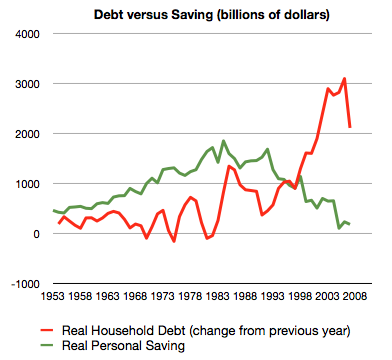
    graph of saving and debt

    The whole sorry mess in one picture (including chart) by Philip Brewer

    Take a gander at that graph. The green line is personal savings. The Bureau of Economic Analysis calculates that. It’s just income minus spending–the obvious way of figuring saving. The red line is debt. The Federal Reserve calculates that value. The value on the graph is the change from the previous year–that is, it shows each year’s new debt, just like the green line shows each year’s saving. Both values are adjusted for inflation–the graph is in billions of (year 2000) dollars.

    Starting back in about 2005, the American consumer reached the point that they could no longer service ever-increasing amounts of debt. That led to the housing bubble popping. The result is what you can see in the last datapoint on the graph–less new borrowing in 2007.

    Related: $2,540,000,000,000 in USA Consumer DebtAmericans are Drowning in Debtsave an emergency fundFinancial Illiteracy Credit Trapposts on saving money

  • Why America Needs an Economic Strategy

    In a recent article in Business Week Michael E. Porter makes some excellent points – Why America Needs an Economic Strategy:

    First, the U.S. has an unparalleled environment for entrepreneurship and starting new companies.

    Second, U.S. entrepreneurship has been fed by a science, technology, and innovation machine that remains by far the best in the world. While other countries increase their spending on research and development, the U.S. remains uniquely good at coaxing innovation out of its research and translating those innovations into commercial products.

    Third, the U.S. has the world’s best institutions for higher learning, and they are getting stronger. They equip students with highly advanced skills and act as magnets for global talent, while playing a critical role in innovation and spinning off new businesses.

    Fourth, America has been the country with the strongest commitment to competition and free markets.

    An inadequate rate of reinvestment in science and technology is hampering America’s feeder system for entrepreneurship. Research and development as a share of GDP has actually declined, while it has risen in many other countries.

    A creeping relaxation of antitrust enforcement has allowed mergers to dominate markets. Ironically, these mergers are often justified by “free market” rhetoric. The U.S. is seeing more intervention in competition, with protectionism and favoritism on the rise. Few Americans know that the U.S. ranks only 20th among countries in openness to capital flows, 21st on low trade barriers, and 35th on absence of distortions from taxes and subsidies

    I have discussed similar idea in this blog and the Curious Cat Science and Engineering Blog: The Future is EngineeringEngineering the Future EconomyScience GapNot Understanding Capitalism

  • Treasury Bought $125B in Bank Stocks

    On Tuesday the United States Treasury department purchased $125 billion of bank stocks becoming one of the largest stockholders in the world instantly.

    $25 billion was invested in Citigroup, JPMorgan Chase and Wells Fargo.

    $15 billion was invested in Bank of America and $10 billion in Merrill Lynch (which is being acquired by Bank of America).

    $10 billion was invested in Goldman Sachs and Morgan Stanley. And the treasury department invested $3 billion in Bank of New York Mellon $2 billion in State Street.

    Related: Goldman Sachs Rakes In Profit in Credit Crisis (Nov 2007)Warren Buffett Webcast on the Credit CrisisRodgers on the US and Chinese Economies (Feb 2008)Credit Crisis

  • Buy American Stocks. Buffett Is.

    Buy American. I Am. by Warren Buffett:

    The financial world is a mess, both in the United States and abroad. Its problems, moreover, have been leaking into the general economy, and the leaks are now turning into a gusher. In the near term, unemployment will rise, business activity will falter and headlines will continue to be scary.

    A simple rule dictates my buying: Be fearful when others are greedy, and be greedy when others are fearful. And most certainly, fear is now widespread, gripping even seasoned investors. To be sure, investors are right to be wary of highly leveraged entities or businesses in weak competitive positions. But fears regarding the long-term prosperity of the nation’s many sound companies make no sense.

    Let me be clear on one point: I can’t predict the short-term movements of the stock market. I haven’t the faintest idea as to whether stocks will be higher or lower a month — or a year — from now. What is likely, however, is that the market will move higher, perhaps substantially so, well before either sentiment or the economy turns up.

    Today people who hold cash equivalents feel comfortable. They shouldn’t. They have opted for a terrible long-term asset, one that pays virtually nothing and is certain to depreciate in value. Indeed, the policies that government will follow in its efforts to alleviate the current crisis will probably prove inflationary and therefore accelerate declines in the real value of cash accounts.

    Equities will almost certainly outperform cash over the next decade, probably by a substantial degree.

    Yet more great advice from Warren Buffett. I must admit I think buying stocks from the USA and elsewhere is wise, but there isn’t any reason to listen to me instead of him.

    Related: Financial Markets Continue Panicky BehaviorGreat Advice from Warren BuffettStock Market DeclineWarren Buffett’s 2004 Annual ReportDoes a Declining Stock Market Worry You?

  • Manufacturing Employment Data – 1979 to 2007

    I have had difficulty finding good economic data on manufacturing jobs. I have posted about this previously but have trouble finding much worth posting about: Worldwide Manufacturing Job DataManufacturing Jobs. The Unites States Department of Labor, Bureau of Labor Statistics has published some interesting data and so here is a look at some of that data.

    The table shows average annual productivity gains (output per hour, in USA dollars – I think it is not clear) – the 2007 output totals are from the United Nations data I posted about last week (Data on Top Manufacturing Countries).

    Average Annual Manufacturing Productivity Gains by Country
    Country 1979-1990 1990-1995 1995-2000 2000-2007 1979-2007 2007 Output
    $USA billion
    Taiwan 6.1 4.7 5.6 6.4 5.9
    Korea NA 9.4 10.8 7.6 NA 241
    USA 2.8 3.7 5.6 4.6 3.9 1,831
    France 3.8 3.4 4.6 3.5 3.8 296
    Japan 3.8 3.3 3.4 3.8 3.6 926
    United Kingdom 4.1 2.8 2.7 3.9 3.6 342
    Germany 2.1 2.9 3.7 3.8 3.0 670
    Spain 3.3 3.1 0.8 2.1 2.5 208
    Canada 2.1 3.4 3.8 1.1 2.4 218
    Italy 3.4 3.8 1.4 -.2 2.2 345

    The countries that were part of the study but are not included in the table above: Australia, Belgium, Denmark, Netherlands, Norway, Sweden.

    Manufacturing productivity increased in 14 of 16 countries in 2007, according to the study. The United States of America increase of 4.1 was the fourth largest among the 16 economies and was slightly above the 3.9 percent U.S. average annual increase since 1979. 15 of the 16 countries increased manufacturing output in 2007.

    9 countries increased manufacturing hours worked in 2007, the USA increased 2.3% (below their average increase since 1979). Hours worked decreased for all countries in the period of 2000-2007 (UK has had the largest decrease 3.9% annual average decrease, the USA in next at 3.1%).

    Manufacturing employment increased in 10 countries in 2007. From 2000-2007 the USA has experienced average annual declines of 3% in manufacturing employment (the second sharpest drop to the UK which has fallen 4%). From 1979-2007 the USA annual declines averaged 1.2% (only Taiwan.9% and Spain .1% showed increases). From 2000-2007 four countries show slight average annual increases: Spain .5%, Korea .4%, Taiwan .2% and Italy .2%. From 2000-2007 only 3 countries showed annual average decreases in output: Canada -.3%, Italy -.2% and UK – .1%.

    Hourly manufacturing compensation has increased in all countries for the period 1979-2007 (data shown for this item is in each national currency: USA 4.6% average annual increases, Spain up 7.2% annually, Taiwan up 7%, UK 6.8%, Germany 4.4%, Japan 4.2%.

    via: Canada’s Manufacturing Crisis in International Perspective

    Related: posts on employmentTop 10 Manufacturing Countries 2006