Tag: USA

  • Government Debt Compared to GDP 1990-2007

    Government debt as percent of GDP 1990-2007Chart showing government debt as a percentage of GDP by Curious Cat Investing Economics Blog, Creative Commons Attribution, data from OECD, Sept 2009.
                    

    For 2007 most countries slightly decreased their government debt to GDP ratio – as economic growth exceeded debt growth. The OECD is made up of countries in Europe and the USA, Japan, Korea, Australia, New Zealand and Canada. The overall OECD debt to GDP ratio decreased from 77% in 2005 to 75% in 2007. The USA moved in the opposite direction increasing from 62% to 63%: still remaining far below the OECD total. Most likely 2008, 2009 and 2010 will see both the USA and other OECD national dramatically increase the debt burden.

    Compared to the OECD countries the USA is actually better than average. The chart shows the percentage of GDP that government debt represents for various countries. The USA ended 2007 at 63% while the overall OECD total is 75%. In 1990 the USA was at 63% and the OECD was at 57%. Japan is the line way at the top with a 2007 total of 171% (that is a big problem for them). Korea is in the best shape at just a 29% total in 2007 but that is an increase from just 8% in 1990.

    Related: Government Debt as a Percentage of GDP Through 2006Oil Consumption by Country in 2007Federal Deficit To Double This YearPoliticians Again Raising Taxes On Your ChildrenTrue Level of USA Federal DeficitTop 12 Manufacturing Countries in 2007
    (more…)

  • Loan Delinquency Rates Increased Dramatically in the 2nd Quarter

    chart of loan default rates 1998 to 2009Chart showing loan delinquency rates for real estate, consumer and agricultural loans for 1998 to 2009 by the Curious Cat Investing Economics Blog, Creative Commons Attribution, data from the Federal Reserve.

    Delinquency rates on commercial (up another 151 basis points) and residential (93 basis points) real estate continued to increase dramatically in the second quarter. Credit card delinquency rates increased but only by 20 basis points.

    Real estate delinquency rates exploded in 2008. In the 4th quarter of 2007 residential delinquency rates were 3.02% by the 4th quarter of 2008 they were 6.34% and in the 2nd quarter of this year they were 8.84% (582 basis points above the 4th quarter of 2007). Commercial real estate delinquency rates were at 2.74% in the 4th quarter of 2007, 5.43% in the fourth quarter of 2008 and 7.91% in the 2nd quarter of 2009 (a 517 basis point increase).

    Credit card delinquency rates were much higher than real estate default rates for the last 10 years (the 4-5% range while real estate hovered above or below 2%). Now they are over 200 and 300 basis points bellow residential and commercial delinquency rates respectively. From 4.8% in the 3rd quarter 2008 to 5.66% in the 4th and 6.5% in the 1st quarter of 2009.

    The delinquency rate on other consumer loans and agricultural loan delinquency rates are up but nowhere near the amounts of real estate or credit cards.

    As I wrote recently bond yields in the last few months show a dramatic increase in investor confidence for corporate bonds.

    Data from the Federal Reserve

    Related: Loan Delinquency Rates: 1998-2009The Impact of Credit Scores and Jumbo Size on Mortgage Rates30 Year Mortgage Rate and Federal Funds Rate Chart

  • 2nd Quarter USA GDP down 1%

    chart of 2005-2009 quarterly gdp changesChart from the Bureau of Economic Analysis showing the quarter to quarter growth in real GDP from 2005-2009.

    Current-dollar GDP — the market value of the nation’s output of goods and services — decreased 1.0%, or $34.7 billion, in the second quarter to a level of $14,143.3 billion. In the first quarter, current-dollar GDP decreased 4.6%, or $169.3 billion.

    More details on 2nd quarter, 2009 GDP.

    Related: First Quarter GDP 2009 down 6.1%Economists Raise Projections for Second Half of 2009What the Bailout and Stimulus Are and Are Not

  • Oil Consumption by Country in 2007

    The largest oil consuming countries (and EU), in millions of barrels per day for 2007. China increased use by 1 billion barrels a day, the USA and Europe decreased use by 100 million barrels a day from our post last year on Oil Consumption by Country.

    Country consumption % of oil used % of population % of World GDP % of oil used in 2006
    USA 20.7 24.3 4.5 21.0 25.9
    European Union 14.4 16.9 7.4 21.9 18.1
    China 7.9 9.2 19.9 10.8 8.6
    Japan 5.0 5.8 1.8 6.5 6.7
    India 2.7 3.1 17.3 4.5 3.0
    Russia 2.7 3.1 2.0 3.1 3.6
    Germany 2.5 2.8 1.2 4.2 3.3
    Brazil 2.4 2.7 2.9 2.8 2.6
    Canada 2.4 2.7 0.4 1.9 2.9
    Mexico 2.1 2.4 1.6 2.0 2.6
    South Korea 2.1 2.4 0.7 1.8 2.7

    Data is from CIA World Factbook 2009 (downloaded August 2009). GDP calculated using purchasing power parity from 2008 fact book with estimated 2007 data.

    Related: Government Debt as a Percentage of GDPGlobal Manufacturing Production by CountryManufacturing Contracting Globally (March 2009)

  • Buffett on Need to Reduce Government Deficits

    The Greenback Effect by Warren Buffett

    The United States economy is now out of the emergency room and appears to be on a slow path to recovery.

    Because of this gigantic deficit, our country’s “net debt” (that is, the amount held publicly) is mushrooming. During this fiscal year, it will increase more than one percentage point per month, climbing to about 56 percent of G.D.P. from 41 percent. Admittedly, other countries, like Japan and Italy, have far higher ratios and no one can know the precise level of net debt to G.D.P.

    Legislators will correctly perceive that either raising taxes or cutting expenditures will threaten their re-election. To avoid this fate, they can opt for high rates of inflation, which never require a recorded vote and cannot be attributed to a specific action that any elected official takes.

    Our immediate problem is to get our country back on its feet and flourishing — “whatever it takes” still makes sense. Once recovery is gained, however, Congress must end the rise in the debt-to-G.D.P. ratio and keep our growth in obligations in line with our growth in resources.

    Unchecked carbon emissions will likely cause icebergs to melt. Unchecked greenback emissions will certainly cause the purchasing power of currency to melt. The dollar’s destiny lies with Congress.

    Related: Warren Buffett Webcast on the Credit CrisisThe Long-Term USA Federal Budget OutlookBerkshire Hathaway Annual Meeting 2008Federal Reserve to Buy $1.2 Trillion in Bonds, Mortgage-Backed Securities

  • Capacity Utilization Rate Up Slightly From All Time Low

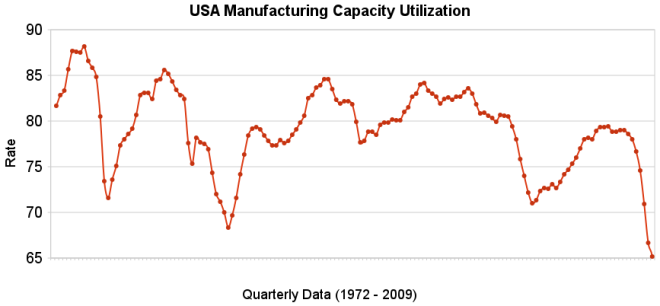
    chart of USA capacity utilization rate 1972-2009The chart shows the capacity utilization rate in the USA. By Curious Cat Investing Economics Blog, Creative Commons Attribution, data from the Federal Reserve.

    Industrial production increased .5% in July and capacity utilization rate increased to 68.5% from an all time low of 68.1%. Capacity utilization has averaged 80.9% from 1972 to today.

    Manufacturing output increased 1.0% in July but remained 14.4% lower than its year-earlier level. The factory operating rate rose to 65.4% in July, 70 basis points above the historical low recorded in June; the series begins in 1948. Production in durable goods industries advanced 2.2% in July. In addition to the sharp increase in motor vehicles and parts output, large production gains occurred for nonmetallic mineral products and for primary metals. The indexes for wood products, computer and electronic products, aerospace and miscellaneous transportation equipment, furniture and related products, and miscellaneous goods also rose. The indexes for fabricated metal products, machinery, and electrical equipment declined.

    The production of nondurable goods fell 0.1% in July. The indexes for textile and product mills and for printing and support recorded sizable declines; the indexes for food, beverages, and tobacco and for petroleum and coal products also declined. The output of paper, of chemicals, and of plastic and rubber products increased.

    The index for other manufacturing, which consists of publishing and logging, was down 0.6% in July.

    The output of electric and gas utilities decreased 2.4%, and the operating rate for utilities dropped 21 basis points, to 77.6%. Mining production moved up 0.8%; its utilization rate in July, at 81.7%, was 59 basis points below its 1972-2008 average.

    Data from the St. Louis Federal Reserve and Federal Reserve August 14th Industrial Production and Capacity Utilization press release.

    Related: Loan Default Rates: 1998-2009Government Debt as a Percentage of GDPUSA Spent $2.2 Trillion, 16.2% of GDP, on Health Care in 2007
    (more…)

  • Unemployment Rate Drops Slightly to 9.4%

    The USA unemployment rate dropped slightly to 9.4%. The economy lost 247,000 jobs which is both a sign the economy is not strong and also that it is improving (job losses from November through April were 645,000/month and 331,000/month from May through July). The job losses for May and June were both revised to show 20,000 fewer job losses each in the press release from the Bureau of Labor Statistics.

    The number of long-term unemployed (those jobless for 27 weeks or more) rose by 584,000 over the month to 5.0 million. In July, 1 in 3 unemployed persons were jobless for 27 weeks or more.

    The employment-population ratio, at 59.4%, was little changed over the month but has declined by 330 basis points since the recession began in December 2007. About 2.3 million persons were marginally attached to the labor force in July, 709,000 more than a year earlier (The data are not seasonally adjusted). These individuals, who were not in the labor force, wanted and were available for work and had looked for a job sometime in the prior 12 months. They were not counted as unemployed because they had not searched for work in the 4 weeks preceding the survey.

    In July, the average workweek of production and nonsupervisory workers on private nonfarm payrolls edged up by 0.1 hour to 33.1 hours. The manufacturing workweek increased by 0.3 hour to 39.8 hours. Factory overtime was unchanged at 2.9 hours.

    This news supports the increasing livelihood of a weak recovery taking hold during 2009 – which is frankly pretty amazing in my opinion. The economy could certainly have taken longer to recover. Still, more job losses and an increasing unemployment rate are likely before the end of 2009.

    Related: Another 450,000 Jobs Lost in JuneUSA Unemployment Rate Jumps to 9.4% (May 2009)USA Unemployment Rate Rises to 8.1%, Highest Level Since 1983 (March 2009)
    (more…)

  • The Long-Term USA Federal Budget Outlook

    The decisions over the past 30 years to pass huge huge tax bills to those in the future is unsustainable. Saying you cut taxes when all you actually do is postpone them is dishonest. However, many people go along with such false statements so politicians have learned to buy votes today by raising taxes on the future. Since the public keeps voting for such people when the facts are clear the only explanation is they support raising taxes, not today, but in the future (or, I suppose, they are not able to understand the clear implications of what they vote for). The Long-Term Budget Outlook

    Under current law, the federal budget is on an unsustainable path, because federal debt will continue to grow much faster than the economy over the long run. Although great uncertainty surrounds long-term fiscal projections, rising costs for health care and the aging of the population will cause federal spending to increase rapidly under any plausible scenario for current law.

    For decades, spending on Medicare and Medicaid has been growing faster than the economy. CBO projects that if current laws do not change, federal spending on Medicare and Medicaid combined will grow from roughly 5 percent of GDP today to almost 10 percent by 2035. By 2080, the government would be spending almost as much, as a share of the economy, on just its two major health care programs as it has spent on all of its programs and services in recent years.

    CBO projects that Social Security spending will increase from less than 5 percent of GDP today to about 6 percent in 2035 and then roughly stabilize at that level.

    Federal interest payments already amount to more than 1 percent of GDP; unless current law changes, that share would rise to 2.5 percent by 2020.

    The cost of paying for a dysfunctional medical system has been a huge drain on the USA economy for decades. But that is nothing compared to what the future holds if we don’t adopted sensible strategies that reduce the huge extra costs we pay and the worse performance we receive for that cost.

    Social security is not the huge problem many think it is. Still I would support reducing the payout to wealthy individuals and bringing the age limits more in line with the changes in life expectancy. 12.4% of pay for low and middle wage workers (high income earners stop paying social security taxes so in effect marginal tax rates decrease by 12% for any income above $106,800). Medicare taxes add 2.9% bringing the total social security and Medicare taxes to 15.1% (including both the amount paid directly by the employee and the amount paid for the employee by the employer).

    Related: True Level of USA Federal DeficitUSA Federal Debt Now $516,348 Per Householdquotations about economicsarticles on improving the health care systemUSA Spent $2.2 Trillion, 16.2% of GDP, on Health Care in 2007

  • Economists Raise Projections for Second Half of 2009

    Economists are raising projections for the USA economy in the second half of 2009. The predictions are still for an anemic economy growing at just 1.5% and with unemployment reaching 10.1%. Still I think if we achieve that we should feel lucky. Economists Raise U.S. Outlook as Recession Fades

    Growth will average 1.5 percent in the July-to-December period, compared with last month’s 1.2 percent projection, according to the median of 57 forecasts in the survey taken from July 2 to July 8. The jobless rate will exceed 10 percent early next year and average 9.8 percent for 2010.

    The economy probably shrank at a 1.8 percent rate from April to June, the latest survey showed, less than economists forecast last month. The U.S. will return to growth in the current quarter and expand 2.1 percent next year.

    A separate report from the Commerce Department today showed the trade deficit unexpectedly narrowed in May as exports jumped while imports of crude oil and auto parts slid. The gap between imports and exports decreased 9.8 percent to $26 billion, the smallest since November 1999, from $28.8 billion in April.

    Unemployment will rise to 10.1 percent in the first quarter of 2010 from 9.5 percent last month, already the highest since August 1983, the survey of economists showed.

    The trade deficit is still far to large. And the to move the economy in the right direction we need to continue reducing personal debt (and start reducing government debt).

    Related: First Quarter GDP 2009 down 6.1%When Will the Recession Be Over?Warren Buffett Webcast on the Credit Crisis

  • Another 450,000 Jobs Lost in June

    Nonfarm payroll employment continued to decline in June (by 467,000), and the unemployment rate increased to 9.5% (with a total of 14.7 million unemployed), the Bureau of Labor Statistics of the U.S. Department of Labor reported today. Job losses were widespread across the major industry sectors, with large declines occurring in manufacturing, professional and business services, and construction.

    Since the start of the recession in December 2007, the number of unemployed persons has increased by 7.2 million, and the unemployment rate has risen by 460 basis points (from 4.9% to 9.5%). The number of long-term unemployed (those jobless for 27 weeks or more) increased by 433,000 over the month to 4.4 million. In June, 30% of unemployed persons were jobless for 27 weeks or more.

    Employment in manufacturing fell by 136,000 over the month and has declined by 1.9 million during the recession. Health care employment increased by 21,000 in June. Job gains in health care have averaged 21,000 per month thus far in 2009, down from an average of 30,000 per month during 2008.

    The number of persons working part time for economic reasons (sometimes referred to as involuntary part-time workers) was little changed in June at 9.0 million. Since the start of the recession, the
    number of such workers has increased by 4.4 million.

    About 2.2 million persons (not seasonally adjusted) were marginally attached to the labor force in June, 618,000 more than a year earlier. These individuals wanted and were available for work and had looked for a job sometime in the past 12 months. They were not counted as unemployed because they had not searched for work in the 4 weeks preceding the survey.

    Related: posts on employmentUnemployment Rate Increased to 8.9%Can unemployment claims predict the end of the American recession?The Economy is in Serious TroubleOver 500,000 Jobs Disappeared in November 2008