Category: Investing

  • House for Rent in Arlington, Virginia

    photo of house

    I am renting my house in Arlington, Virginia. If you are interested here is a great house with a large yard in a wonderful, quiet neighborhood near the Washington DC metro, great restaurants, parks, shopping and more. See more pictures of the house and floorplans.

    Related: backyard wildlifeApartment Vacancies Fall to Lowest in 3 Years in the USAApartment Rents Rise, Slightly, for First Time in 5 Quarters (April 2010)
    (more…)

  • USA Added 244,000 Jobs in April

    Nonfarm payroll employment rose by 244,000 in April, and the unemployment rate edged up to 9.0% (from 8.8%) as the labor force grew slightly, the U.S. Bureau of Labor Statistics reported today. Also the number of jobs added is taken from the household survey while the unemployment rate is taken from the business payroll survey (they often have slightly different readings month to month). I, and many others, suspected the 8.8% figure might have been a bit low (and frankly the 9% figure may as well). In April of 2010 the unemployment rate was at 9.9%.

    The change in total nonfarm payroll employment for February was revised from +194,000 to +235,000, and the change for March was revised from +216,000 to +221,000. Bringing the total jobs added with this report to 290,000 (244,000 + 41,000 + 5,000) – which is a very good result. Now if we can keep this up for a year that would be great. Overall this provides very encouraging news on the job front.

    The number of unemployed persons stands at 13.7 million, up a little in April. Unemployment rates for several groups stood at: adult men 8.8%, adult women 7.9%, teenagers 24.9%, whites 8.0%, blacks 16.1%, Hispanics 11.8% and for Asians was 6.4%.

    In another positive sign, the number of long-term unemployed (those jobless for 27 weeks and over) declined by 283,000 to 5.8 million; their share of unemployment declined to 43.4%. This is still a serious problem, but at least it is improving a bit.

    The civilian labor force participation rate was 64.2% for the fourth consecutive month. The employment-population ratio, at 58.4%, changed little in April.

    The private sector added 268,000 jobs. Employment rose in a number of service-providing industries, manufacturing, and mining. Since a recent low in February 2010, total payroll employment has grown by 1.8 million. Private sector employment has increased by 2.1 million over the same period.

    Manufacturing employment rose by 29,000 in April. Since reaching an employment low in December 2009, manufacturing has added 250,000 jobs, including 141,000 in 2011. This is more great news. There has been real strength in manufacturing. Manufacturing is a real source of strength and if it can continue to be strong that will be very good news.

    Related: USA Adds 216,00 Jobs in March and the Unemployment Rate Stands at 8.8%USA Added 290,000 Jobs In April 2010Unemployment Rate Increased to 8.9% in April 2009USA Unemployment Rate Rises to 8.1%, Highest Level Since 1983
    (more…)

  • Amazon Keeps Spending, Sales Growing But Not Income

    I think Amazon is a great company and Jeff Bezos is a great leader. I sold the stock I had in Amazon hoping that prices would fall and I could buy it back (I sold a small portion held in my 12 stock for 10 year portfolio). So far that hasn’t worked. The latest earnings from Amazon were more of the same. Very good revenue growth (up 38% to $9.86 billion). Very large increases in spending. And bad earnings news (net income down 33% year over year). I think this is due to smart choices by Amazon (I would be a bit more focused on current earnings but I understand the vision of Bezos and it is very wise and support it).

    Normally the stock market punishes this type of pattern. Even Google, that has a similar pattern (but with much better earnings growth), has a stock price that has been held back much more. This quarter investors again punished Google for good earning growth but also high expense growth. Amazon avoided that response, even with shrinking earnings and guidance of lower earnings. Jeff Bezos wrote about these decisions to invest in increasing expenses in Amazon’s shareholder letter

    The advances in data management developed by Amazon engineers have been the starting point for the architectures underneath the cloud storage and data management services offered by Amazon Web Services (AWS). For example, our Simple Storage Service, Elastic Block Store, and SimpleDB all derive their basic architecture from unique Amazon technologies.

    All the effort we put into technology might not matter that much if we kept technology off to the side in some sort of R&D department, but we don’t take that approach. Technology infuses all of our teams, all of our processes, our decision-making, and our approach to innovation in each of our businesses. It is deeply integrated into everything we do.

    And we like it that way. Invention is in our DNA and technology is the fundamental tool we wield to evolve and improve every aspect of the experience we provide our customers. We still have a lot to learn, and I expect and hope we’ll continue to have so much fun learning it. I take great pride in being part of this team.

    Operating cash flow increased 9% to $3.03 billion for the trailing twelve months, compared with $2.78billion for the trailing twelve months ended March 31, 2010. Free cash flow decreased 18% to $1.90 billion for the trailing twelve months, compared with $2.32 billion for the trailing twelve months ended March 31, 2010.

    Operating income was $322 million in the first quarter, compared with $394 million in first quarter 2010. Net income decreased 33% to $201 million in the first quarter, or $0.44 per diluted share, compared with net income of $299 million, or $0.66 per diluted share, in first quarter 2010.

    I continue to think Amazon is being a bad corporate citizen by fighting efforts to have Amazon play its proper role in the collection of sales tax. Ethics mean doing the right thing even if it costs you something personally. Amazon continues to act as an organization that fights what is right for society for their own greedy reasons. This is the worst behavior Bezos continues to push and does indicated a refusal to accept the responsibilities of participation in a society. Overall I believe Bezos does many great things but this disrespect for our society is a serious ethical problem.

    Related: Amazon Soars on Good Earnings and Projected Sales (Oct 2009)12 Stocks for 10 Years: Feb 2011 UpdateAnother Great Quarter for Amazon (July 2007)Amazon’s Bezos on Lean Thinking

  • Google’s Earnings Grow 17%, but Investors Unhappy

    Google again had some pretty spectacular earnings. Google reported revenues of $8.58 billion for the quarter ended March 31, 2011, an increase of 27% compared to the first quarter of 2010. GAAP net income in the first quarter of 2011 was $2.30 billion, compared to $1.96 billion in the first quarter of 2010. Non-GAAP net income in the first quarter of 2011 was $2.64 billion, compared to $2.18 billion in the first quarter of 2010.

    Operating expenses, other than cost of revenues (which are essentially just a revenue split with sites showing Google ads), were $2.84 billion in the first quarter of 2011, or 33% of revenues, compared to $1.84 billion in the first quarter of 2010, or 27% of revenues. The growth in expenses and reduction in the profit margin is the biggest concern for invests and why Google’s stock is down 6% today.

    GAAP operating income in the first quarter of 2011 was $2.80 billion, or 33% of revenues. This compares to GAAP operating income of $2.49 billion, or 37% of revenues, in the first quarter of 2010. Non-GAAP operating income in the first quarter of 2011 was $3.23 billion, or 38% of revenues. This compares to non-GAAP operating income of $2.78 billion, or 41% of revenues, in the first quarter of 2010.

    Google-owned sites generated revenues of $5.88 billion, or 69% of total revenues, in the first quarter of 2011. This represents a 32% increase over first quarter 2010 revenues of $4.44 billion. Google ads on other companies web sites grew at a 19% rate. Revenues from outside of the United States totaled $4.57 billion, representing 53% of total revenues in the first quarter of 2011, compared to 52% in the fourth quarter of 2010 and 53% in the first quarter of 2010.

    From 2006 to 2010 Google’s revenue grew at a 29% annual rate, as did net income. The price of the stock was $460 on December 31, 2006. For 2006 per share earnings were $9.94. At the end of 2010 Google sold at $594 and in 2010 earnings per share were $26.31. Today the price is $535. Yes it is likely earnings will not grow at a 29% annual rate over the next 5 years (and this quarter they grew at 17% – so slower than the previous 4 years). 17% is hardly a bad performance.
    (more…)

  • Apartment Vacancies Fall to Lowest in 3 Years in the USA

    Apartment Vacancies in U.S. Fall to Lowest in Almost Three Years

    The vacancy rate declined to 6.2 percent from 8 percent a year earlier and 6.6 percent in the fourth quarter of 2010, the New York-based research firm said in a report today. The rate was the lowest since it reached 6.1 percent in the second quarter of 2008.

    Effective rents, or what tenants actually pay, increased in 75 of the 82 markets Reis tracks, to an average $991 a month from $967 a year earlier and $986 in the fourth quarter. Landlords’ asking rents also climbed, to $1,047 from $1,027 a year earlier and $1,043 in the previous quarter, according to the report.

    San Jose, California, had the most growth in effective rents during the past year, with 5.2 percent, followed by suburban Virginia and New York City, according to Reis. Effective rents declined 1.5 percent in Las Vegas during the year and grew the least in Orlando, Florida; and Colorado Springs, Colorado.

    Rents have been slowly recovering the last year, after the economic shocks of the credit crisis. People, moved back into parents house and more people started sharing apartments and houses in the last few years as people where thrown out of jobs due to the after effects of the financial actions by large financial institutions. Slowly the economy has been recovering and jobs have been slowly growing and as a result the rental market has been strengthening .

    Also the decline in construction the last few years has decreased the normal addition to supply. At the same time the population has continued growing. Some areas of the country seem to still have a large overcapacity in housing but areas that are adding jobs (such as Northern Virginia and New York City) are seeing increasing rents.

    I have 2 properties for rent in Arlington, Virginia.

    Related: Landlords See Increase in Apartment Rentals (July 2010)USA Housing Inventory Puts Pressure on Prices (Sep 2010)Apartment Rents Rise, Slightly, for First Time in 5 Quarters (Apr 2010)It’s Now a Renter’s Market (Apr 2009)Housing Rents Falling in the USA (Feb 2009)

  • Top Countries For Renewable Energy Capacity

    I believe it is wise from an environmental and economic viewpoint to invest in renewable energy projects. I believe the costs of fossil fuel based energy will continue to increase. Renewable energy is continuing to improve and when considering the negative externalities caused by oil, gas and coal and the continuing improvement in wind, solar and geothermal generation investment in renewable energy are going to payoff well for countries.

    Top countries for installed renewable energy capacity
    Rank Country Capacity (GigaWatts)
    1 China 103.4
    2 USA 58.0
    3 Germany 48.9
    4 Spain 27.8
    5 Japan 26.0
    6 India 18.7
    7 Italy 16.7
    8 Brazil 13.8
    9 France 9.6

    The largest increases in renewable energy capacity by country from 2005 to 2010 are: China (up 106%), South Korea (up 88%), Turkey (up 85%), Germany (up 67%), Italy and Japan (up 45%). All the data is from the Pew Clean Engery Program report: Who’s Winning the Clean Energy Race? (pdf).

    In 2010, [China] accounted for almost 50 percent of global clean energy superpower. The nation’s all manufacturing of solar modules and wind ascendance has been steady and steep. In turbines. China’s installation of less than 1 GW of 2005, China attracted less than $3 billion worth of private investments in clean energy. In 2009, solar energy capacity demonstrates that most of its production is for export markets. In contrast, 17 GW of wind energy was installed in China in 2010 helping the nation move quickly toward its 2020 target for installing 150 GW of wind. In fact, China accounted for 47 percent of all wind energy investments globally, with $45 billion tallied. Similarly, China led the world in asset financing, with $47.3 billion in private investments directed toward installation of clean energy generating capacity.

    India is poised to take a leadership role in the solar sector, with a target of deploying 20 GW by 2020. In 2010, the country set about getting its National Solar Mission in place by permitting 0.5 GW worth of large solar thermal capacity and a modest 150 MW worth of photovoltaic (PV) solar.

    My guess is that the stimulus packages in several countries contributed greatly to the increases (notably Germany and Italy targeted green investments – as did China to some extent, in Wind Energy). Spain took a hit as debt levels caused the government to cut spending. I would imagine this is likely to happen in Italy (and was expected to happen in Germany – the extent of decreases is less certain after the earthquake in Japan).

    Related: Chart of oil consumption by country from 1990-2009Wind Power Capacity Up 170% Worldwide from 2005-2009Japan to Add Personal Solar Subsidies (2008)Chart of Top Nuclear Power Generating Countries from 1985 to 2009Wind Power has the Potential to Produce 20% of Electricity Supply by 2030

    (more…)

  • Buffett Cautions Against Buying Long Term USD Bonds

    This is another article supporting my belief that long term bonds are not investments I want to take on now. The risks of inflation and low yields seem like a very bad combination.

    Buffett Says Avoid Long-Term Bonds Tied to Eroding Dollar, quoting Warren Buffett:

    “I would recommend against buying long-term fixed-dollar investments”

    “I would much rather own businesses,” he said. “It’s very easy to take away the value of fixed-dollar investments.”

    By “take away” he mean the government can undertake policies to “inflate” their way out of a budget mess. By undertaking policies that create inflation (drastically increasing the money supply, borrowing huge amounts of money, running huge trade deficits…) the country can devalue the currency, the US dollar in this case, and thus reduce the effective cost of the payments they have to make on long term bonds (because they pay back the loans with devalued, inflated, dollars). I believe he is right and long term USD bonds are a very risky (inflation risk) investing option today. Of course I have felt the same way for the last 5 years. I own very little in the way of bonds – I do own a bit of TIPS (Treasury Inflation-Protected Securities), in my 401(k) – but stopped allocating money to that class in the last year.

    Related: Bill Gross Warns Bond Investors (March 2010)Bond Yields Stay Very Low, Treasury Yields Drop Even MoreWho Will Buy All the USA’s Debt?

  • Consumer and Real Estate Loan Delinquency Rates 2000-2010

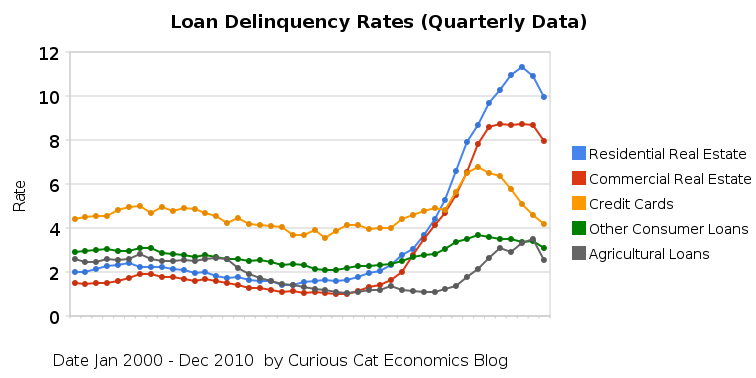
    The chart shows the total percent of delinquent loans by commercial banks in the USA.

    chart showing consumer and real estate loan delinquency rates from 2000 to 2010

    The second half of 2010 saw real estate, agricultural, credit card and other loan delinquencies decrease. The rates are still quite high but at least are moving in the right direction. Residential real estate delinquencies decreased 138 basis points in the second half of 2010, to 9.94%, which brought them to just below the rate at the end of 2009. In the second half of 2010, commercial real estate delinquencies decreased 77 basis points to 7.97% (which was also exactly 77 basis points less than at the end of 2009. Agricultural loan delinquencies decreased 76 basis points, to 2.55% (down 53 basis points from the end of 2009). Consumer loan delinquencies decreased, with credit card delinquencies down 90 basis points to 4.17% and other consumer loan delinquencies down 27 basis points to 3.1%. The credit card delinquency rate decreased a very impressive 219 basis points in 210.

    Related: Real Estate and Consumer Loan Delinquency Rates 2000 through June 2010Real Estate and Consumer Loan Delinquency Rates 1998-2009Bond Rates Remain Low, Little Change in Late 2009posts with charts showing economic data
    (more…)

  • Retirement: Roth IRA Earnings and Contribution Limits

    For 2010 and 2011, the most that an individual can contribute to a traditional IRA or Roth IRA generally is the smaller of: $5,000 ($6,000 if the individual is age 50 or older), or the individual’s taxable compensation for the year. You have until your taxes are due (April 15th, 2011) to add to your IRA for 2010.

    This is the most that can be contributed regardless of whether the contributions are to one or more traditional or Roth IRAs or whether all or part of the contributions are nondeductible. However, other factors may limit or eliminate the ability to contribute to an IRA as follows:

    • An individual who is age 70½ or older cannot make regular contributions to a traditional IRA (just to make things complicated you can add to a Roth IRA) for the year.
    • Contributions to a Roth IRA are limited based on income. The limits are based on modified adjusted gross income (which is before deductions are taken). The Roth IRA earnings limits for 2010 are:

    • Single filers: Up to $105,000; from $105,000 – $120,000 (a partial contribution is allowed)
    • Joint filers: Up to $167,000; from $167,000 – $177,000 (a partial contribution)

    For 2011 the earning limits increase to

    • Single filers: Up to $105,000; from $107,000 – $122,000 (a partial contribution is allowed)
    • Joint filers: Up to $167,000; from $169,000 – $179,000 (a partial contribution)

    More details from the IRS website and earning limits details.

    The income limits do not cap what you can add using a 401(k). So if you were planning on adding to a Roth IRA but cannot due to the income limits you may want to look into increasing your 401(k) contributions.

    Related: Add to Your Roth IRAAdd to Your 401(k) and IRA401(k)s are a Great Way to Save for Retirement

  • Curious Cat Investing and Economics Carnival #12

    Welcome to the Curious Cat Investing and Economics Carnival: find useful recent personal finance, investing and economics blog posts and articles.

    • The Myth of Japan’s ‘Lost Decades’ by Eamonn Fingleton – “Japan’s surplus is up more than five-fold since 1990. And, yes, far from falling against the dollar, the Japanese yen has actually boasted the strongest rise of any major currency in the last two decades. How can such facts be reconciled with the ‘two lost decades’ story? I don’t think they can.”
    • Investment Risk Matters Most as Part of a Portfolio, Rather than in Isolation by John Hunter – “It is not less risky to have your entire retirement in treasury bills than to have a portfolio of stocks, bonds, international stocks, treasury bills, REITs… This is because their are not just risk of an investment declining in value. There are inflation risks, taxation risks…” (including structural imbalances introduced by the Feb depressing short term yields to provide billions to large banks from the pockets of savers).
    • Cheating Investors As Official Government Policy by Daniel R. Amerman – “When you put your savings into a money market fund, and the policy of the US government is to force interest rates to unnaturally low levels – you are being cheated out of the yield you should be receiving. When you buy a corporate bond or corporate bond fund – you are being cheated by overt government market interventions that have the explicitly stated purpose of lowering corporate borrowing costs.”
    • Force Yourself to Save by – “Save 50% of any bonus or raise… Theoretically you could save 100% of your raise and maintain the same lifestyle, but that’s no fun. What’s the point of a raise if it doesn’t include a new PS3?” (I have long favored putting a portion of each raise toward a saving plan – John)
    • Who holds the most U.S. Treasuries in the world? (Hint: It’s not China.) by James Jubak – “For a while China was the biggest holder of U.S. government debt. But now with $896 billion China has slipped to No. 2. As of last week, the leader of the pack is—the envelope, please–the New York Fed, which holds the Federal Reserve’s Treasury bills, notes, bonds, and TIPs. (TIPS are Treasury Inflation Protected Securities.) As of last week the Fed’s System Open Market Account held $1,108 billion in U.S. government debt. “
    • 15 Things You Need to Do, Before Reading Another Financial Blog – “Set up a system to monitor your next goal – Now that you have a goal, set up a system to monitor your progress. I have Mint email monthly progress reports on my financial goals. Another way is track your goal is by doing a monthly review.”
    • How Much House Can You Afford? by Ryan Guina – “if your mortgage payment is expected to jump $500 a month, set that money aside for a few months as part of your normal budgeting. Do this for other spending categories that may increase, such as utilities, home owner’s insurance, taxes, etc.”
    • MERS: Stop Foreclosing in Our Name by Barry Ritholtz – “Allow me to spell this out for you more specifically: MERS is an abomination, a legal blasphemy that should be destroyed before it unleashes the four horsemen of the apocalypse.”

    Related: investing booksarticles on investingCurious Cat Investing and Economics Search