Tag: USA

  • Consumer Debt Down, but Still Over $2.4 Tillion in the USA

    Consumers debt decreasing very slowly. In the 3rd quarter it decreased at an annual rate of 1.5%, after decreasing at a 3.25% rate in the second quarter. Revolving credit (credit card debt) decreased at an annual rate of 8.5% (compared to 9.5% in the second quarter), and nonrevolving credit (car loans…, not including mortgages) was up 2.5% (versus essentially unchanged).

    Revolving consumer debt now stands at $814 billion down $52 billion this year. That is on top of a $92 decline in 2009. Hopefully we can increase the size of the decrease going forward. As individuals we should aim to have no consumer debt and build up cash reserves instead (the way the debt figures are calculated though, even if you don’t really have any debt, say you pay off your credit card bill each month, I believe your balance is still seen as “debt”, it is credit extended to you).

    On September 30, 2010 total outstanding consumer debt was $2,411 billion (a decline of just $8 billion in the 3rd quarter, after a decline of $21 billion in the 2nd quarter). This still leaves over $8,000 in consumer debt for every person in the USA and $20,000 per family.

    Consumer debt grew by about $100 billion each year from 2004 through 2007. In 2009 consumer debt declined over $100 billion: from $2,561 billion to $2,449 billion. For the first 3 quarters of 2010 it has declined just $38 billion.

    The huge amount of outstanding consumer and government debt remains a burden for the economy. At least some progress is being made to decrease consumer debt. Credit card delinquency rates have actually been decreasing the last couple of year (from a high of 6.75% in the 2nd quarter of 2009 to 5% in the 2nd quarter of 2010 (I would guesstimate the average for the decade was 4.5%).

    Those living in USA have consumed far more than they have produced for decades. That is not sustainable. You don’t fix this problem by encouraging more spending and borrowing: either by the government or by consumers. The long term problem for the USA economy is that people have consuming more than they have been producing.

    We can’t afford to seek even more short term spending powered by more debt. Government debt has been exploding so unfortunately that problem has continued to get worse.

    Data from the federal reserve.

    Related: Consumers Continue to Slowly Reduce Their Debt LevelThe USA Economy Needs to Reduce Personal and Government DebtConsumer debt needs to decline much more.
  • 3rd Quarter USA GDP Up 3% from 2009

    Real gross domestic product increased at an annual rate of 2.0% in the third quarter, reaching a annual rate of $14,730 billion (that is, from the second quarter to the third quarter), according to the “advance” estimate released by the Bureau of Economic Analysis. In the second quarter, real GDP increased 1.7%. The 3rd quarter real USA GDP was up 3.1% compared to the 3rd quarter of 2009. Just scanning the headlines gives a hint why investors are moving money into emerging markets: China up 9.6%, India 8.8%, Brazil 8.8%.

    The third-quarter advance estimate released today is based on source data that are incomplete or subject to further revision (the “second” estimate for the third quarter, based on more complete data, will be released on November 23, 2010).

    The increase in real GDP in the third quarter primarily reflected positive contributions from
    personal consumption expenditures (PCE), private inventory investment, nonresidential fixed
    investment, federal government spending, and exports that were partly offset by a negative contribution from residential fixed investment. Imports, which are a subtraction in the calculation of GDP, increased.

    The small acceleration in real GDP in the third quarter primarily reflected a sharp deceleration in imports and accelerations in private inventory investment and in PCE that were partly offset by a downturn in residential fixed investment and decelerations in nonresidential fixed investment and in exports.

    The price index for gross domestic purchases, which measures prices paid by U.S. residents,
    increased 0.8% in the third quarter, compared with an increase of 0.1% in the second. Real personal consumption expenditures increased 2.6% in the third quarter, compared
    with an increase of 2.2% in the second. Durable goods increased 6.1%, compared with an
    increase of 6.8%.

    Related: Initial 4th Quarter 2009 Data Show USA GDP Increased at 5.7% Annual RateFirst Quarter 2009 USA GDP Down 6.1%India Grew GDP 8.6% in First QuarterChina Economy Grows 11.9% in 1st Quarter
    (more…)

  • Government Debt as Percentage of GDP 1990-2009: USA, Japan, Germany, China…

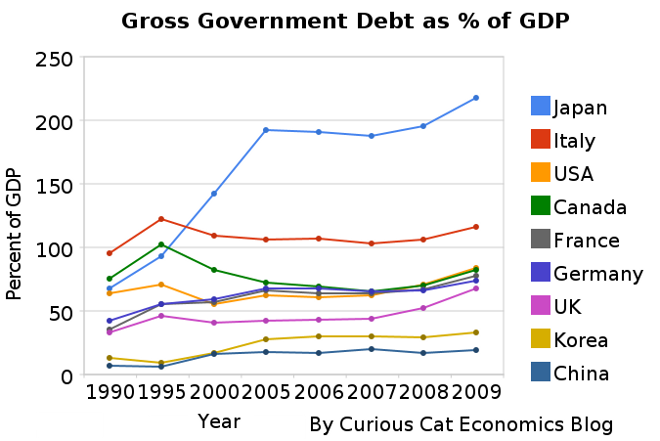
    The world today has a much different economic landscape than just 20 years ago. China’s amazing economic growth is likely the biggest story. But the overwhelming success of many other countries is also a huge story. Today it is not the developing world that has governments spending taxes they promise their grandchildren will pay, but instead the richest countries on earth that choose to spend today and pay tomorrow. While “developing” countries have well balanced government budgets overall.

    graph showing government debt as percentage of GDPThe chart shows gross government debt as percentage GDP from 1990-2009. By Curious Cat Investing and Economics Blog, Creative Commons Attribution. Data source: IMF
    ___________________________

    There are plenty of reasons to question this data but I think it gives a decent overall picture of where things stand. It may seem like government debt should be an easy figure to know but even just agreeing what would be the most reasonable figure for one country is very difficult, comparing between countries gets even more difficult and the political pressures to reduces how bad the data looks encourages countries to try and make the figures look as good as they can.

    The poster child for irresponsible spending is Japan which has gross government debt of 218% of GDP (Japan’s 2009 figure is an IMF estimate). Greece is at 115%. Gross debt is not the only important figure. Government debt held within the country is much less damaging than debt held by those outside the country. Japan holds a large portion of its own debt. If foreigners own your debt then debt payments you make each year are paid outside your country and it is in essence a tax of a portion of your economic production that must be paid. If the debt is internal it mean taxpayers have to support bond holders each year (but at least when those bondholders spend the money it stays within your economy).
    (more…)

  • More than half of the USA Federal Government Debt Held in USA Again

    U.S. Investors Regain Majority Holding of Treasuries

    For the first time since the start of the financial crisis in August 2007, U.S. investors own more Treasuries than foreign holders.

    Mutual funds, households and banks have boosted the domestic share of the $8.18 trillion in tradable U.S. debt to 50.2 percent as of May, according to the most recent Treasury Department data.

    The biggest jump in demand this year among domestic buyers of Treasuries has been commercial lenders. Bank holdings of Treasury and agency securities increased 5 percent to $1.57 trillion last month, according to the latest data available from the Fed.

    The Fed’s decision to hold its target for the overnight lending rate at a record low has made it possible for banks to borrow at near-zero interest rates to finance purchases of longer-term and higher-yielding Treasuries while lending less.

    I must say, unless you are getting special government interest free loans to invest in treasuries (like those that caused the credit crisis are) it seems crazy to me to invest at these low rates. In retirement, it probably does make sense to have some just as a diversification measure but other than that I would certainly reduce my holdings from what they would have been 10 years ago.

    If politicians or the fed would just give special favors to me to borrow billions and essentially 0% and then lend it back for more I would take that deal.

    But if I am not granted the welfare Chase, Goldman Sachs, Citibank and the rest are (with huge amounts of free money and bailouts if their bets fail) buying extremely low yield government debt is not an investment I want. I don’t think betting on deflation is not a bet I want to take. Inflation seems a bigger risk to me. But people get to make their own decisions, and we will see which investors are right.

    Related: Paying Back Direct Cash from Taxpayers Does not Excuse Bank MisdeedsCan Bankers Avoid Taking Responsibility Again?What the Financial Sector Did to Us

  • USA Economy Lost 125,000 Jobs and Unemployment Rate Decreased to 9.5%

    Total nonfarm payroll employment declined by 125,000 in June, and the unemployment rate edged down to 9.5 percent, the U.S. Bureau of Labor Statistics reported today. The decline in payroll employment reflected a decrease (-225,000) in the number of temporary employees working on Census 2010. Private-sector payroll employment edged up by 83,000. I will be amazed if the unemployment rate is not higher 3 months from now. And I will be surprised if we don’t add over 400,000 jobs in the next 3 months.

    Both the number of unemployed persons, at 14.6 million, and the unemployment rate, at 9.5 percent, edged down in June. Among the major worker groups, the unemployment rate for adult women (7.8%) declined, while the rates for adult men (9.9%) and teenagers (25.7%) showed little or no change.

    In June, the number of long-term unemployed (those jobless for 27 weeks and over) was unchanged at 6.8 million. These individuals made up 45% of unemployed persons. The civilian labor force participation rate fell by 0.3 percentage point in June to 64.7%. The employment-population ratio, at 58.5%, edged down over the month.

    There were 1.2 million discouraged workers in June, up by 414,000 from a year earlier. (The data are not seasonally adjusted.) Discouraged workers are persons not currently looking for work because they believe no jobs are available for them.

    Total nonfarm payroll employment decreased by 125,000 in June, reflecting the departure of 225,000 temporary Census 2010 workers from federal government payrolls. Total private employment edged up over the month (+83,000). So far this year, private-sector employment has increased by 593,000 but in June was 7.9 million below its December 2007 level.

    Health care employment edged up in June (+9,000). Over the past 12 months, the industry has gained 217,000 jobs. Manufacturing employment continued to trend up over the month (+9,000). The industry has added 136,000 jobs since December 2009. Construction employment decreased by 22,000 in June, with the largest decline in nonresidential specialty trade contracting. On net, construction employment has shown little change over the last 4 months.

    Related: Unemployment Rate Drops to 9.7% But Job Gains DisappointUSA Added 290,000 Jobs In April 2010Unemployment Rate Reached 10.2% (Oct 2009)
    (more…)

  • Manufacturing Output as a Percent of GDP by Country

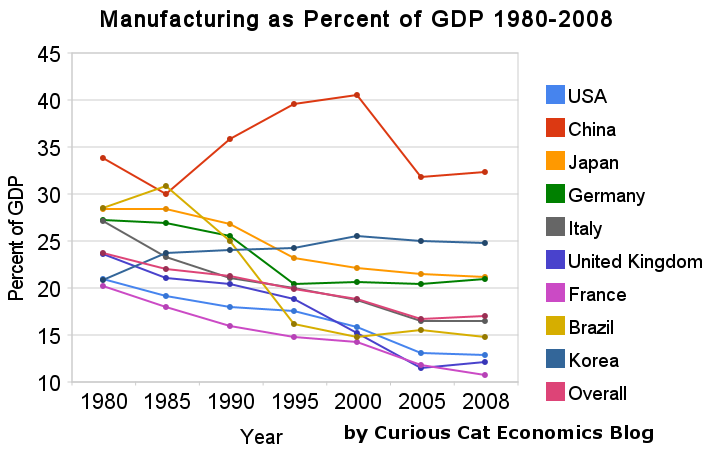
    In previous posts I have shown data for global manufacturing output by country. One of the things those posts have showed is that manufacturing output in China is growing tremendously, but it is also growing in the United States. The chart below shows manufacturing production by country as a percent of GDP. China dominates again, with over 30% of the GDP from manufacturing.

    chart of manufacturing output as percent of gdp by country 1980-2008

    Chart showing manufacturing output, as percent of GDP, by country was created by the Curious Cat Economics Blog based on UN data* (based on current USA dollars). You may use the chart with attribution.

    For the 14 biggest manufacturing countries in 2008, the overall manufacturing GDP percentage was 23.7% of GDP in 1980 and dropped to 17% in 2008. I left India (15% in 1980, 15% in 2008), Mexico (20%, 18%), Canada (17%, 13%), Spain (25%, 14%) and Russia (21% in 1990 [it was part of USSR in 1980], 15%) off the chart.

    Over the last few decades Korea, and to some extent China, are the only countries that have increased the percent of GDP from manufacturing. China has not only grown manufacturing activity tremendously but also other areas of the economy (construction, mining, information technology). The countries with the largest manufacturing portions of their economies in 2008 were: China 32%, South Korea 25%, Japan and Germany at 21%. The next highest is Mexico at 18% which declined slightly over the last 15 years (with NAFTA in place). Globally, while manufacturing has grown, other areas of economic activity have been growing faster than manufacturing.

    The manufacturing share of the USA economy dropped from 21% in 1980 to 18% in 1990, 16% in 2000 and 13% in 2008. Still as previous posts show the USA manufacturing output has grown substantially: over 300% since 1980, and 175% since 1990. The proportion of manufacturing output by the USA (for the top 14 manufacturers) has declined from 31% in 1980, 28% in 1990, 32% in 2000 to 24% in 2008. The proportion of USA manufacturing has declined from 33% in 1980, 29% in 1990, 36% in 2000 to 30% in 2008. While manufacturing output has grown in the USA it has done so more slowly than the economy overall.

    Related: The Relative Economic Position of the USA is Likely to DeclineManufacturing Data, Accuracy QuestionsTop 12 Manufacturing Countries in 2007Manufacturing Employment Data: 1979 to 2007USA Manufacturing Output Continues to Increase (over the long term)

    * I made edits to the 1980 Brazil manufacturing data and 1980, 1985 and 2008 China manufacturing data because the UN data only showed manufacturing data combined with mining and utility data. And I am using older UN data that had manufacturing separated from mining and utility figures for China in the other years.

  • Defaults Pare USA Consumer Debt

    Default, Not Thrift, Pares U.S. Debt

    As of the end of March, the average U.S. household’s total mortgage, credit-card and other debt stood at 122% of annual disposable income

    That sounds like a lot, but it’s better than it was before: At its peak in the first quarter of 2008, the debt-to-income ratio stood at 131%. Economists tend to see 100% as a reasonable level, so we’re almost a third of the way there.

    Since household debt hit its peak in early 2008, banks have charged off a total of about $210 billion in mortgage and consumer loans, including credit cards. If one assumes that investors suffered at least that much in losses on similar loans that banks packaged and sold as securities (a very conservative assumption), then the total – that is, the amount of debt consumers shed through defaults – comes to much more than $400 billion.

    Problem is, that’s more than the concurrent decrease in household debts, which amounts to only $372 billion, according to the Federal Reserve. That means consumers, on average, aren’t paying down their debts at all. Rather, the defaulters account for the whole decline, while the rest have actually been building up more debt straight through the worst financial crisis and recession in decades.

    Interesting data, and not good news. We need to reduce consumer debt levels by reducing the borrowing we are doing. This is not a new need. We have been living beyond our means for far too long. That is not a solid base for an economy. It does boost current GDP but only by consuming future productive capacity (when you borrow from external sources – other countries – as we have been doing).

    Related: USA Consumer Debt Stands at $2.44 TrillionHow a Family Shed $106,000 in Debt

  • Unemployment Rate Drops to 9.7% But Job Gains Disappoint

    Total nonfarm payroll employment grew by 431,000 in May but that total includes the hiring of 411,000 temporary employees to work on Census 2010, the U.S. Bureau of Labor Statistics reported today. Private-sector employment changed little (+41,000). Manufacturing, temporary help services, and mining added jobs, while construction employment declined. Economists were predicting over 500,000 job gains (given the large number of temporary census hires).

    In order to substantially increase the job prospects going forward we need to average over 250,000 new jobs a month to make up for the lost jobs due to the credit crisis. The economy needs to gain about 125,000 jobs a month to keep up with population growth. The temporary census jobs help but those jobs are temporary so can’t be counted on for long term improvement in the job picture.

    The number of unemployed persons was 15.0 million in May. The unemployment rate edged down to 9.7 percent, the same rate as in the first 3 months of 2010. The unemployment rates for adult men stand at 9.8%, 8.1% for adult women and 26.4% for teenagers.

    In May, the number of long-term unemployed (those jobless for 27 weeks and over) was about unchanged at 6.8 million. These individuals made up 46.0 percent of unemployed persons, about the same as in April.

    In May, the civilian labor force participation rate edged down by 20 basis points to 65%. The employment-population ratio was about unchanged over the month at 58.7%.

    Among the marginally attached, there were 1.1 million discouraged workers in May, up by 291,000 from a year earlier. (The data are not seasonally adjusted.) Discouraged workers are persons not currently looking for work because they believe no jobs are available for them. The remaining 1.1 million persons marginally attached to the labor force had not searched for work in the 4 weeks preceding the survey for reasons such as school attendance or family responsibilities.

    Manufacturing employment has risen by 126,000 over the past 5 months. Within manufacturing, both fabricated metals and machinery added jobs in May. Temporary help services added 31,000 jobs over the month; employment in the industry has risen by 362,000 since September 2009.

    Government employment rose by 390,000 in May. The Federal government hired 411,000 temporary workers for Census 2010, bringing total temporary census staffing during the payroll survey reference period to 564,000. Employment in state government excluding education decreased by 13,000.

    In May, the average workweek for all employees on private nonfarm payrolls increased by 0.1 hour to 34.2 hours. The manufacturing workweek for all employees increased by 0.3 hour to 40.5 hours. The average workweek for production and nonsupervisory employees on private non-
    farm payrolls increased by 0.1 hour to 33.5 hours over the month.

    Average hourly earnings of all employees in the private nonfarm sector increased by 7 cents, or 0.3 percent, to $22.57 in May. Over the past 12 months, average hourly earnings have increased by 1.9 percent. In May, average hourly earnings of private-sector production and nonsupervisory employees increased by 4 cents, or 0.2 percent, to $18.99.

    The change in total nonfarm payroll employment for March was revised from +230,000 to +208,000, while the change for April remained at +290,000.

    Related: USA Added 290,000 Jobs In AprilUnemployment Rate Reached 10.2% (Nov 2009)Another 663,000 Jobs Lost in March, 2009 in the USA

  • Increasing USA Foreign Oil Dependence In The Last 40 years

    In his presentation Mike Milken explores foreign oil dependence for the USA and presidential statements:

    President Richard Nixon (in 1974 with 36.1% of oil from foreign sources): “At the end of this decade, in the year 1980, the United States will not be dependent on any other country for the energy we need.”

    President Gerald Ford (in 1975 with 36.1% of oil from foreign sources): “We must reduce oil imports by one million barrels per day by the end of this year and by two million barrels per day by the end of 1977.”

    President Jimmy Carter (1979, 40.5%): “Beginning this moment, this nation will never use more foreign oil than we did in 1977 – never.”

    President Ronald Reagan (1981, 43.6%): “While conservation is worthy in itself, the best answer is to try to make us independent of outside sources to the greatest extent possible for our energy.”

    President George Bush (1992, 47.2%): “When our administration developed our national energy strategy, three principles guided our policy: reducing our dependence on foreign oil…”

    President Bill Clinton (1995, 49.8%): “The nation’s growing reliance on imports of oil… threatens the nation’s security… [we] will continue efforts to…enhance domestic energy production.”

    President George W. Bush (2006, 65.5%): “Breakthroughs…will help us reach another great goal: to replace more than 75 percent of our oil imports from the Middle East by 2025.”

    President Barack Obama (2009, 66.2%) “It will be the policy of my administration to reverse our dependence on foreign oil while building a new energy economy that will create millions of jobs.”

    See slides.

    Related: Oil Consumption by Country in 2007Google’s Energy InterestsSouth Korea To Invest $22 Billion in Overseas Energy Projects

  • Mortgage Foreclosure Rate Reaches Record 4.63%

    The fallout of the credit crisis continues. The delinquency rate for mortgage loans on one-to-four-unit residential properties increased to a seasonally adjusted rate of 10.1% percent of all loans outstanding as of the end of the first quarter of 2010, an increase of 59 basis points from the fourth quarter of 2009, and up 94 basis points from one year ago, according to the Mortgage Bankers Association’s (MBA) National Delinquency Survey. The non-seasonally adjusted delinquency rate decreased 106 basis points from 10.4% in the fourth quarter of 2009 to 9.40% this quarter.

    The percentage of loans on which foreclosure actions were started during the first quarter was 1.23%, up 3 basis points from last quarter but down 14 basis points from one year ago.

    The delinquency rate includes loans that are at least one payment past due but does not include loans in the process of foreclosure. The percentage of loans in the foreclosure process at the end of the first quarter was 4.63%, an increase of five basis points from the fourth quarter of 2009 and 78 basis points from one year ago. This represents another record high. The combined percentage of loans in foreclosure or at least one payment past due was 14.0% on a non-seasonally adjusted basis, a decline from 15.0%.

    The serious delinquency rate, the percentage of loans that are 90 days or more past due or in the process of foreclosure, was 9.54%, a decrease of 13 basis points from last quarter, but an increase of 230 basis points from the first quarter of last year.

    “The issue this quarter is that the seasonally adjusted delinquency rates went up while the unadjusted rates went down. Delinquency rates traditionally peak in the fourth quarter and fall in the first quarter and we saw that first quarter drop in the data. The question is whether the drop represents anything more than a normal seasonal decline or a more fundamental improvement. Most importantly, the normal seasonal drop is coming right at the point where we believe delinquencies could potentially be declining and the problem for the statistical models is determining which is which,” said Jay Brinkmann, MBA’s chief economist.

    “The seasonal models say it is not a fundamental improvement and that the seasonal drop should have been larger to represent a true improvement, hence the increase in the seasonally adjusted numbers. Yet there is reason to believe the seasonally adjusted numbers could be too high. Simply put, fundamental market factors may be having a greater influence on the delinquency rates than is normally the case, but mathematical models have difficulty discerning the difference over a short period of time.

    “Since discerning what represents a fundamental improvement versus a simply seasonal improvement is probably more of an art than a mathematical science at this point, the seasonally adjusted numbers should be viewed with a degree of caution.

    The seasonally adjusted delinquency rate increased for all loan types with the exception of FHA loans. On a seasonally adjusted basis, the delinquency rate stood at 6.2% for prime fixed loans, 13.5% for prime ARM loans, 25.7% for subprime fixed loans, 29.1% percent for subprime ARM loans, 13.2% for FHA loans, and 8.0% for VA loans. On a non-seasonally adjusted basis, the delinquency rate fell for all loan types.

    The foreclosure starts rate increased for all loan types with the exception of subprime loans. The foreclosure starts rate increased six basis points for prime fixed loans to 0.7%, 17 basis points for prime ARM loans to 2.3%, 18 basis points for FHA loans to 1.5%, and 8 basis points for VA loans to 0.9%. For subprime fixed loans, the rate decreased nine basis points to 2.6% and for subprime ARM loans the rate decreased 39 basis points to 4.3%.

    Predicting is much harder than explaining past data. But I believe the odds for better reports on foreclosures and delinquencies over the next 12 months. Delinquencies may well rise. But it is certainly possibly things will get worse. And if the jobs added each month doesn’t average close to 200,000 things will likely not be very good. My guess is we will add over 2.0 million jobs in the USA in the next 12 months but that is far from certain.

    Related: Real Estate and Consumer Loan Delinquency Rates 1998-2009Another Wave of Foreclosures Loom (July 2009)Nearly 10% of Mortgages Delinquent or in Foreclosure (Dec 2008)