Tag: USA

  • USA Added 290,000 Jobs In April

    The stock market showed again yesterday how non-efficient it can be at times. Several stocks fell to pennies a share for awhile before returning to tens of a dollars a share. While the markets continue to react violently, the economy appears to be gaining more strength.

    Nonfarm payroll employment rose by 290,000 in April, the unemployment rate increase to 9.9%, and the labor force increased sharply, the U.S. Bureau of Labor Statistics reported today. Job gains occurred in manufacturing, professional and business services, health care, and leisure and hospitality. Federal government employment also rose, reflecting continued hiring of temporary workers for Census 2010. Since December, nonfarm payroll employment has expanded by 573,000, with 483,000 jobs added in the private sector. The vast majority of job growth occurred during the last 2 months.

    Household Survey Data

    In April, the number of unemployed persons was 15.3 million, and the unemployment rate edged up to 9.9%. The rate had been 9.7% for the first 3 months of this year.

    The number of long-term unemployed (those jobless for 27 weeks and over) continued to trend up over the month, reaching 6.7 million. In April, 45.9% of unemployed persons had been jobless for 27 weeks or more.

    In April, the civilian labor force participation rate increased by 0.3 percentage point to 65.2 percent, as the size of the labor force rose by 805,000. Since December, the participation rate has increased by 0.6 percentage point. The employment-population ratio rose to 58.8 percent over the month and has increased by 0.6 percentage point since December.

    Manufacturing added 44,000 jobs in April. Since December, factory employment has risen by 101,000. Over the month, gains occurred in several durable goods industries, including fabricated metals (9,000) and machinery (7,000). Employment also grew in nondurable goods manufacturing (14,000).

    Related: USA Added 162,000 Jobs in MarchUnemployment Rate Reached 10.2% (Oct 2009)USA Unemployment Rate Rises to 8.1%, Highest Level Since 1983 (March 2009)Over 500,000 Jobs Disappeared in November, 2008
    (more…)
  • Middle Class Families from 1970-2005

    As I have said before, Elizabeth Warren is one of the people I find most informative on the economy we have created. This lecture (from January 31, 2008) is very interesting: The Coming Collapse of the Middle Class: higher risks, lower rewards and a shrinking safety net. It is important for us to realize that the decisions we make have consequences. If we allow corruption to grow and grow in the USA we will suffer more and more. If we continue to elect people that give away society wealth to those the pay them to the detriment of society (investment banks, drug companies, “intellectual property” lawyers, retail banks, farmers, trial lawyers, hedge fund managers, trust fund babies, physicians…) that naturally means their is less wealth for the rest of society.

    Interesting data. Looking at standard family (Mom, Dad and 2 kids from 1970 to 2005), in inflation adjusted dollars: earnings increased a great deal (due to women working much more) but disposable income decreased. This is because basic expenses increased: health care, housing, transportation… (and this is with assuming employer provided health care – which has really been decreasing in likelihood over time). Those families are also more deeply in debt and reliant on 2 incomes. And if either income producer losses their jobs the economics of the family fail. Which means the family is much more at risk.

    It really is great that lectures like this are available to us now.

    Related: Elizabeth Warren Webcast On Failure to Fix the SystemIn the USA 43% Have Less Than $10,000 in Retirement SavingsFailure to Regulate Financial Markets Leads to Predictable ConsequencesLobbyists Keep Tax Off Billion Dollar Private Equities Deals and On For Our Grandchildren

  • Private Foreign Banking Deposits by Country

    According to a new report on Privately Held, Non-Resident Deposits in Secrecy Jurisdictions the United States is the country with the largest amount of private, non-resident, deposits. Cayman Islands takes second, upholding its commonly held reputation as a tax haven often used to avoid paying taxes own by wealthy people. Switzerland comes in 9th.

    The countries with the most private, foreign deposits in billion of $US.

    Country June 2008 June 2009
    1 United States $2,899 $2,183
    2 Cayman Islands $1,515 $1,550
    3 United Kingdom $1,796 $1,534
    4 Luxembourg 588 435
    5 Germany 494 426
    6 Jersey 544 393
    7 Netherlands 413 316
    8 Ireland 273 276
    9 Switzerland 289 274
    10 Hong Kong 325 268

    Since 2001 deposits in the Cayman Islands have more than tripled, while those in the UK have close to tripled and in the USA they have a bit more than doubled.

    • Total Current total deposits by non-residents in offshore centers and secrecy jurisdictions are just under US$10 trillion;
    • The United States, the United Kingdom, and the Cayman Islands top the list of jurisdictions, with the United States out in front with more than US$2 trillion in non-resident, privately held deposits in the most recent quarter for which data are available (June 2009);
    • Contrary to expectations of perceived favorability for deposits, Asia accounts for only 6 percent of worldwide offshore deposits, although Hong Kong is the tenth most popular secrecy jurisdiction by deposits in this report;
    • The rate of growth of offshore deposits in secrecy jurisdictions has expanded at an average of 9 percent per annum since the early 1990s, significantly outpacing the rise of world wealth in the last decade. The gap between these two growth rates may be attributed to increases in illicit financial flows from developing countries and tax evasion by residents of developed countries.

    The report is an interesting read and provides some background on the banking practices often used in concert with wealthy people avoiding paying taxes. As you may we recall we noted that rich USA tax evaders tried to sue to hide their illegal activities from the Department of Justice. As far as I know those rich thieves have not been put in jail. I guess stealing tens and hundreds of thousands of dollars from the United States of America, by rich people, is not seen as important (either that or brides work to make sure the way rich people steal isn’t punished) say compared to some teenager stealing from a store.

    Related: Government Debt Globally as Percentage of GDP 1990-2008USA, China and Japan Lead Manufacturing Output in 2008Oil Consumption by Country in 2007

    (more…)

  • Consumer Debt Needs to Decline Much More

    Economic data don’t point to boom times just yet

    American households are trying to reduce debt to stabilize finances. But they are doing so slowly, with total household debt at 94 percent of gross domestic product in the fourth quarter down just slightly from 96 percent when the recession began in late 2007.

    By contrast, that ratio of household debt to economic output was 70 percent in 2000. To get back to that level, Americans would need to pay down $3.4 trillion in debt

    And it isn’t like the 2000 level was one of great consumer discipline. The economy needs to improve in several ways to be approaching a state that could be called a healthy economy. The 2 biggest, in my mind are 1) decreasing debt (consumer and government) and 2) increasing jobs. My next most important would probably be increasing the number of “good” jobs. Many other data points are important, such as: decreasing income inequality; increasing the age at retirement (because of all the systemic problems caused by extremely long retirements financed not by savings but taxes on existing workers); low inflation (luckily that is continuing to look good); value added economic activity (real GDP); decrease in the cost of the health care system as a % of GDP; decrease in financial leverage; economic strength worldwide (economic weakness of Japan, Europe… can severely hamper economic success in the USA). I do not see a bubble hyped economy as a healthy economy – even if lots of measures look good.

    Related: Americans are Drowning in DebtDollar Decline Due to Government Debt or Total Debt?Financial Illiteracy Credit TrapConsumer Debt Down Over $100 Billion So Far in 2009 (Nov 2009)

  • Will The Savings Rate Fall Back Again

    Welcome to the False Recovery by Eric Janszen

    Because of the way the government measures household savings, the increase doesn’t signify more money in people’s wallets; instead, it suggests that consumers are paying off their mounting debt during a period of reduced borrowing. That’s no harbinger of growth.

    Companies planning for sudden and relatively near-term growth should reshape their strategies to make the best of economic flatness.

    He makes a decent point for companies, but the he flips back and forth between the need to save more (because we are buried in debt) and the need to spend more (because we need to grow the economy right now). And while I wouldn’t stake my life on it I wouldn’t be surprised that we have a strong economic rebound (it is also perfectly conceivable we have a next to no growth or even fall into a recession). But it seems to me the return to bubble thinking and spending beyond our means is making a strong comeback.

    The money is not going under mattresses or into bank accounts, from where it will emerge one day to jump-start the economy. It’s actually subsidizing the previous boom, which was built on debt and the presumption that assets would always cover that debt.

    Another ok, point but we have hardly paying off anything of the previous living beyond our means. It would take decades at this rate.

    Banks can loosen lending policies to allow people to borrow and spend again—but for that to solve anything, consumers must be extremely judicious in how they take on and use their debt. It’s more likely that consumer debt levels will rise again as individuals stretch themselves to afford what they want. Alas, this will drive the reported savings rate back down. By the end of 2010, I expect it to dip below 3%. Then, any drop in asset values will set off the debt trap. We’ll again see a rising savings rate and tightened lending, followed by loosened lending and a declining savings rate. The recovery will become a series of starts and stops: promising progress, periods of retreat.

    So the problem is the saving are not actually resulting in increased ability to spend (first point above) – which is bad he says, because it means their won’t be more spending (because people won’t have the ability to spend). Then he says when banks lend the consumers money they will spend and the saving rate will go down (which is bad – though he doesn’t seem to really want more savings (because that means business won’t get increased sales).

    The conventional wisdom likes to point out the long term problem of low savings rate but then quickly point out we need more spending or the economy will slow. Yes, when you have an economy that is living beyond its means if you want to address the long term consequences of that it means you have to live within your means. It isn’t tricky. We need to save more. If that means the economy is slower compared to when we lived beyond our means that is what it takes. The alternative is just to live beyond your means for longer and dig yourself deeper into debt.
    (more…)

  • Real Estate and Consumer Loan Delinquency Rates 1998-2009

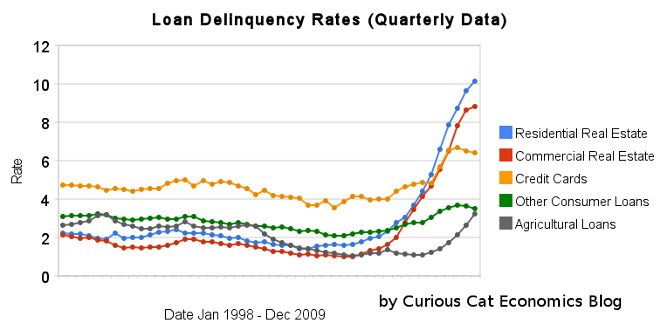
    The chart shows the total percent of delinquent loans by commercial banks in the USA.

    charts showing loan delinquency rates in the USA, 1998-2009

    That last half of 2009 saw real estate delinquencies continue to increase. Residential real estate delinquencies increased 143 basis points to 10.14% and commercial real estate delinquencies in 98 basis points to 8.81%. Agricultural loan delinquencies also increased (112 basis points) though to just 3.24%. Consumer loan delinquencies decreased with credit card delinquencies down 18 basis points to 6.4% and other consumer loan delinquencies down 19 basis points to 3.49%.

    Related: Loan Delinquency Rates Increased Dramatically in the 2nd QuarterBond Rates Remain Low, Little Change in Late 2009Government Debt as Percentage of GDP 1990-2008 – USA, Japan, Germany… posts with charts showing economic data
    (more…)

  • USA Added 162,000 Jobs in March

    Nonfarm payroll employment increased by 162,000 in March, and the unemployment rate held at 9.7%, based on U.S. Bureau of Labor Statistics surveys. Hiring for the census added 48,000 jobs in March, a large temporary increase, but less than expected amount, for the month. The change in total nonfarm payroll employment for January was revised from -26,000 to +14,000, and the change for February was revised from -36,000 to -14,000 together this results in an addition of 90,000 jobs.

    The 162,000 added jobs is the largest increase since March of 2007. It is a good start but the economy will have to continue to increase the number of job added each month to reduce unemployment. Population growth requires an addition of approximately 125,000 jobs a month. The current labor pool has been temporarily reduced by those who have dropped out of the labor market. As jobs return they will come back into the market.

    The economy has lost 8.2 million jobs since the recession started in December 2007. Now that was the bubble induced peak still, by the time the economy adds 8 million jobs many more jobs will be needed (since 125,000 additional jobs are needed each month). Still if we added 200,000 a month it would take 40 months to get back to the previous peak total. And by that time the economy would have accumulated another 9 million jobs needed (it would be about Dec 2013 = 6 * 12 months *125,000/month). While the bubble induced peak may well be a unrealistic target, the job market needs to add over 200,000 jobs a month to regain ground lost over the last several years.

    In March, the number of unemployed persons was little changed at 15.0 million, and the unemployment rate remained at 9.7%. The number of long-term unemployed (those jobless for 27 weeks and over) increased by 414,000 over the month to 6.5 million. In March, 44.1% of unemployed persons were jobless for 27 weeks or more. Both are all time highs.

    The civilian labor force participation rate (64.9%) and the employment-population ratio (58.6%) continued to edge up in March. The average length of unemployment rose to 31 weeks – the highest average ever (since 1948).
    Related: USA Unemployment Rate Remains at 9.7%663,000 Jobs Lost in March, 2009 in the USAAnother 450,000 Jobs Lost in June, 2009Manufacturing Employment Data – 1979 to 2007
    (more…)

  • Taxes per Person by Country

    From Greg Mankiw’s Blog

    Taxes/GDP x GDP/Person = Taxes/Person

    France .461 x 33,744 = $15,556

    Germany .406 x 34,219 = $13,893

    UK .390 x 35,165 = $13,714

    US .282 x 46,443 = $13,097

    Canada .334 x 38,290 = $12,789

    Italy .426 x 29,290 = $12,478

    Spain .373 x 29,527 = $11,014

    Japan .274 x 32,817 = $8,992

    The USA is the 2nd lowest for percent of GDP taxes 28.2% v 27.4% for Japan. But in taxes per person toward the middle of the pack. France which has 46% taxes/GDP totals $15,556 in tax per person compared to $13,097 for the USA.

    Related: Government Debt as Percentage of GDP 1990-2008 – USA, Japan, Germany…Oil Consumption by Country in 2007USA, China and Japan Lead Manufacturing Output in 2008Bigger Impact: 15 to 18 mpg or 50 to 100 mpg?

  • Government Debt as Percentage of GDP 1990-2008 – USA, Japan, Germany…

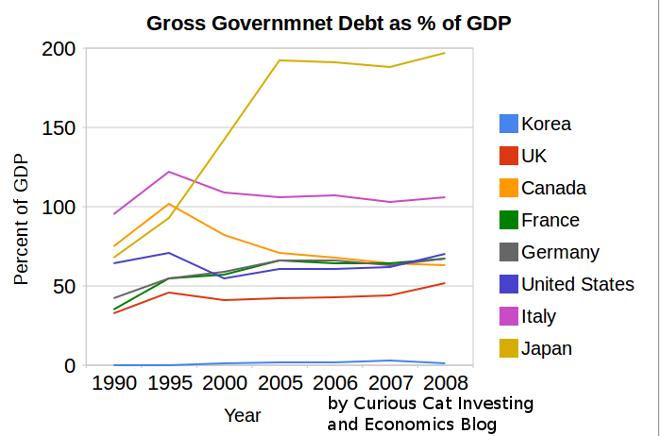
    Recently Greece and the huge USA federal deficits have highlighted the problem of excessive government debt. The above chart shows gross government debt by country from the IMF.

    Korea has essentially no gross government debt (under 2% of GDP for the entire period). At the other end of the spectrum Japan has seen gross government debt rise to 197% (Japan’s 2008 figure is an IMF estimate). The IMF did not have data for Greece (which would likely look very bad) or China (which I would think would be very low – maybe even negative – the government having more assets than debt).

    The USA debt stood at 64% in 1990, 71% in 1995, 55% in 2000, 61% in 2005 and 70% in 2008. Most countries are expected to see significant increases in 2009. The IMF sees the USA going to 85% in 2009 and 100% in 2012. They see Germany at 79% in 2009 and 90% in 2012. They See the UK at 69% in 2009 and 94% in 2012. They see Japan at 237% in 2012.

    Government debt as percentage GDP 1990-2008The chart shows gross government debt as percentage GDP 1990-2008. By Curious Cat Investing and Economics Blog, Creative Commons Attribution.

    ___________________________

    The data here is very similar to the OECD data I provided earlier, Government Debt Compared to GDP 1990 to 2007, though with some notable differences. In the OECD data was still in the best shape, but is seen as having 29% debt to GDP in 2007. The IMF data attempts to avoid issues where some countries have debt of non-federal governments that are hidden when looking just at federal government debt.

    Data source: IMF data (for some countries the data is also from that site but at different urls).

    Related: The Long-Term USA Federal Budget OutlookUSA, China and Japan Lead Manufacturing Output in 2008Oil Consumption by Country in 2007Saving Spurts as Spending Slashed

  • Mortgage Delinquencies and Foreclosures Data Indicates 2010 Could Show Improvement

    The delinquency rate for mortgage loans on one-to-four-unit residential properties fell to a seasonally adjusted rate of 9.5% of all loans outstanding as of the end of the fourth quarter of 2009, down 17 basis points from the third quarter of 2009, and up 159 basis points from one year ago, according to the Mortgage Bankers Association’s (MBA) National Delinquency Survey. The non-seasonally adjusted delinquency rate increased 50 basis points from 9.9% in the third quarter of 2009 to 10.4% this quarter.

    The delinquency rate includes loans that are at least one payment past due but does not include loans in the process of foreclosure. The percentage of loans in the foreclosure process at the end of the fourth quarter was 4.6%, an increase of 11 basis points from the third quarter of 2009 and 128 basis points from one year ago. The combined percentage of loans in foreclosure or at least one payment past due was 15% on a non-seasonally adjusted basis, the highest ever recorded in the MBA delinquency survey.

    The percentage of loans on which foreclosure actions were started during the fourth quarter was 1.2 percent, down 22 basis points from last quarter and up 12 basis points from one year ago.

    The percentages of loans 90 days or more past due and loans in foreclosure set new record highs. The percentage of loans 30 days past due is still below the record set in the second quarter of 1985.

    The data is far from good but it could well signal the situation is improving. The next few quarters seem poised to start showing better results. Granted given how bad these results are we have a long way to go before the data is actually good. “We are likely seeing the beginning of the end of the unprecedented wave of mortgage delinquencies and foreclosures that started with the subprime defaults in early 2007, continued with the meltdown of the California and Florida housing markets due to overbuilding and the weak loan underwriting that supported that overbuilding, and culminated with a recession that saw 8.5 million people lose their jobs,” said Jay Brinkmann, MBA’s chief economist.

    “The continued and sizable drop in the 30-day delinquency rate is a concrete sign that the end may be in sight. We normally see a large spike in short-term mortgage delinquencies at the end of the year due to heating bills, Christmas expenditures and other seasonal factors. Not only did we not see that spike but the 30-day delinquencies actually fell by 16 basis points from 3.79% to 3.63%. Only three times before in the history of the MBA survey has the non-seasonally adjusted 30-day delinquency rate dropped between the third and fourth quarter and never by this magnitude.

    “This drop is important because 30-day delinquencies have historically been a leading indicator of serious delinquencies and foreclosures. With fewer new loans going bad, the pool of seriously delinquent loans and foreclosures will eventually begin to shrink once the rate at which these problems are resolved exceeds the rate at which new problems come in. It also gives us growing confidence that the size of the problem now is about as bad as it will get.

    “Despite the drop in short-term delinquencies, foreclosure rates could continue to climb, however, based on the ability of borrowers 90 days or more delinquent to solve their problems. A sizable number of the loans in the 90+ day delinquent bucket are in loan modification programs. They are carried as delinquent until borrowers demonstrate they will make the payments agreed to in the plans.

    Related posts: Mortgage Delinquencies Continue to Climb (Nov 2009)USA Housing Foreclosures Slowly Declining (Dec 2009)Nearly 10% of Mortgages Delinquent or in ForeclosureHow Not to Convert Equity (Jan 2006)
    (more…)