Tag: USA

  • USA, China and Japan Lead Manufacturing Output in 2008

    Once again the USA was the leading country in manufacturing in 2008. And once again China grew their manufacturing output amazingly. In a change with recent trends Japan grew output significantly. Of course, the 2009 data is going to show the impact of a very severe worldwide recession.
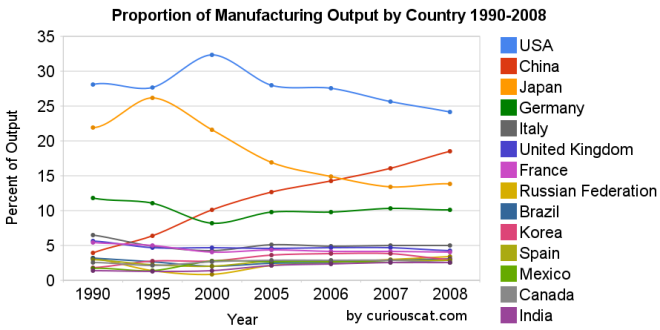
    Chart showing percent of output by top manufacturing countries from 1990 to 2008Chart showing the percentage output of top manufacturing countries from 1990-2008 by Curious Cat Management Blog, Creative Commons Attribution.

    The first chart shows the USA’s share of the manufacturing output, of the countries that manufactured over $185 billion in 2008, at 28.1% in 1990, 27.7% in 1995, 32% in 2000, 28% in 2005, 28% in 2006, 26% in 2007 and 24% in 2008. China’s share has grown from 4% in 1990, 6% in 1995, 10% in 2000, 13% in 2005, 14% in 2006, 16% in 2007 to 18% in 2008. Japan’s share has fallen from 22% in 1990 to 14% in 2008. The USA has about 4.5% of the world population, China about 20%. See Curious Cat Investment blog post” Data on the Largest Manufacturing Countries in 2008.

    Even with just this data, it is obvious the belief in a decades long steep decline in USA manufacturing is not in evidence. And, in fact the USA’s output has grown substantially over this period. It has just grown more slowly than that of China (as has every other country), and so while output in the USA has grown the percentage with China has shrunk. The percentage of manufacturing output by the USA (excluding output from China) was 29.3% in 1990 and 29.6% in 2008. The second chart shows manufacturing output over time.
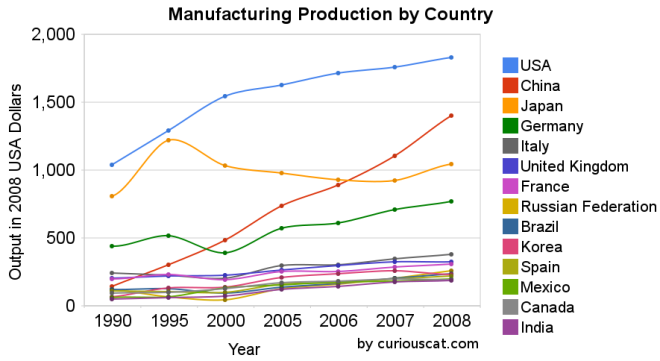
    charts showing the top manufacturing countries output from 1990-2008Chart showing the output of the top manufacturing countries from 1990-2008 by Curious Cat Management Blog, Creative Commons Attribution.

    The 2008 China data is not provided for manufacturing alone (the latest UN Data, for global manufacturing, in billions of current USA dollars). The percentage of manufacturing (to manufacturing, mining and utilities) was 78% for 2005-2007 (I used 78% of the manufacturing, mining and utilities figure provided in the 2008 data). There is a good chance this overstates China manufacturing output in 2008 (due to very high commodity prices in 2008).

    Hopefully these charts provide some evidence of what is really going on with global manufacturing and counteracts the hype, to some extent. Global economic data is not perfect. These figures are an attempt to capture the economic reality in the world but they are not a perfect proxy. This data is shown in 2008 USA dollars which is good in the sense that it shows all countries in the same light and we can compare the 1995 USA figure to 2005 without worrying about inflation. However foreign exchange fluctuations over time can show a country, for example, having a decline in manufacturing output in some year when in fact the output increased (just the decline against the USA dollar that year results in the data showing a decrease – which is accurate when measured in terms of USA dollars).

    If the dollar declines substantially between when the 2008 data was calculated and the 2009 data is calculated that will give result in the data showing a substantial increase in those countries that had a currency strengthen against the USA dollar. At this time the Chinese Renminbi has not strengthened while most other currencies have – the Chinese government is retaining a peg to a specific exchange rate.

    Korea (1.8% in 1990, 3% in 2008), Mexico (1.7% to 2.6%) and India (1.4% to 2.5%) were the only countries to increase their percentage of manufacturing output (other than China, of course, which grew from 3.9% to 18.5%).

    Related: posts on manufacturingGlobal Manufacturing Data by Country (2007)Global Manufacturing Employment Data – 1979 to 2007Top 10 Manufacturing Countries 2006Top 10 Manufacturing Countries 2005

  • Initial 4th Quarter Data Show GDP Increased at 5.7% Annual Rate

    Real gross domestic product — the output of goods and services produced by labor and property located in the United States — increased at an annual rate of 5.7% in the fourth quarter of 2009, (that is, from the third quarter to the fourth quarter), according to the “advance” estimate released by the Bureau of Economic Analysis. In the third quarter, real GDP increased 2.2%.

    Real GDP decreased 2.4% in 2009 (that is, from the 2008 annual level to the 2009 annual level), in contrast to an increase of 0.4% in 2008. The price index for gross domestic purchases increased 0.1% in 2009, compared with an increase of 3.2% in 2008.

    The Bureau emphasized that the fourth-quarter advance estimate released today is based on source data that are incomplete or subject to further revision. The “second” estimate for the fourth quarter, based on more complete data, will be released on
    February 26, 2010.

    Related: China GDP up 8.7% in 20092nd Quarter 2009 USA GDP down 1%Japanese Economy Grew at 3.7% Annual Rate in 2nd Quarter 2009

    The increase in real GDP in the fourth quarter primarily reflected positive contributions from private inventory investment, exports, and personal consumption expenditures (PCE). Imports, which are a subtraction in the calculation of GDP, increased.

    The change in real private inventories added 3.39 percentage points to the fourth-quarter change in real GDP after adding 0.69 percentage point to the third-quarter change. Private businesses decreased inventories $33.5 billion in the fourth quarter, following decreases of $139.2 billion in the third quarter and $160.2 billion in the second. Real final sales of domestic product — GDP less change in private inventories — increased 2.2% in the fourth quarter, compared with an increase of 1.5% in the third.
    (more…)

  • The USA Pays Double for Worse Health Results

    This graphic from the National Geographic shows the amazingly high cost of health care in the USA and the poor performance. Granted just life expectancy is not a good overall measure of success. But this just mirrors the general mediocre at best performance of the USA health care system.

    Chart of health care cost versus life expectancy by country

    The USA spends $7,290 per person (based on 2007 OECD data) the next highest spending country is Switzerland at $4,417. Canada spends the 4th most: $3,895. Only 5 countries have a lower life expectancy. The most any of those countries spend is $1,626. How people continue to accept arguments by the apologists for the special interests trying to defend the current system is beyond me.

    The Cost of Care by Michelle Andrews

    The United States spends more on medical care per person than any country, yet life expectancy is shorter than in most other developed nations and many developing ones. Lack of health insurance is a factor in life span and contributes to an estimated 45,000 deaths a year. Why the high cost? The U.S. has a fee-for-service system – paying medical providers piecemeal for appointments, surgery, and the like. That can lead to unneeded treatment that doesn’t reliably improve a patient’s health. Says Gerard Anderson, a professor at Johns Hopkins Bloomberg School of Public Health who studies health insurance worldwide, “More care does not necessarily mean better care.”

    Related: USA Spent $2.2 Trillion, 16.2% of GDP, on Health Care in 2007Employees Face Soaring Health Insurance CostsInternational Health Care System PerformanceUSA Heath Care System Needs Reform

  • Volcker on the Great Recession and Need for Reform

    America Must ‘Reassert Stability and Leadership’

    SPIEGEL: Can the current situation be compared with the Great Depression?

    Volcker: I remember there were people, beggars and tramps as we called them, who wanted to be fed. So it’s true, today we also have people who are relying on food stamps and other payments but we are a long way from the Great Depression. We are in a serious, great recession. Today we have 10 percent unemployment, but at that time it was more like 20 or 25 percent. That’s a big difference. You had mass unemployment.

    SPIEGEL: Are you sure? The Wall Street businesses are doing well. The big bonuses are back.

    Volcker: It’s amazing how quickly some people want to forget about the trouble and go back to business as usual. We face a real challenge in dealing with that feeling that the crisis is over. The need for reform is obviously not over. It’s hard to deny that we need some forward looking financial reform.

    SPIEGEL: But the American government seems to have lost some eagerness in setting a tougher regime of rules and regulations to control Wall Street. Everything is being watered down. Why?

    Volcker: I will do the best I can to fight any tendency to water it down. What we need is broad international consensus to make things happen.

    I am surprised how many people are trying to compare the economic situation today (often using unemployment rates) and say we are in nearly as bad a situation as the great depression. The economy is certainly struggling, great recession, is a good term for it, I think. But taking the high measures of unemployment and underemployment today and comparing it to unemployment in the 1930’s is not comparing like numbers. The employment situation is bad now. It was much worse in the great depression. As intended, support systems like unemployment pay, FDIC, food stamps… have worked to reduce the depth of the recession.

    He is right that we need serious reform to the deregulation that allowed the credit crisis to explode the economy.

    Related: Volcker: Economic Decline Faster Now Than Any Time He RemembersThe Economy is in Serious Trouble (Nov 2008)Unemployment Rate Reached 10.2%Canada’s Sound Regulation Resulted in a Sound Banking System Even During the Credit Crisis

  • Dollar Decline Due to Government Debt or Total Debt?

    With the dollar declining sharply, many are focused on the issue now. And the most common culprit for blame seems to be the federal debt. While I agree the dollar is likely to fall, the deficit doesn’t seem like the main reason, to me. The federal debt is large and growing quickly, which is a problem. But still the USA federal debt to GDP is lower than the OECD average. Even with a few more years of crazy federal debt growth the USA will still be below that average.

    Japan has by far the highest level of government debt in the OECD. The Yen is not collapsing. The debt is a factor but the lack of saving (USA consuming more than it produces) seems the biggest problem to me. China not only does not have large government debt it has large amounts of personal savings. People have been living far within their means in Japan and China (only by government intervention, due to desires to not have the currency appreciate has that appreciation been slowed).

    Thankfully we have been increasing savings a bit recently but it is a drop in the bucket so far (Consumer Debt Down Over $100 Billion So Far in 2009). It will have to increase in size and continue for years to begin to address the problems in a significant way.

    Related: The USA Economy Needs to Reduce Personal and Government Debt (March 2009)The Truth Behind China’s Currency PegWho Will Buy All the USA’s Debt?

  • Why the Dollar is Falling

    Why the dollar is falling

    On Tuesday October 20th, for example, the dollar index had slipped to 75.24, its lowest point in more than a year.

    This hardly constitutes an outright collapse, nor is it necessarily cause for concern. American exporters, whose goods have become more competitive abroad, are happy with their weaker currency. Similarly domestic producers may be cheered that rival, imported goods are more expensive. And European tourists, who can buy more for their euros during weekend shopping excursions to America, may cheer too. However, the continued decline of the dollar does come against a backdrop of ominous murmurs from the likes of China and Russia, who hold much of their reserves in dollars, about the need to shift their reserves out of the greenback. Brazil’s imposition of a 2% levy on portfolio inflows is also a sign that other countries are getting nervous about seeing their currencies rise against the dollar.

    But it is hard, also, to think of a parallel in history. A country heavily in debt to foreigners, with a government deficit it is making little headway at controlling, is creating vast amounts of additional currency. Yet it is allowed to get away with very low interest rates. Eventually such an arrangement must surely break down, bringing a new currency system into being, just as Bretton Woods emerged in the 1940s.

    The absence of a credible alternative to the dollar means that, despite its declining value, its status as the world’s reserve currency is not seriously under threat. But the system could change in other ways. A world where currencies traded within bands, or where foreign creditors insist on America issuing some debt in other currencies, are all real possibilities as the world adjusts to a declining dollar.

    The issuance of USA government debt of any significant size in other currencies would be an amazing event, to me. However, that does not mean it won’t happen. In my opinion it is hard to justify the non-collapse of the dollar, and has been for quite some time.

    The huge future tax liability imposed over the last few decades along with the failure to save by those in the country creates a hollow economy. Granted the USA had a huge surplus of wealth built up since the end of World War II. The USA has to a great extent sold off that wealth to finance living beyond the productive capacity of the country the last 20-30 years. But that can only go on so long.

    The only thing saving the dollar is that other countries do not want the dollar to decline because they don’t want the competition of American goods (either being sold to their country or for the goods they hope to export). So they intervene to stop the fall of the dollar (and buy USA government debt). That can serve to artificially inflate the dollar for some time. However, eventually I think that will collapse. And when it does it will likely be very quick. The idea of the USA issuing debt in other currencies seems crazy now. It could then go from possibility to necessity within months.

    You cannot print money forever to live beyond your means and have people accept it as valuable. The government can runs deficits if the citizen’s finance that debt with savings: and still maintain a sound currency. But the recent period, given the macro-economic conditions, don’t justify the value of the dollar. It should have fallen much further a long time ago. The other saving grace for the dollar is few large economies have untarnished economies. The Euro has strengths but is hardly perfect. The Chinese Renminbi is possibly the strongest contender but the economy is still very controlled, financial data is untrustworthy, political freedom is not sufficient… The Japanese Yen does have some strengths but really their long term macro-economic conditions is far from sound.

    In the current economic environment investing in currencies is one way to look for higher returns and even to diversify and hedge your portfolio using forex trading strategies.

    Related: The USA Economy Needs to Reduce Personal and Government DebtLet the Good Times Roll (using Credit)Federal Reserve to Buy $1.2T in Bonds, Mortgage-Backed SecuritiesWho Will Buy All the USA’s Debt?

  • Health Care: Lessons for the USA

    Health Care: Lessons for America

    But unlike Clinton-era America, Switzerland got its medical act together.

    It switched to a system that separates insurance from employment. Each individual or family is required to buy coverage, and insurers must offer a basic package of benefits to all applicants. They can’t profit from selling basic coverage, but they can from supplemental plans. Premiums are deducted from paychecks; the unemployed and poor are subsidized.

    Despite opposition from insurers, drugmakers, and business, the plan passed by a bare majority and went into effect in 1996. Switzerland now spends 11% of its gross domestic product on health care, just as it did before. But everyone is covered, insurers are more profitable than ever, and its high-quality health care has been maintained.

    The lesson, as laid out in The Healing of America: A Global Quest for Better, Cheaper, and Fairer Health Care, by T.R. Reid, is that “health-care systems can be changed, even in the face of powerful…interests.”

    Many Americans boast about having the best health care in the world, even though the U.N. ranks the U.S. system 37th, based on a broad range of measurements

    At the same time, he learned that almost all countries use one of four health-care models: Germany’s Bismarck system, in which hospitals and insurers are private entities and financing comes from payroll deductions; Britain’s Beveridge Model, with the government providing health care financed by taxes; the Canadian plan, where private doctors and hospitals are paid by the government through taxes; and the out-of-pocket care found in most poor nations, where those who can afford care get it, while the rest suffer or die. Unlike any other country, the U.S. combines all four models

    Related: posts on the economics of health careBroken Health Care System: Self-Employed InsuranceMany Experts Say USA Health-Care System Inefficient, WastefulUSA Spent $2.2 Trillion, 16.2% of GDP, on Health Care in 2007International Health Care System Performance

  • Consumer Debt Declined a Record $21.5 Billion in July

    Last November USA consumer debt fell, by a then record of $8 billion. In July, 2009, consumer debt was reduced another $21 billion, which is a good sign.

    April of 2008 USA consumer debt stood at $2.54 trillion. Based on a population of 300 million people that would mean $8,467 for every person in just personal debt. Living beyond your means is not a good thing. After the July decrease of $21.55 billion, the total consumer debt stood at $2.47 trillion, a decline of $70 billion over the last 15 months.

    Decreasing this debt level was (and is) necessary. If that means we have some suffering today to pay for living beyond our means for years the ‘fix’ is not to continue to live beyond our means. The ‘fix’ is to accept the consequences of past behavior and build a more sustainable economy now for the future.

    Consumer credit down record amount in July

    This is the sixth straight monthly drop in consumer credit — the longest consecutive string of declines in credit since the second half of 1991.

    Consumers have retrenched since the financial crisis hit in full force last September. Credit has fallen in every month except January. In percentage terms, the drop in credit is the biggest since June 1975.

    And on a year-on-year basis, credit is down 4.3%, the biggest drop since June 1944. The retrenchment was much more than expected. Economists surveyed by MarketWatch expected consumer credit to decline by $4.3 billion. There were also sharp downward revisions to June data.

    Economists said shrinking credit might strangle the recovery. “There is no real way to put a positive spin on these data. Credit is still shrinking and that is going to have an impact on consumption,” wrote Charmaine Buskas, senior economics strategist at TD Securities, in a note to clients.

    credit-card debt fell $6.11 billion, or 8.5%, in July to $905.58 billion. This is the record 11th straight monthly drop in credit card debt. Non-revolving credit, such as auto loans, personal loans and student loans fell a record $15.44 billion or 11.7% to $1.57 trillion.

    Here is a positive spin on it. We owe $21.5 billion less than we did last month. How lost are we that there is no positive way to spin owing less money than you used to owe?

    Related: Personal Saving and Personal Debt in the USAAmericans are Drowning in Debt

  • China May Take Car Sales Lead from USA in 2009

    China’s economy continues to grow quickly. It looks as though that, along with the slump in US car sales, likely will lead to China taking the world sales lead for cars (I would imagine for the first time ever the USA has not held this title). China 2009 Vehicle Sales May Rise 28% on Stimulus:

    Full-year sales may reach as high as 12 million vehicles, Chen Bin, chief director of the industry coordination department at the National Development and Reform Commission, said today at a conference in Tianjin. U.S. sales will likely be around 10.5 million, according to both General Motors Co. and Ford Motor Co.

    China has boosted auto sales this year through tax cuts and subsidies as a part of a wider 4 trillion yuan ($586 billion) stimulus that has shielded the country from the worst of the global recession. U.S. sales have slumped 28 percent, pushing the old GM and Chrysler LLC into bankruptcy. Last year’s total was 13.2 million, compared with 9.4 million in China.

    Partially due to the strong internal Chinese demand (and partially due to Chinese regulation) India actually exports more cars than China. 5 times as many cars are purchased in China as are bought in India.

    Indian Car Exports Beat China’s

    [In India] Total exports, including vans, sport-utility vehicles and trucks, rose 18 percent to 229,809.

    In contrast, China’s exports slumped 60 percent to 164,800 between January and July, according to government data. Vehicles produced in Thailand for export declined 43 percent to 263,768, according to the Thai Automotive Club.

    South Korean exports dropped 31 percent to 1.12 million units, according to the Korea Automobile Manufacturers Association. Japan, the world’s largest automobile producer and exporter, shipped 1.77 million cars, trucks and buses.

    Related: The Relative Economic Position of the USA is Likely to DeclineManufacturing Cars in the USARodgers on the US and Chinese Economies

  • Unemployment Rate Increases to 9.7%

    The unemployment rate in the USA continued the climb toward 10% in August in the aftermath of the credit crisis. Nonfarm payroll employment decline in August, by 216,000 more jobs, and the unemployment rate rose to 9.7%, the U.S. Bureau of Labor Statistics reported today. Since December 2007, employment has fallen by 6.9 million jobs.

    In August, the number of unemployed persons increased by 466,000 to 14.9
    million, and the unemployment rate rose to 9.7%. The unemployment rates for adult men (10.1%), whites (8.9%), and Hispanics (13.0%) rose in August. The jobless rates for adult women (7.6%), teenagers (25.5%), and blacks (15.1%) were little changed over the month.

    The civilian labor force participation rate remained at 65.5% in August. The employment-population ratio, at 59.2%, edged down over the month and has declined by 3.5 percentage points since the recession began in December 2007.

    In August, the number of persons working part time for economic reasons was little changed at 9.1 million. These individuals indicated that they were working part time because their hours had been cut back or because they were unable to find a full-time job.

    In August, manufacturing employment continued to trend downward, with a decline of 63,000. The pace of job loss has slowed throughout manufacturing in recent months. Employment in health care continued to rise in August (28,000), with gains in ambulatory care and in nursing and residential care. Health care has added 544,000 jobs since the start of the recession.

    In August, the average workweek for production and nonsupervisory
    workers on private nonfarm payrolls was unchanged at 33.1 hours.
    The manufacturing workweek and factory overtime also showed no
    change over the month (at 39.8 hours and 2.9 hours, respectively).

    Related: Unemployment Rate Drops Slightly to 9.4%posts on employmentMay 2009 Unemployment Rate Jumps to 9.4%California Unemployment Rate Climbs to 10.5 Percent (March 2009)